
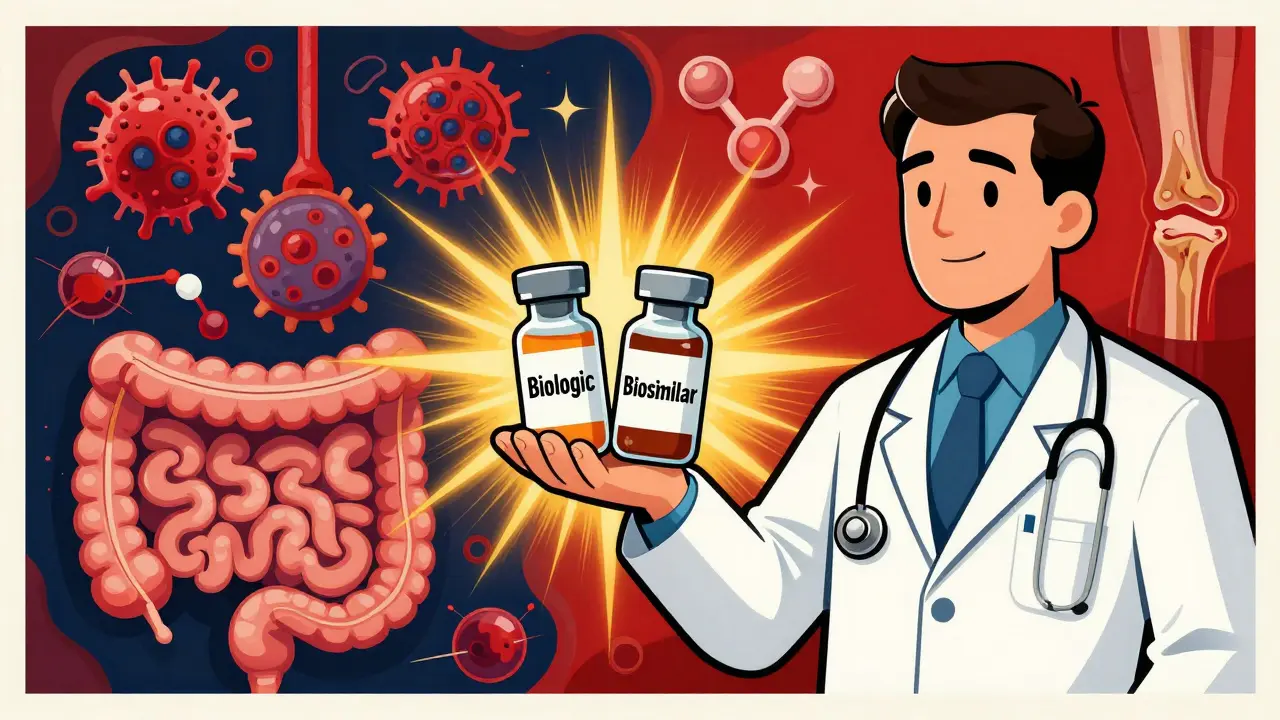
When a doctor prescribes a biologic drug for rheumatoid arthritis, Crohn’s disease, or cancer, patients often assume they’re getting the only version that works. But that’s not true anymore. Biosimilars are now a standard part of treatment plans across the U.S. and Europe, and the data shows they work just as well as the original biologics-without the same price tag.
What Exactly Are Biosimilars?
Biosimilars aren’t generics. That’s a common misunderstanding. Generics are exact copies of small-molecule drugs, like aspirin or metformin. Biosimilars, on the other hand, are highly similar versions of complex biologic drugs made from living cells-like antibodies or proteins. These drugs are used to treat serious conditions: cancer, autoimmune diseases, diabetes, and more.Because they’re made from living systems, no two batches of a biologic are ever exactly the same-even the original manufacturer can’t reproduce them perfectly every time. That’s why biosimilars don’t need to be identical. They just need to be highly similar, with no clinically meaningful differences in safety, purity, or potency.
The approval process is strict. Before a biosimilar hits the market, it must pass over 200 analytical tests comparing its structure, function, and behavior to the reference biologic. Then comes pharmacokinetic (PK) and pharmacodynamic (PD) studies-measuring how the body absorbs and responds to the drug. Only after that do regulators consider whether a clinical trial is even needed. For many, it’s not.
Do Biosimilars Work as Well? The Evidence
The short answer: yes. Over 100 biosimilars have been approved globally since 2006, and the real-world results are clear.A 2022 meta-analysis of 1,711 patients across six cancer types-including lung, breast, and lymphoma-found no meaningful difference in how well biosimilars worked compared to the original drugs. For example:
- Bevacizumab biosimilar vs. reference: 1.02 response rate (95% CI, 0.94-1.10)
- Trastuzumab biosimilar vs. reference: 1.01 response rate (95% CI, 0.94-1.08)
- Rituximab biosimilar vs. reference: 1.04 response rate (95% CI, 1.00-1.08)
Numbers close to 1.0 mean the biosimilar performed just like the original. The confidence intervals all crossed 1.0, meaning any small differences were due to chance-not effectiveness.
In inflammatory bowel disease, a Canadian study followed 1,200 patients for two years. Those switched from reference infliximab to its biosimilar (CT-P13) showed identical rates of treatment persistence, disease flare-ups, and side effects. No difference.
The NOR-SWITCH trial in 2016, one of the largest randomized studies ever done on biosimilars, enrolled 480 patients with various cancers. Half stayed on the original rituximab; half switched to the biosimilar. After six months, response rates were nearly identical: 72.9% vs. 69.3%. The difference? Not statistically significant.
What About Safety? Side Effects and Immune Reactions
One big worry has been immunogenicity-whether the body might react differently to a biosimilar and develop antibodies that make the drug less effective or cause side effects.Early concerns were theoretical. Real-world data has since put them to rest. A 2023 review of over 500,000 patients across 300 studies by the International Society for Pharmacoeconomics and Outcomes Research found no increased risk of immune reactions with biosimilars.
On PatientsLikeMe, 1,245 patients using the adalimumab biosimilar Amjevita reported the same side effect rates (23%) as those on Humira. A survey of 2,100 arthritis patients in the U.S. found 92% saw no change in disease control after switching to the infliximab biosimilar Inflectra. Only 2% said their condition worsened-and even then, doctors couldn’t confirm it was the biosimilar’s fault.
Even in the UK’s NHS, where over 12,000 patients were switched to the rituximab biosimilar Rixathon, there was no spike in adverse events. That’s important: switching thousands of people from one drug to another without a safety bump is a huge win.
Why Don’t More People Use Them?
Despite the evidence, adoption is still uneven. In rheumatology, 78% of providers use biosimilars. In oncology? Only 31%.Part of the problem is perception. A 2021 survey found 38% of U.S. doctors still worry biosimilars might be less effective-even though every major study says otherwise. Some of this comes from misinformation, lack of training, or fear of liability.
Patients, too, can be hesitant. Many think “biosimilar” means “second-rate.” But when given clear, simple information, refusal rates drop. Kaiser Permanente cut patient refusals from 22% to just 5% by using standardized educational materials.
Another barrier? Pharmacy benefit managers (PBMs). Some restrict which biosimilars are covered, or force switches without clinician input. That can cause confusion and distrust.
Cost Savings Are Real-and Massive
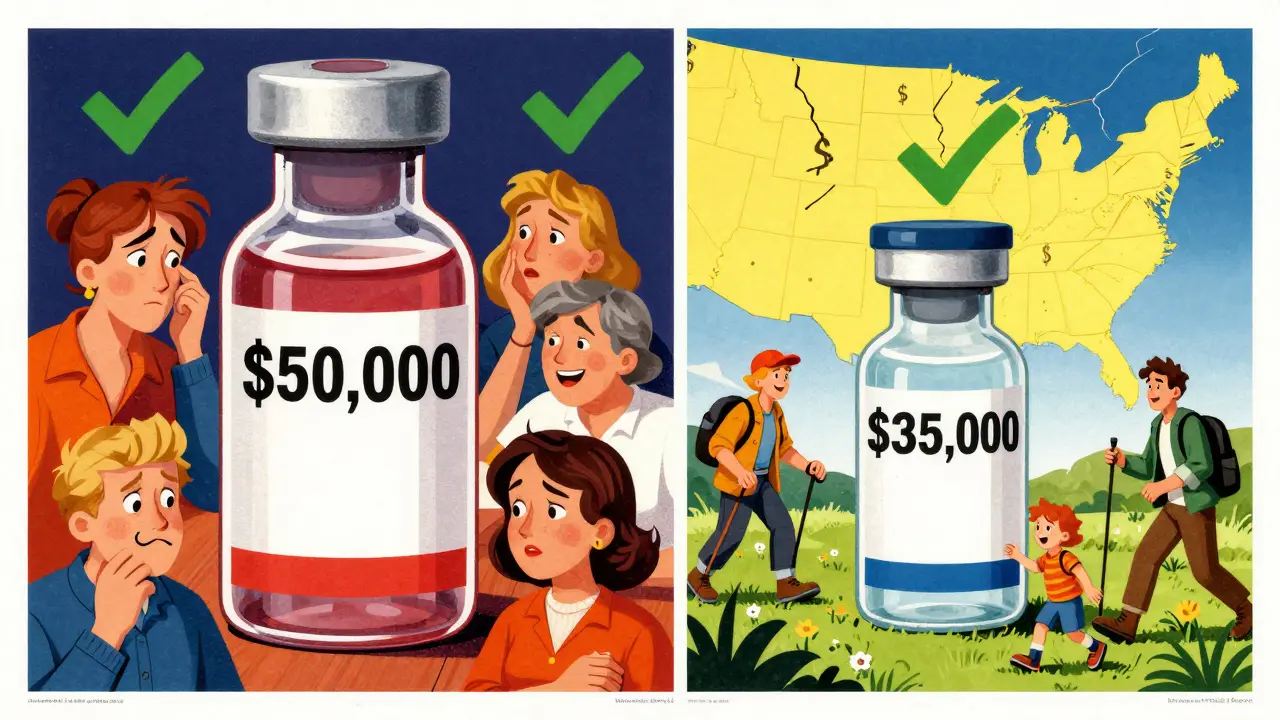
This isn’t just about science. It’s about access.Biologics can cost $20,000 to $50,000 a year. Biosimilars? In the U.S., they’re typically 15-30% cheaper. In Europe, where competition is fiercer, prices drop by 25-85%.
The Congressional Budget Office estimates biosimilars will save the U.S. healthcare system $169 billion over the next decade. Medicare Part B alone saved $1.3 billion in one year thanks to biosimilar competition.
That’s not just a win for insurers. It’s a win for patients who can’t afford the original drug-or who get denied coverage because of cost. It’s a win for hospitals that can treat more people with the same budget.

Switching Is Safe-Here’s How It’s Done Right
Switching from a reference biologic to a biosimilar isn’t a gamble. It’s a process.Best practices include:
- Provider education: Clinicians need to understand the science behind biosimilars.
- Clear patient communication: Explain why the switch is happening and that it’s backed by data.
- Monitoring: Check in after 1-3 months to assess response and side effects.
- Electronic alerts: EHR systems can flag when a biosimilar is available and appropriate.
A 2023 study across 15 U.S. health systems found 98% achieved over 75% biosimilar adoption within a year using these methods. No drop in outcomes. No rise in side effects.
Even switching between biosimilars is now proven safe. A 2023 study in Clinical Rheumatology found patients who switched multiple times between different adalimumab biosimilars had the same drug retention rates as those who stayed on one.
What’s Next?
Regulators are making it easier. The FDA’s 2023 draft guidance suggests eliminating clinical trials altogether when analytical and PK/PD data are strong enough. That could cut development time and cost even further.More biosimilars are coming. Over 120 are in global development, targeting everything from insulin to monoclonal antibodies for multiple sclerosis. The market is projected to hit $38.5 billion by 2030.
The big challenge now isn’t science. It’s trust. We’ve had over 15 years of global data, half a million patients, and dozens of peer-reviewed studies. The evidence isn’t just strong-it’s overwhelming.
Biosimilars work. They’re safe. They save money. And they’re changing how chronic diseases are treated-for the better.
Are biosimilars the same as generics?
No. Generics are exact copies of simple chemical drugs, like ibuprofen. Biosimilars are highly similar versions of complex biologic drugs made from living cells. They’re not identical, but they’re proven to work the same way with no meaningful difference in safety or effectiveness.
Can I switch from a biologic to a biosimilar safely?
Yes. Multiple large studies, including the NOR-SWITCH trial and real-world data from the NHS and U.S. health systems, show switching is safe. Patients experience the same outcomes, side effects, and disease control. Providers typically monitor for 1-3 months after the switch to ensure stability.
Do biosimilars cause more immune reactions?
No. Early concerns about increased immunogenicity haven’t held up in practice. Over 500,000 patients across hundreds of studies show no higher risk of antibody development or immune-related side effects compared to the original biologics. Regulatory agencies continue to monitor this closely.
Why are biosimilars cheaper if they’re just as good?
Biosimilars don’t require the same expensive clinical trials as the original biologic. Developers use existing data on safety and effectiveness to prove similarity, cutting development time and cost. The savings are passed on, often reducing prices by 15-85% depending on the market and competition.
Are biosimilars approved by the FDA and EMA?
Yes. The FDA has approved 46 biosimilars as of November 2023, with 37 currently on the market. The EMA has approved 104 as of December 2023. Both agencies require rigorous analytical, preclinical, and clinical testing to ensure biosimilars are highly similar with no clinically meaningful differences.
Can I switch between different biosimilars?
Yes. A 2023 study found patients who switched multiple times between different adalimumab biosimilars had the same treatment success rates as those who stayed on one biosimilar. This supports the idea that biosimilars are interchangeable within their class, even without formal interchangeability designation.
Final Thoughts
If you’re on a biologic and your doctor suggests switching to a biosimilar, don’t panic. The science is solid. The data is clear. The savings are real. And millions of patients worldwide are already benefiting from this shift.The real question isn’t whether biosimilars work. It’s why we’re still hesitating when the evidence has been this strong for so long.



Phil Hillson
January 19, 2026 AT 20:14This whole biosimilar thing is just pharma’s way of cutting corners and making us guinea pigs
sujit paul
January 20, 2026 AT 15:36One must contemplate the metaphysical implications of biological identity-when a molecule is not identical, yet functionally equivalent, does it retain the same ontological status as its progenitor? The soul of the protein, one might ask, is it preserved?
And yet, the capitalist machinery of healthcare demands homogenization, reducing the sacred complexity of life to a commodified metric of cost-efficiency. Are we not trading the divine uniqueness of biological precision for the cold arithmetic of balance sheets?
The FDA, EMA, and their bureaucratic priesthoods declare equivalence-but equivalence in what? In laboratory assays? In statistical noise? Not in the lived experience of the human body, which is never a controlled variable.
I have seen patients whose immune systems, once stable, began to falter after the switch. Anecdotal? Perhaps. But science, at its core, begins with observation, not registration.
And yet, the chorus of consensus drowns out the whisper of doubt. That is the danger of institutional dogma.
Malikah Rajap
January 20, 2026 AT 18:18Wait-so you’re telling me that after 15 years, thousands of studies, half a million patients… we’re STILL having this conversation?!!
Like… I get it, fear of the unknown is real-but when the data is this overwhelming, isn’t it just… lazy thinking to keep clinging to the original because it’s ‘familiar’?!
And also, why is oncology so behind?? I mean, if you’re getting chemo, wouldn’t you want to save money so you can afford rent, food, childcare, and not go bankrupt??
Also, the fact that PBMs are forcing switches without doctor input?? That’s a whole other nightmare-but that’s not the biosimilar’s fault!!
Stop blaming the science. Start blaming the system.
Aman Kumar
January 21, 2026 AT 04:52The entire biosimilar paradigm is a neoliberal Trojan horse disguised as cost-saving innovation. The pharmaceutical-industrial complex has engineered this narrative to erode the sanctity of therapeutic fidelity. They do not care about patient outcomes-they care about market penetration and shareholder dividends.
When a protein is synthesized by a living cell, its glycosylation patterns, folding conformations, and post-translational modifications are stochastic by nature-even the originator cannot replicate them identically. Therefore, the claim of ‘no clinically meaningful difference’ is a statistical fiction.
And yet, the regulatory bodies, beholden to lobbying interests, have abdicated their duty to preserve biological integrity. The NOR-SWITCH trial? A carefully curated illusion. The sample size? Inadequate. The follow-up? Insufficient.
Patients are not data points. They are biological organisms with unique immunological histories. To interchange biologics is to gamble with life.
And don’t even get me started on the fact that biosimilars are being pushed in developing nations where pharmacovigilance is nonexistent. This is medical colonialism.
Tracy Howard
January 22, 2026 AT 12:48Look, I love that Canada’s doing this right-we switched over 80% of our infliximab patients to CT-P13 years ago, and not one hospital has had to rehire a single rheumatologist because of ‘biosimilar chaos.’
Meanwhile, the U.S. is still stuck in 2008 debating whether biosimilars are ‘real medicine.’ You know what’s real? A mom in Saskatchewan who can afford to keep her kid on treatment because the drug costs $12,000 instead of $50,000.
Stop comparing us to the U.S. We don’t have pharmacy benefit managers deciding what your immune system gets. We have doctors and patients deciding together.
And yes, I know some Americans think we’re ‘socialist’ for doing this. But we’re not socialist-we’re just not insane.
Erwin Kodiat
January 23, 2026 AT 16:22I’ve been on Humira since 2018. My doc switched me to Amjevita last year. Zero difference. Same energy. Same joint pain control. Same side effects (none, honestly).
My insurance saved $1,800 a month. I used that to pay off my credit card and take my dog on a road trip.
It’s not magic. It’s math. And math is good.
Lewis Yeaple
January 25, 2026 AT 07:42It is imperative to clarify that biosimilars are not interchangeable by default; interchangeability is a separate regulatory designation requiring additional studies. The FDA has approved only a limited number of biosimilars as interchangeable, and many of the switches occurring in clinical practice are not legally interchangeable-merely substitutable under state pharmacy laws.
Therefore, the assertion that ‘switching between biosimilars is proven safe’ is misleading without qualification. The 2023 study cited involved adalimumab biosimilars, which are not interchangeable in most jurisdictions.
Furthermore, while the aggregate data is reassuring, individual pharmacokinetic variability may still exist. The assumption of homogeneity across biosimilar batches, even within the same manufacturer, remains a point of contention among pharmacologists.
Therefore, while the broader trend is positive, clinical decisions must be individualized, and patient consent must be informed-not merely assumed.
Jackson Doughart
January 25, 2026 AT 17:31I’ve worked in oncology for 18 years. I used to be skeptical. I watched patients cry when they heard ‘biosimilar’-they thought it meant ‘cheaper, worse.’
So we started sitting down with them. We showed them the data. We told them about the NOR-SWITCH trial. We said, ‘This isn’t a downgrade. It’s a smart upgrade.’
Now? Most of them ask for it. Some even thank us.
The real tragedy isn’t the biosimilar. It’s the silence we let happen. We didn’t explain. We assumed they’d understand. We failed them.
Now we talk. And we win.
Jake Rudin
January 26, 2026 AT 01:14What is ‘equivalence’… really?
If two drugs produce the same outcome, but through slightly different molecular pathways, are they the same?
Or are we just defining ‘same’ by the outcome we care about-tumor shrinkage, joint pain reduction-and ignoring the deeper, more mysterious ways the body responds?
Science measures what it can. But life… life is what it cannot.
Maybe biosimilars work. Maybe they’re safe. But perhaps we’re reducing the miracle of biological medicine to a spreadsheet-and forgetting that healing is not just a function of molecules, but of trust, of meaning, of the human story behind the prescription.
Lydia H.
January 27, 2026 AT 06:59My mom’s on a biosimilar for RA. She’s 72. She used to be terrified of switching. Now she says, ‘If it works, why pay more?’
She’s not a scientist. She’s not a policy wonk. She’s just a woman who wants to garden without crying from pain.
And guess what? She’s gardening.
That’s all the evidence I need.
Astha Jain
January 29, 2026 AT 02:59bioligics? biosimilars? like… what even is the diff? i thought they were the same thing??
also why is everyone so mad? if it works, just take it and save money??
so confused
Jacob Hill
January 30, 2026 AT 17:31Can I just say how amazing it is that we’re even having this conversation? Like, 20 years ago, we were still arguing whether generic statins were safe. Now we’re debating complex biologics? That’s progress.
And the fact that we’re getting data from 500,000 patients? That’s not just science-that’s a global community choosing to trust evidence over fear.
I’m not a doctor. I’m not a regulator. But I’m a person who’s watched a loved one suffer from unaffordable meds.
Biosimilars? Yes. Please. More of them.
Josh Kenna
January 31, 2026 AT 16:29Okay so I work at a hospital and we switched everyone to biosimilars last year and I swear to god half the nurses thought they were giving out placebos
One of them asked me if it was like buying a knockoff Rolex
WE HAD TO DO A POWERPOINT
But now? Everyone’s fine. No one died. No one got worse. And the hospital saved enough to hire a new PA
Stop being dramatic. The science is here. Let’s just do it.
Valerie DeLoach
February 2, 2026 AT 15:20For the patients who are afraid-your fear is valid. But your fear should be met with education, not dismissal.
When I switch someone, I don’t say, ‘It’s the same.’ I say, ‘It’s been studied in more people than most drugs you’ve ever taken. And it’s been used by millions without harm.’
I show them the graphs. I tell them about the UK’s 12,000-patient switch. I tell them my cousin switched and now she’s hiking in Colorado.
People don’t resist science. They resist feeling unheard.
Listen first. Then inform.
Christi Steinbeck
February 2, 2026 AT 21:24Let’s stop acting like this is a debate. It’s not.
It’s a moral issue.
People are dying because they can’t afford biologics.
Biosimilars save lives. Not just by cutting costs-but by making treatment accessible to people who were told, ‘We’re sorry, you don’t qualify.’
If you’re still hesitant? Fine. Stay on the original.
But don’t stand in the way of someone else getting the treatment they need.
Erwin Kodiat
February 3, 2026 AT 10:09Just read this thread and realized I’m the only one who’s actually switched twice-first from Humira to Amjevita, then from Amjevita to a different adalimumab biosimilar last month.
No issues. No flares. No weird side effects.
My doctor said, ‘You’re basically a walking clinical trial.’
I said, ‘Then I guess I’m winning.’