
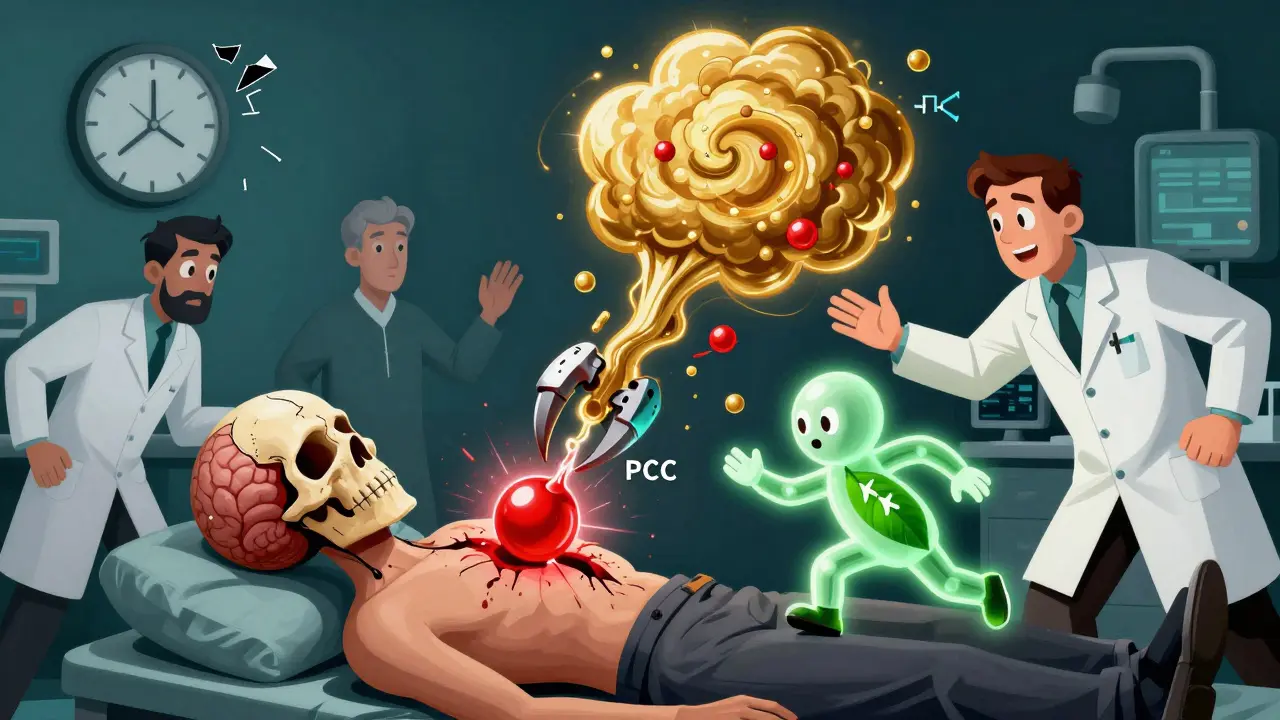
When someone on blood thinners suffers a serious bleed-like a fall that causes a brain hemorrhage-time isn't just money. It's life. And that’s where anticoagulant reversal agents come in. These aren’t just fancy drugs. They’re emergency tools designed to stop bleeding fast. If you or someone you know is taking a blood thinner, understanding what happens if things go wrong could make all the difference.
Why Reversal Agents Even Exist
Over 15 million Americans take direct oral anticoagulants (DOACs) like apixaban, rivaroxaban, or dabigatran. That’s up from just a few million a decade ago. These drugs are great at preventing strokes and clots. But if a major bleed happens-especially in the brain-their effects can turn deadly. About 30 to 50% of people with a brain bleed while on anticoagulants don’t survive. That’s why doctors need ways to reverse these drugs fast. Not hours. Not days. Minutes.
Before 2015, the only real option for reversing most blood thinners was giving fresh frozen plasma or vitamin K. Both are slow. Plasma takes hours to prepare and infuse. Vitamin K? It can take 24 hours to work. That’s too long when someone’s bleeding into their skull.
Vitamin K: The Old School Answer
Vitamin K isn’t new. It’s been around since the 1940s. It reverses warfarin, the classic blood thinner, by helping the liver make clotting factors again. But here’s the catch: it doesn’t work fast. Even if you give 10 mg IV, it takes 4 to 6 hours just to start working. Full reversal? That’s 24 hours.
That’s why vitamin K is never used alone in emergencies. It’s always paired with something faster-like PCC. Think of vitamin K as the long-term fix. It rebuilds what was broken. But if you’re bleeding now, you need a short-term bridge. Give vitamin K, yes-but only after you’ve already given something that works right away.
Prothrombin Complex Concentrate (PCC): The Workhorse
PCC, especially the 4-factor version (4F-PCC), is the most commonly used reversal agent in U.S. hospitals. It contains concentrated clotting factors II, VII, IX, and X. It’s given as a single IV bag, and it starts working in minutes. Most patients see their INR drop below 1.5 within 30 minutes.
Dosing is simple: 25-50 units per kilogram, depending on how high the INR is. For INR over 6, use 50 units/kg. A typical 70 kg adult gets 3500 units total. The whole thing takes less than half an hour to give.
But here’s what most people don’t know: PCC’s effect lasts only 6 to 24 hours. That’s why vitamin K must follow. Without it, the clotting factors the body makes will be too low again, and bleeding can come back. This is called rebound anticoagulation. It’s not rare. It’s predictable. And it’s preventable.
Cost-wise, PCC is a bargain. A full dose runs $1,200 to $2,500. Compare that to the newer agents. That’s why most hospitals keep it on hand-even for DOAC reversals, even though it’s technically off-label.
idarucizumab: The Dabigatran Killer
idarucizumab is a monoclonal antibody fragment. Sounds complicated? It’s not. Think of it like a sponge that soaks up dabigatran. It binds to it so tightly that the drug can’t do anything anymore. The result? Instant reversal.
It’s given as two 2.5g IV infusions-total 5g. That’s it. No weight-based dosing. No waiting. Within 5 minutes, dabigatran’s effect is gone. Studies show 82% of patients with brain bleeds stop bleeding after idarucizumab. And only 5% have a clot after. That’s the lowest thrombosis rate of any reversal agent.
It’s also simple to use. No training needed. No complex infusion pumps. Just two bags, one after the other. Emergency rooms love it. A 2022 survey of 127 U.S. ERs found 78% prefer idarucizumab for dabigatran cases. The price? Around $3,500 per vial. Expensive, yes. But when you’re saving a life, cost becomes secondary.
andexanet alfa: The Double-Edged Sword
andexanet alfa was made to reverse factor Xa inhibitors: rivaroxaban, apixaban, edoxaban. It’s a modified version of factor Xa-so it tricks the body into thinking it’s the real thing. The drug binds to the DOAC, neutralizing it.
But here’s the problem: it’s complicated. You give a 400mg IV bolus, then a 4mg/min infusion for two full hours. That’s not something you can just hand to a nurse on a busy night. It needs a pump, a timer, and someone who knows how to monitor it.
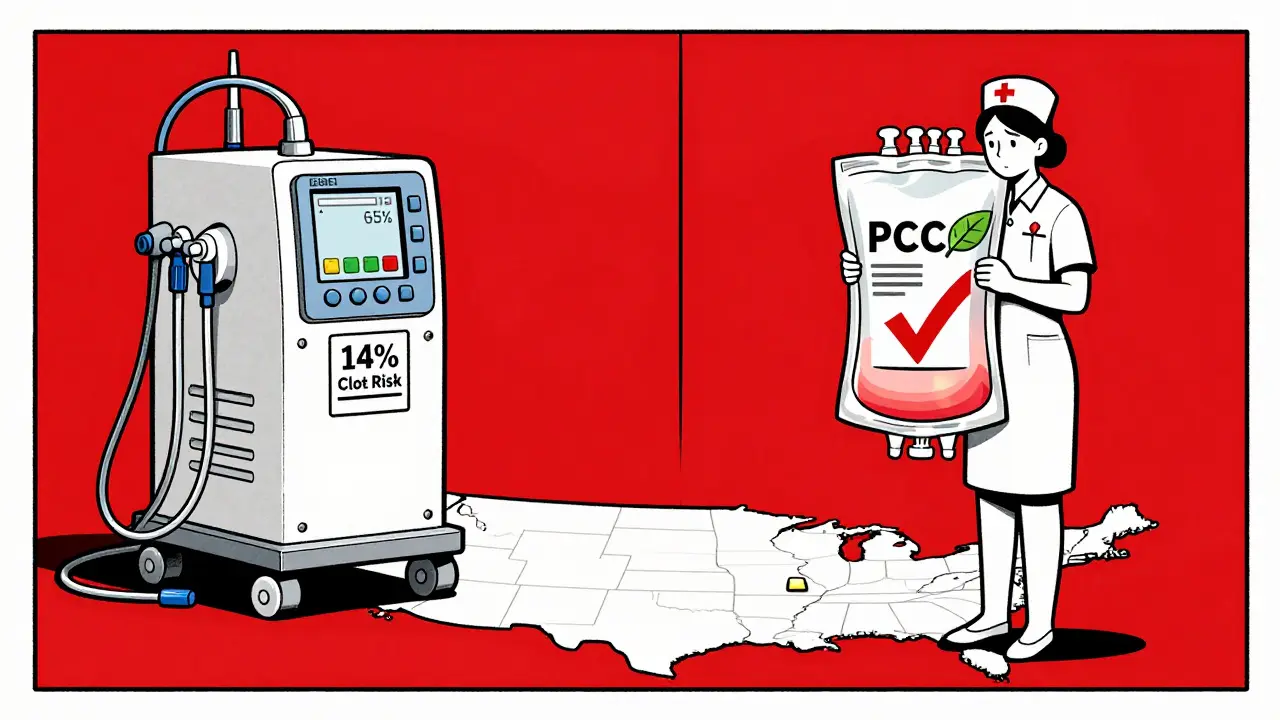
It works fast-reversal in 2 to 5 minutes. But it’s risky. The ANNEXA-4 trial showed 14% of patients had a clot after treatment. That’s double the rate of PCC. The FDA even put a boxed warning on it: “risk of thrombotic events.”
And the cost? $13,500 per treatment. Only 65% of U.S. hospitals stock it. Many can’t afford it. In Australia, it’s rarely available. In smaller hospitals? Forget it. So while it’s powerful, it’s not practical for most places.
What Works Best? The Real-World Picture
Here’s the truth: there’s no single “best” agent. It depends on the drug, the bleed, the hospital, and the cash.
- If it’s dabigatran: idarucizumab. No contest. Fast, safe, simple.
- If it’s apixaban or rivaroxaban: andexanet alfa works best-but only if you have it and can use it. If not? 4F-PCC is your backup. It’s not perfect, but it’s reliable.
- If it’s warfarin: PCC + vitamin K. Always. No exceptions.
Studies show idarucizumab has the lowest death rate (11%) after reversal. Andexanet alfa? 24%. PCC? 26%. But here’s the twist: in real life, many patients get PCC even for DOACs because it’s available. And guess what? It still saves lives.
Dr. Joshua Goldstein, a Harvard hematologist, says it best: “We don’t have head-to-head trials comparing these drugs. So we’re making decisions based on fragments of data.” That’s reality.
What’s Coming Next?
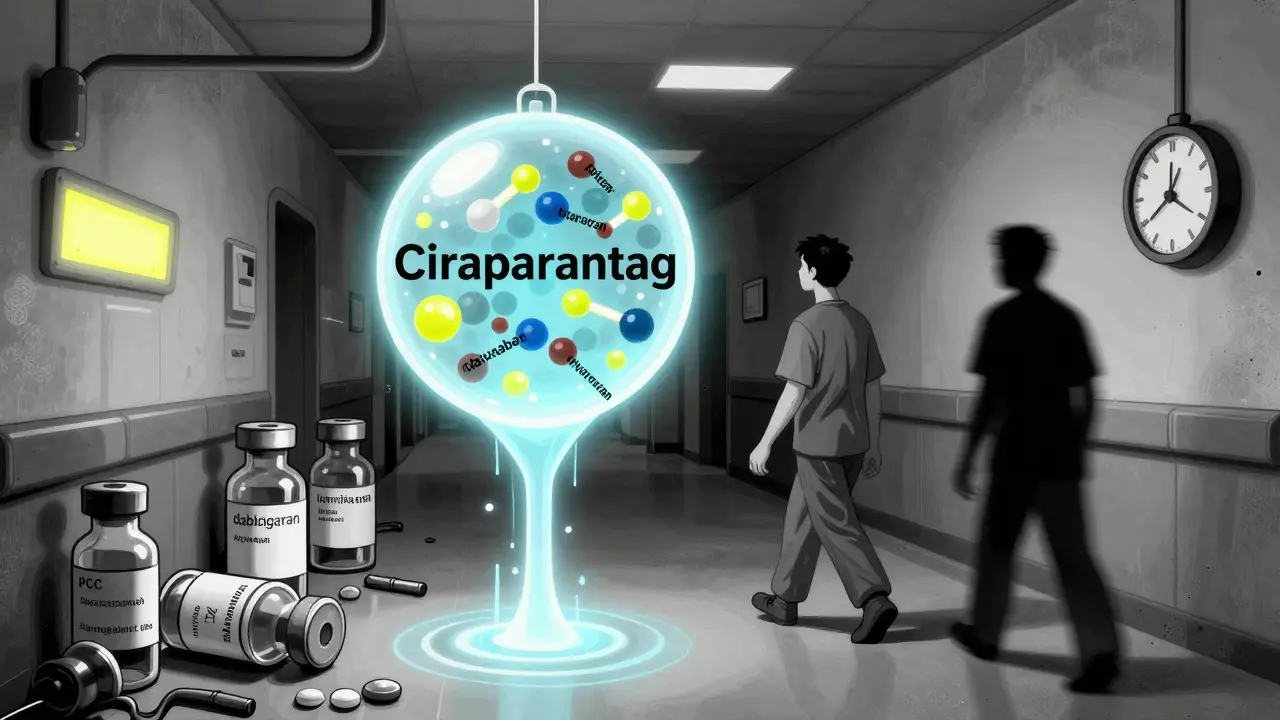
There’s a new player on the horizon: ciraparantag. It’s a small molecule that can reverse almost every anticoagulant-DOACs, heparin, even low molecular weight heparin. It’s in Phase III trials. If approved by late 2025, it could be a game-changer. One drug for everything. No more guessing which reversal agent to use.
Right now, though, we’re stuck with what we have. And that’s why knowing the difference matters.
Practical Takeaways
If you’re a patient or a caregiver:
- Know what blood thinner you’re on. Write it down.
- Ask your doctor: “What would we do if I had a major bleed?”
- Keep a list of your meds in your wallet or phone. Paramedics need it.
If you’re a clinician:
- Have a local protocol. Don’t wing it.
- Stock PCC and vitamin K. They’re cheap and effective.
- Use idarucizumab for dabigatran. Always.
- Use andexanet alfa only if you’re trained and it’s available.
- Never give PCC without vitamin K for warfarin reversal.
Final Thought
These reversal agents aren’t magic. They’re tools. And like any tool, they work best when you know how to use them-and when you have them. The future of anticoagulation isn’t just about preventing clots. It’s about managing the risks when things go wrong. Because sometimes, the difference between life and death isn’t the drug you take. It’s the drug you have ready when you need it most.
Can vitamin K reverse DOACs like apixaban or rivaroxaban?
No. Vitamin K only works on warfarin and other vitamin K antagonists. It has no effect on direct oral anticoagulants (DOACs) like apixaban, rivaroxaban, dabigatran, or edoxaban. These drugs work differently-they block clotting factors directly, not by depleting vitamin K. For DOACs, you need specific reversal agents like idarucizumab or andexanet alfa, or PCC as an alternative.
Is PCC safe to use for reversing DOACs even though it’s off-label?
Yes, and it’s commonly done. While PCC is FDA-approved for warfarin reversal, many hospitals use it off-label for DOACs when specific agents aren’t available. Studies show it’s effective in about 75% of cases. The 2024 American College of Chest Physicians guidelines explicitly say PCC is a viable alternative when idarucizumab or andexanet alfa aren’t accessible. The risk of not treating a bleed outweighs the off-label use concern.
Why is andexanet alfa so expensive and hard to get?
Andexanet alfa costs about $13,500 per treatment because it’s a complex biologic made using recombinant protein technology. It requires specialized manufacturing and storage. Only about 65% of U.S. hospitals stock it due to cost and storage needs. Many smaller hospitals can’t justify keeping it on hand, especially when PCC works well enough for many cases. Its high price and limited availability make it a luxury in many settings.
Do reversal agents prevent death from brain bleeds?
They significantly reduce the risk. Studies show that without reversal, the death rate from anticoagulant-related intracranial hemorrhage is 30-50%. With timely reversal, that drops to 11-26%, depending on the agent used. Idarucizumab, for example, has a 11% mortality rate in trials. But speed matters. Every minute counts. The sooner you reverse the anticoagulant, the better the outcome.
Can I reverse anticoagulation at home?
No. None of these reversal agents can be given at home. They require IV administration, monitoring, and emergency equipment. Even vitamin K, which is available orally, takes too long to work in an emergency. If you’re on blood thinners and have a serious injury or signs of internal bleeding-like severe headache, vomiting, confusion, or weakness-you must go to the hospital immediately. There’s no safe home alternative.
Paul Ratliff
March 18, 2026 AT 16:29damn if i had a dime for every time someone said "just take vitamin k" during a brain bleed
bro that shit takes 24 hours. you’re gonna lose the patient before the liver even wakes up
we’re talking minutes here. not hours. not days.
idarucizumab? yes. pcc? yes. vitamin k? after. always after.
stop acting like this is a choice. it’s survival.
SNEHA GUPTA
March 20, 2026 AT 15:21The science behind reversal agents reveals a deeper truth: medicine is not about perfect tools, but about using what is available with wisdom.
Idarucizumab may be ideal for dabigatran, but in rural India, where PCC is the only option, the difference between life and death lies not in the drug, but in the protocol.
Every minute counts, yes-but so does every decision made under pressure.
Perhaps the real innovation isn’t the drug, but the training that ensures someone knows what to do when the clock is ticking.
Our systems must reflect this-not just our pharmacies.
Gaurav Kumar
March 21, 2026 AT 05:51USA thinks it’s the only country with medical innovation? 😒
Andexanet alfa costs $13,500? In India, we use PCC + vitamin K and save lives for under $200.
Western hospitals are drowning in luxury drugs while real medicine happens elsewhere.
Stop glorifying expensive gadgets. The real heroes are the nurses who know how to push PCC when the system fails.
And yes-we don’t need 2-hour infusions. We need brains. And we have them.
Stop acting like your expensive toys are the only way.
Laura Gabel
March 22, 2026 AT 13:20pcc works fine
why overcomplicate it
save the 13k for something else
MALYN RICABLANCA
March 23, 2026 AT 13:18OH MY GOD.
YOU GUYS. I JUST READ THIS ENTIRE THING.
AND LET ME TELL YOU-THIS ISN’T JUST MEDICINE.
THIS IS A PSYCHOLOGICAL WARZONE.
Imagine: a 72-year-old woman, brain bleeding, husband screaming in the ER, nurses running around like headless chickens, and someone’s like, "Wait-did we order andexanet?"
NO. WE DIDN’T. WE HAVE PCC.
AND THEN-
THE DOCTOR-
THE DOCTOR-
-PULLS OUT VITAMIN K AND THINKS "IT’LL WORK EVENTUALLY"
NO. NO. NO.
YOU DON’T GIVE VITAMIN K FIRST. YOU DON’T WAIT FOR THE LIVER TO "CATCH UP."
THIS ISN’T A DIET PLAN. THIS IS A BULLET TO THE SKULL.
AND IF YOU DON’T KNOW THE DIFFERENCE BETWEEN DOACs AND WARFARIN-
YOU SHOULDN’T BE TOUCHING A SYRINGE.
I’M CRYING.
WHY ISN’T THIS ON THE NEWS?
WHY ISN’T THIS A MOVIE?
WE’RE LETTING PEOPLE DIE BECAUSE WE’RE TOO LAZY TO MEMORIZE A FREAKING ALGORITHM.
gemeika hernandez
March 24, 2026 AT 04:05people don’t get it. vitamin k doesn’t work on apixaban. period.
i work in the er. i’ve seen it.
we give pcc. then we give vitamin k.
no one remembers the second part.
and then the patient bleeds again 12 hours later.
it’s not complicated. it’s just ignored.
Nicole Blain
March 25, 2026 AT 00:28so basically…
idarucizumab = 🚀
andexanet = 💸💣
pcc = 🛠️
vitamin k = 🌱⏳
and we’re all just trying not to die
thanks for the clarity 😅
Kathy Underhill
March 25, 2026 AT 14:15the most important takeaway isn’t which drug to use-it’s having a system that ensures the right one is available.
if your hospital doesn’t stock idarucizumab, then your protocol must be clear: pcc + vitamin k, in that order, with documentation.
training matters more than cost.
awareness matters more than technology.
we don’t need more drugs.
we need more disciplined practice.
Sanjana Rajan
March 27, 2026 AT 01:51of course pcc works for doacs
everyone knows that
why are we even talking about this
you’re overcomplicating medicine
just give the pcc and move on
stop making everything a debate
Kyle Young
March 27, 2026 AT 13:45I find it fascinating how the economic constraints of healthcare systems shape clinical outcomes more than pharmacological superiority.
When a hospital cannot afford andexanet alfa, and defaults to PCC-even off-label-it’s not an error. It’s an adaptation.
Does this mean PCC is "good enough"? Or does it mean our drug approval system is misaligned with real-world needs?
Perhaps the real question isn’t which agent is best… but why we don’t have universal access to the best one.
Aileen Nasywa Shabira
March 28, 2026 AT 17:45oh wow. a 10,000-word essay on how to not die.
congrats. you wrote a textbook chapter.
but here’s the truth: 90% of hospitals don’t even have idarucizumab.
and the ones that do? They keep it locked in a fridge behind 3 passwords.
so who’s really benefiting here?
the patients? or the pharmaceutical marketing teams?
you call this progress?
i call it performance art.
Kendrick Heyward
March 29, 2026 AT 00:02you think this is bad?
i had a patient last month.
brain bleed.
on rivaroxaban.
no andexanet.
they gave pcc.
and then…
they forgot vitamin k.
he bled again.
we lost him.
you think this is about drugs?
no.
this is about people who don’t read.
and now he’s dead.
because no one cared enough to remember.
lawanna major
March 29, 2026 AT 05:30every single one of these agents has a place.
idarucizumab for dabigatran-perfect.
andexanet for factor xa-when you can afford it.
pcc as the workhorse-reliable, cheap, everywhere.
vitamin k as the foundation-not the hero, but the anchor.
the real win isn’t in having all the tools.
it’s in having the discipline to use them in order.
and the humility to admit when you don’t have the ideal one.
medicine isn’t about perfection.
it’s about doing the best you can with what you have.
and that’s worth honoring.