
Missing a dose of your blood pressure pill? Forgetting your diabetes meds after a long day? You're not alone. Around 30-50% of people with chronic conditions don’t take their meds as prescribed. The result? More hospital visits, worse health outcomes, and billions wasted in healthcare costs every year. But here’s the good news: simple text message reminders can make a real difference-if they’re done right.
Why Text Reminders Work (When They Work)
Text messages cut through the noise. Unlike phone calls or emails, SMS lands on your phone with a buzz and a flash. Studies show that people who get daily text reminders are over twice as likely to take their meds on time compared to those who don’t. A 2017 study tracking over 1,000 heart patients found adherence jumped from 80% to 94% after six months of daily texts. That’s not a fluke-it’s science.
But here’s the catch: not all reminders are created equal. A 2023 study of nearly 10,000 patients found that generic, one-size-fits-all texts like "Take your pill today" made zero difference in refill rates over a year. The difference? Personalization. Messages that mention your name, your specific drug, and even why it matters (“This helps keep your heart strong for your grandkids”) boosted adherence by up to 15%.
How to Set Up Effective Text Reminders
You don’t need a fancy app or a tech degree. Here’s how to build a system that actually works:
- Start with your meds list. Write down every pill you take, the dose, and the time. Don’t guess. Check your prescription label or ask your pharmacist. If you take metformin at 8 a.m. and lisinopril at 7 p.m., write it down exactly like that.
- Choose your timing. Texts sent within two hours of your scheduled dose work best. Too early? You might forget. Too late? You’ve already missed it. If you take a pill at 7 a.m., set the text for 6:30 a.m. or 7:15 a.m. Avoid late-night alerts-sleep matters.
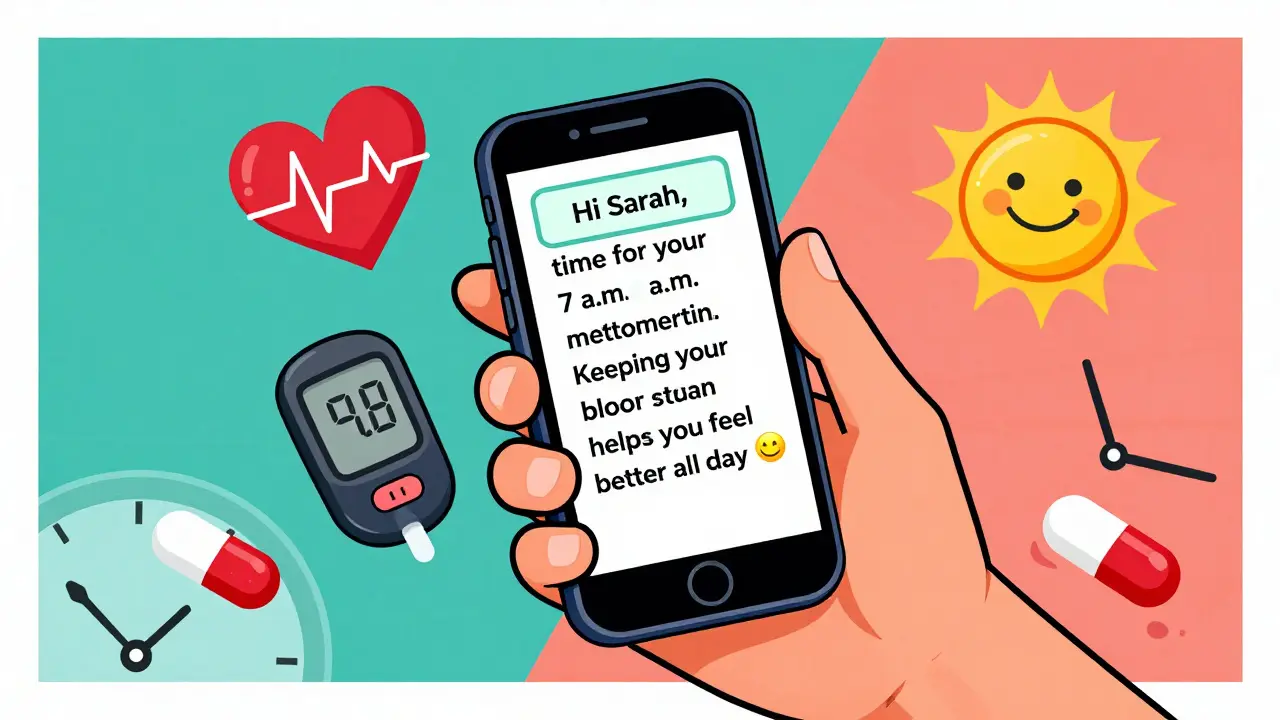
- Personalize the message. Instead of "Take your pill," try: "Hi Sarah, time for your 7 a.m. metformin. Keeping your blood sugar steady helps you feel better all day." Add a smiley if you like. It sounds silly, but emotional cues stick.
- Set frequency based on your condition. Daily reminders work best for high-stakes meds like HIV drugs or blood thinners. For maintenance meds like statins, weekly check-ins can be enough. Too many texts? You’ll tune out. Studies show message fatigue kicks in after 3-6 months if the content doesn’t change.
- Use a reliable platform. You can use free tools like Google Calendar with SMS alerts, or apps like Medisafe or MyTherapy that sync with your phone’s alarm. If you’re on a Medicare Advantage plan, ask your provider-they might already offer a free text reminder service.
What Doesn’t Work
Not every text reminder system delivers results. Here’s where most fail:
- Generic messages. "Take your medication today"-this tells you nothing. It doesn’t remind you of the name, the reason, or the time. Your brain ignores it.
- Wrong timing. Sending a reminder at midnight for a 7 a.m. pill? You’ll ignore it. Or worse, you’ll turn off all alerts.
- No follow-up. If you don’t respond to the text, does anyone check? Systems that track responses (like "Reply YES if taken") and escalate to a call or nurse if ignored? Those are the ones that work long-term.
- One-size-fits-all for all conditions. Text reminders work best for conditions where timing is critical: HIV, TB, epilepsy, or post-heart attack meds. For chronic conditions like high cholesterol, where missing one dose doesn’t cause immediate harm, the effect fades fast.
Real People, Real Results
On Reddit, a user named u/HealthyHeart2022 wrote: "My missed doses dropped from 30% to under 5% after I started using Medisafe’s texts. I even set a custom message: ‘Your heart thanks you.’ I cry every time I read it."
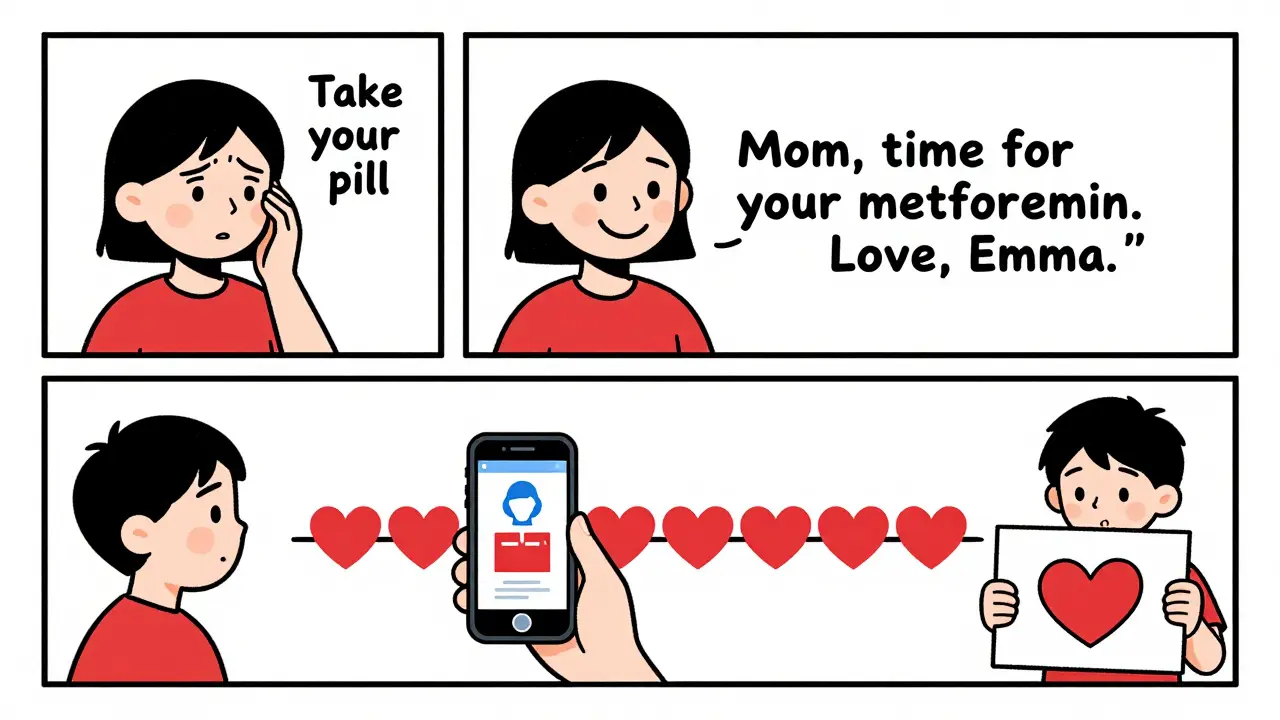
Another user, a 68-year-old in Perth with Type 2 diabetes, told his pharmacist he was forgetting his metformin after dinner. His clinic set up a daily text at 6:45 p.m. with his daughter’s name in the message: "Mom, time for your metformin. Love, Emma." He hasn’t missed a dose in 14 months.
But it’s not magic. One 2021 survey found 23% of users stopped using reminders after six months because they were "too annoying" or "came at the wrong time." That’s why tweaking matters. If a text pops up while you’re driving or in a meeting, reschedule it. Your phone lets you do that. Use it.
Who Should Skip Text Reminders?
Texts aren’t for everyone. If you don’t have a reliable phone, no data plan, or no one to help you set it up, this won’t work. Older adults without smartphones, people with severe cognitive decline, or those in areas with spotty cell service? Text reminders won’t help. In those cases, pill organizers, family check-ins, or in-person pharmacy counseling are better options.
Also, if you’re already taking your meds 90% of the time? You probably don’t need it. Text reminders are for the 30-50% who struggle. If you’re one of them, this could be the simplest tool you’ve ever tried.
The Bigger Picture
Text reminders aren’t a cure-all. A 2023 study across three major U.S. health systems found that after a year, even personalized texts didn’t improve refill rates for heart patients. Why? Because adherence isn’t just about remembering. It’s about cost, side effects, fear, depression, and access. A text won’t fix a $50 copay or a pill that makes you dizzy.
But here’s what we know: when paired with other support-like counseling, affordable meds, or a nurse calling once a month-text reminders become part of a real safety net. They’re not the hero. They’re the sidekick. And sidekicks matter.
Health systems are starting to catch on. In Australia, some Medicare providers now offer free text reminders for chronic disease patients. In the U.S., over 75% of large hospitals now use some form of digital adherence tool. And with AI on the horizon-systems that learn your habits and adjust messages automatically-the future looks smarter, not just louder.
Start Today
You don’t need to wait for your doctor to set it up. Do it yourself:
- Open your phone’s calendar or reminder app.
- Set a daily alert for each medication, with the exact time.
- Turn on SMS notifications.
- Edit the message to include your name, the drug, and one reason why it matters.
- Check after two weeks. Are you still seeing the texts? Are you taking your pills? If yes, you’re already ahead of most people.
It’s not about technology. It’s about consistency. One text. One dose. One day at a time. That’s how health changes.
Tom Sanders
March 8, 2026 AT 03:46I set up texts for my statins and it was useless. Got the same message every day for 6 months. Started ignoring it. Now I just keep the bottle next to my coffee maker. Works better.
rafeq khlo
March 8, 2026 AT 10:49The data presented here is statistically flawed. Adherence metrics are often self-reported and subject to significant bias. Furthermore, the claim that personalized messages improve adherence by 15% lacks peer-reviewed replication. This is anecdotal marketing dressed as science.
Morgan Dodgen
March 10, 2026 AT 09:58Text reminders are just the tip of the surveillance iceberg. Next they'll be syncing with your smart fridge to monitor your sodium intake. Big Pharma + Google Health = digital eugenics. 🤖💉
Philip Mattawashish
March 10, 2026 AT 20:28You think this is helping? You're just training people to be obedient drones. Medicine isn't about compliance. It's about autonomy. If you need a text to remember your pill, maybe you shouldn't be taking it in the first place.
Erica Santos
March 12, 2026 AT 02:47Oh great. Another ‘simple fix’ for systemic failure. Let’s just text people instead of fixing $200 insulin prices or giving them mental health support. Brilliant. 🙄
Stephen Rudd
March 12, 2026 AT 05:58In Australia, our system offers this. But guess what? 60% of seniors don't use smartphones. The whole thing is a middle-class vanity project. Real healthcare doesn't need texts. It needs nurses.
Jazminn Jones
March 13, 2026 AT 23:24The methodology cited in the 2017 study is deeply problematic. The sample size was homogenous, the control group was inadequately matched, and no adjustment was made for socioeconomic confounders. This is not evidence. It is rhetoric.
George Vou
March 15, 2026 AT 15:58i set up texts for my bp med and they kept sending at 3am. i turned them off. now i just put the pill in my toothbrush cup. its dumb but it works. also i spell wrong sometimes lol
Mantooth Lehto
March 17, 2026 AT 15:03I cried when I read my daughter's text. Not because it reminded me to take my meds. But because she still cares. I haven't missed a dose in 2 years. That's not tech. That's love. ❤️
Judith Manzano
March 19, 2026 AT 12:15This is actually one of the most practical pieces of health advice I've seen in a long time. Simple, actionable, and grounded in real human behavior. If you're struggling, start with one pill. One text. One morning. You don't need to fix everything at once.
Leon Hallal
March 20, 2026 AT 03:54I used to forget everything. Now I have texts. I take my pills. I feel better. I don't care how it works. It works. That's all that matters.
APRIL HARRINGTON
March 20, 2026 AT 20:20I just want to say thank you to the person who wrote this. I was ready to give up on my health. This made me feel like I could try again. I set up my texts tonight. I'm not alone anymore. 💪💖