Medication Tool Selector & Safety Guide
Dosing Device Assistant
Match your medication needs to the safest measurement tool
Recommended Tool:
Please select your needs to see the recommendation.
Select the options on the left to generate your safety recommendation.
Giving the wrong amount of medicine isn't just a mistake; it's a dangerous gamble. Whether you're a parent trying to soothe a sick toddler or a caregiver helping an elderly relative, the stress of a medical crisis makes it incredibly easy to misread a tiny line on a plastic cup. This is where visual dosing aids is specialized tools designed to improve medication administration accuracy through visual cues, markings, and measurement systems come into play. By removing the need for complex math in high-stress moments, these tools act as a critical safety net, turning a confusing calculation into a simple visual match.
Why standard measuring tools often fail
Most of us have used a kitchen spoon to give medicine, but that's a recipe for disaster. Household spoons vary wildly in size, and standard measuring cups often have blurry lines that are hard to see in low light. When the dose is measured in milliliters (mL), a tiny slip-just a few millimeters off-can lead to a significant overdose or an underdose that renders the treatment useless.
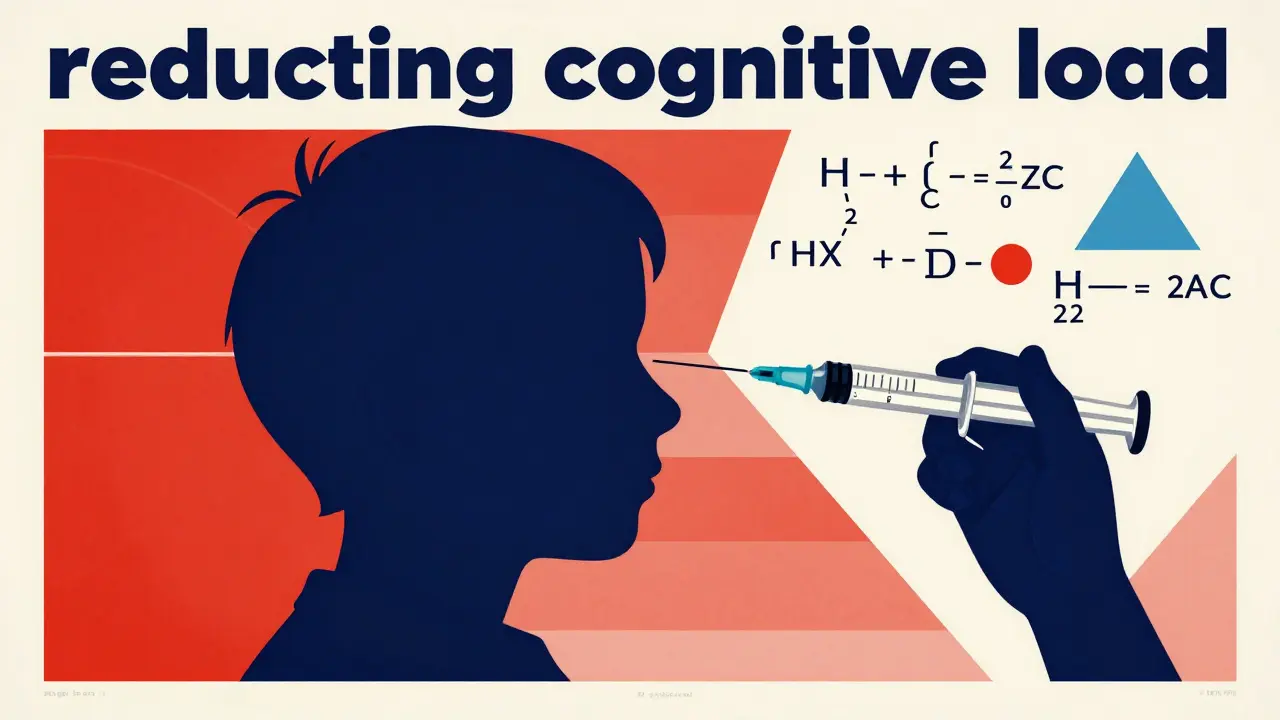
The cognitive load is the real enemy here. Imagine you're in an emergency, your heart is racing, and you have to calculate a dose based on a child's current weight. Research shows that this mental pressure leads to a high rate of errors. For instance, in simulated medical emergencies, groups without visual aids had error rates as high as 40%. When the brain is in "fight or flight" mode, it struggles with math but remains great at recognizing colors and shapes.
The toolkit: Syringes, droppers, and measuring devices
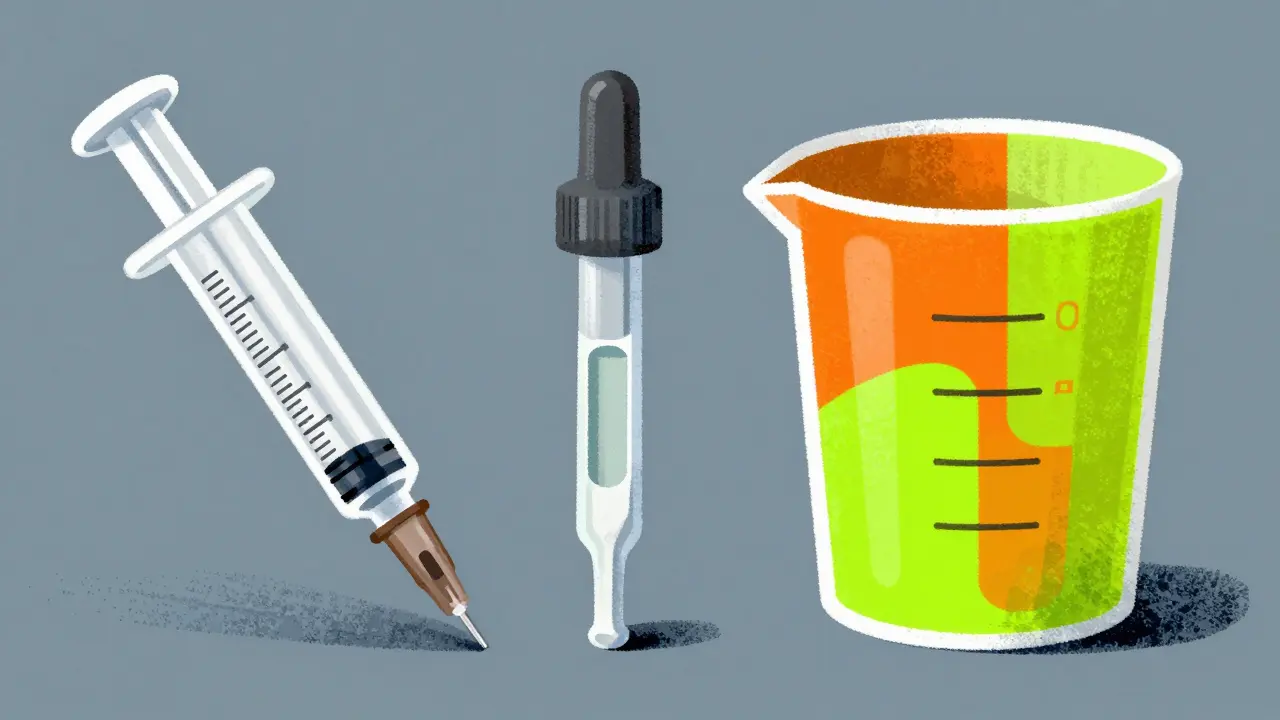
Different medications require different tools. Using the wrong one can be just as risky as using the wrong dose. Here is a breakdown of the primary tools used to ensure accuracy.
Oral Syringes are the gold standard for liquid medicine. Unlike a spoon, a syringe allows you to pull the exact amount of liquid from a bottle, leaving no room for spills. High-quality visual aids in syringes often feature enlarged numbering and contrasting color backgrounds to make the graduations pop, which is vital for those with visual impairments.
Droppers are best for very small doses, typically used for infant eye drops or concentrated vitamins. Modern visual droppers often include a "visual window" or a color-coded indicator that changes once the correct volume is reached, taking the guesswork out of the process.
Measuring Cups are generally used for larger volumes of liquid. The safest versions use a "stability base" to prevent tipping and feature bold, etched markings that don't rub off over time. Some even incorporate "safety zones"-color-coded areas that warn you if you've exceeded a typical safe dosage range.
| Tool | Best Use Case | Key Visual Safety Feature | Common Pitfall |
|---|---|---|---|
| Oral Syringe | Precise pediatric doses | Contrast-colored graduations | Air bubbles in the chamber |
| Dropper | Micro-doses / Eye drops | Volume-indicating windows | Inconsistent drop size |
| Measuring Cup | Large volume liquid meds | Color-coded safety zones | Parallax error (viewing angle) |
How visual aids save time and lives in emergencies
In a crisis, every second counts. Think about an allergic reaction where Epinephrine must be administered immediately. A study by Gardner et al. (2018) found that using visual aids-like posters or color-coded charts-reduced the time it took to administer the drug from 152 seconds down to just 97 seconds. That's a 36.2% improvement in speed.
But it's not just about speed; it's about confidence. When a healthcare provider or parent can look at a visual guide and see "Weight X = Line Y," they stop second-guessing themselves. This reduction in cognitive load prevents the "freeze" response that often happens during medical emergencies. The same study showed that errors dropped from 40% in the non-visual group to 18.2% in the group using visual aids.
Special considerations for pediatric and growth-based dosing
Children aren't just small adults; their needs change weekly. Pediatric medicine often requires dose adjustments based on weight bands. This is where the Visual Dosing Aid (VDA) becomes a lifesaver. Originally developed for antiretroviral treatment in resource-limited settings, the VDA simplifies the complex math required to adjust doses as a child grows.
Instead of requiring a clinician to perform a multi-step calculation (Weight x Concentration / Frequency), a VDA allows them to match a child's weight band to a specific marking on a syringe. This removes the risk of a decimal point error-a common mistake that can lead to a ten-fold overdose.
Common mistakes to avoid when using dosing tools
Even with the best tools, human error exists. The Gardner study noted that self-administration errors remained a problem even with visual aids. Here are a few ways to ensure you're using your tools correctly:
- Avoid the "Eye-Level" Trap: Always hold the syringe or cup at eye level. If you look down at the liquid, you'll likely misread the line (this is called parallax error).
- Purge the Bubbles: In a syringe, an air bubble takes up space where medicine should be. Tap the side of the syringe to move the bubble to the top and push it out before finalizing the dose.
- Match the Tool to the Med: Never use a syringe that came with Medication A to give Medication B unless the manufacturer says it's okay. Concentrations differ, and some plastics can react with certain chemicals.
- Verify the Unit: Check if the tool is marked in milliliters (mL) or teaspoons (tsp). While 5mL is roughly one teaspoon, relying on that conversion is where many errors begin.
Integrating tools into a comprehensive safety plan
A visual aid is a tool, not a total solution. To truly minimize risk, these tools should be part of a larger safety strategy. This means keeping medications in their original packaging, storing them in a locked box out of reach of children, and double-checking the dose with another adult whenever possible.
Training is also key. While these tools are designed to be intuitive, a quick "dry run" with water can help a caregiver feel more comfortable before a real medical need arises. When you combine a physical tool (the syringe) with a visual guide (the chart) and a verified process (double-checking), you create a system where it's hard to fail.
Can I use a kitchen measuring spoon if I don't have a dosing syringe?
No. Kitchen spoons are not standardized and can vary by as much as 25% in volume. Always use the device provided with the medication or a pharmacy-grade oral syringe to ensure the dose is accurate.
What is the most common mistake when using a dosing syringe?
The most common mistakes include ignoring air bubbles in the syringe, which displaces the medication, and reading the measurement from an angle rather than at eye level.
How do visual dosing aids help in emergency situations?
They reduce the cognitive load by replacing complex mental math with simple visual matching. This leads to faster administration times and significantly lower error rates during high-stress events.
Are visual dosing aids only for children?
While they are critical for pediatric weight-based dosing, they are also used for elderly patients who may have vision loss or cognitive decline, and for emergency medical professionals handling high-risk drugs like epinephrine.
Why do some syringes have different colors on the markings?
Color-coding is used to highlight critical dosage points or to indicate safe dosage ranges, making it easier for the user to spot an incorrect dose at a glance.