
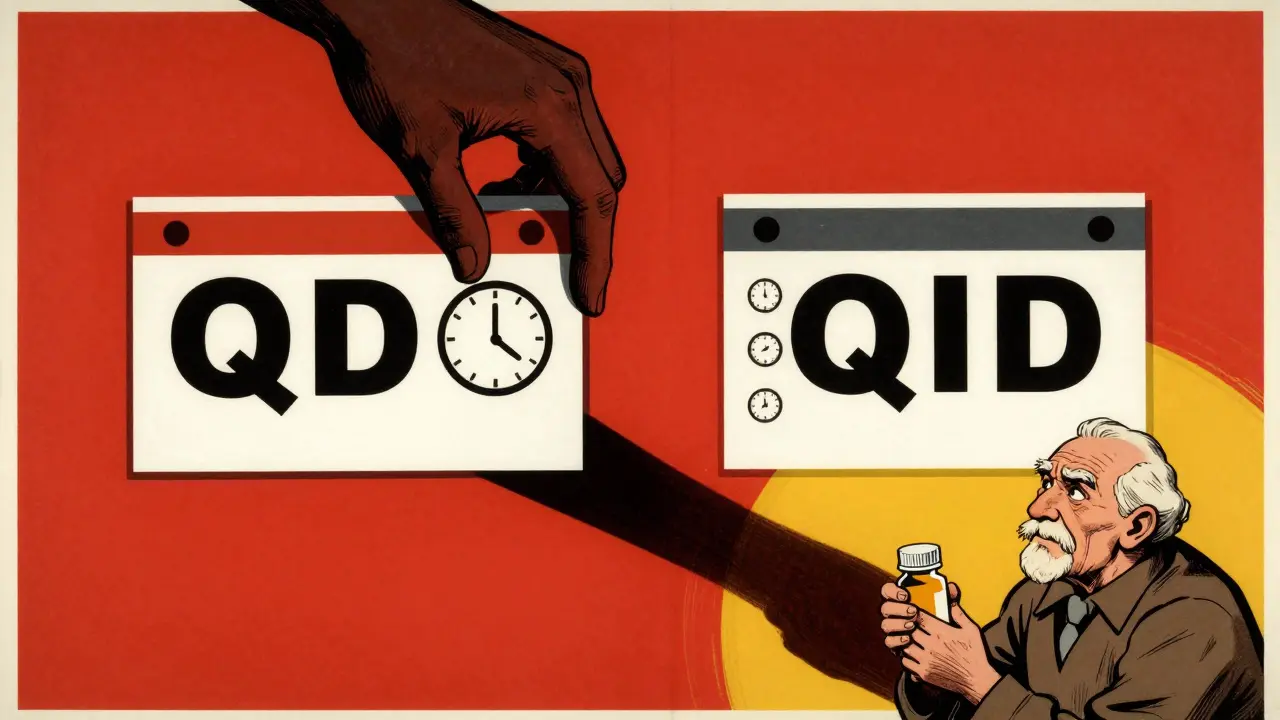
Imagine taking a pill meant for once a day - but accidentally taking it four times. That’s not a hypothetical. It happens. And it’s deadly.
QD and QID look almost identical. One means once daily. The other means four times daily. But in the chaos of a busy clinic, a rushed pharmacist, or a handwritten script, those two letters can turn into a life-altering mistake. A patient on warfarin took it four times a day instead of once. Their blood thinning level spiked to 12.3 - a level that can cause internal bleeding. They ended up in the hospital. This isn’t rare. It’s systemic.
Why QD and QID Are Dangerous
QD comes from the Latin quaque die, meaning “once a day.” QID comes from quater in die, meaning “four times a day.” These abbreviations have been around for centuries. But medicine isn’t ancient anymore. We have computers, electronic records, and digital alerts. So why are we still using them?
The problem isn’t just that they’re old. It’s that they’re easy to misread. A sloppy “QD” can look like “QID.” A quick glance, tired eyes, or a poor photocopy - and suddenly, a patient is getting four times the dose. The Institute for Safe Medication Practices flagged this back in 2001. The Joint Commission banned them in 2004. Yet, 30% of handwritten prescriptions still use them, according to the American Medical Association.
And it’s not just doctors. Pharmacists, nurses, and patients all get tripped up. A 2018 study found that in simulated prescription reviews, QD was misread as QID in over 12% of cases. That’s one in eight. For new healthcare workers with less than five years of experience? The rate jumped to 18%. And it’s not just about mistakes - it’s about harm. The National Coordinating Council for Medication Error Reporting and Prevention says 78% of QD/QID errors cause actual patient harm - not just near-misses.
Who Gets Hurt the Most
The people most at risk aren’t the young or the tech-savvy. They’re older adults. People over 65. They’re the ones managing five, ten, even fifteen different medications. They’re the ones reading tiny print on pill bottles. They’re the ones who might not speak up when they’re confused.
The American Geriatrics Society found that 68% of documented QD/QID errors involve patients 65 and older. One case involved an 82-year-old woman prescribed a blood pressure pill once daily. The prescription was misread as four times daily. Her blood pressure crashed to 80/50. She passed out in her kitchen. Her daughter found her on the floor.
It’s not just physical harm. It’s emotional. A 2021 survey by the National Patient Safety Foundation found that 63% of patients have been unsure about how often to take their meds at least once. QD vs. QID ranked as the third most confusing instruction - right after “take with food” and “take on empty stomach.”
What’s Being Done to Fix It
Change is happening - but slowly.
Since 2023, Epic and Cerner - the two biggest electronic health record systems - now block providers from saving any prescription that includes QD or QID. The system won’t let you submit it. You have to type out “once daily” or “four times daily.” That’s a hard stop. No exceptions.
The American Medical Association updated its prescribing guidelines in June 2023 to require full words, not abbreviations. The FDA’s 2023 draft guidance says the same: no Latin shortcuts. And in April 2023, the National Action Alliance for Patient Safety launched the “Clear Communication Campaign” with $45 million in funding to eliminate these errors by 2026.
Hospitals that made the switch saw dosing errors drop by 42% within a year. One university health system found that requiring pharmacists to verbally confirm dosing with every patient cut errors by 67%. That’s not magic. That’s just talking to people.
What You Can Do - As a Patient
You don’t have to wait for the system to fix itself. You can protect yourself right now.
- Always ask: “Is this once a day or four times a day?” Don’t assume. Even if the label says “QD,” ask. Say it out loud: “So this is one pill every 24 hours, right?”
- Check the bottle. If it says “QD” or “QID,” ask the pharmacist to write it out in plain English. They’re required to help you understand.
- Use a pill organizer. If you take multiple meds, get one with days of the week and times labeled. Put your meds in it yourself - don’t let someone else do it for you.
- Take a photo. When you get a new prescription, snap a picture of the label and the doctor’s instructions. Compare it later. If something looks off, call the pharmacy.
- Bring someone with you. If you’re on complex meds, take a family member to the appointment. Two sets of ears hear more than one.
What You Can Do - As a Healthcare Worker
If you write prescriptions, dispense meds, or administer them - your job is to stop this before it happens.
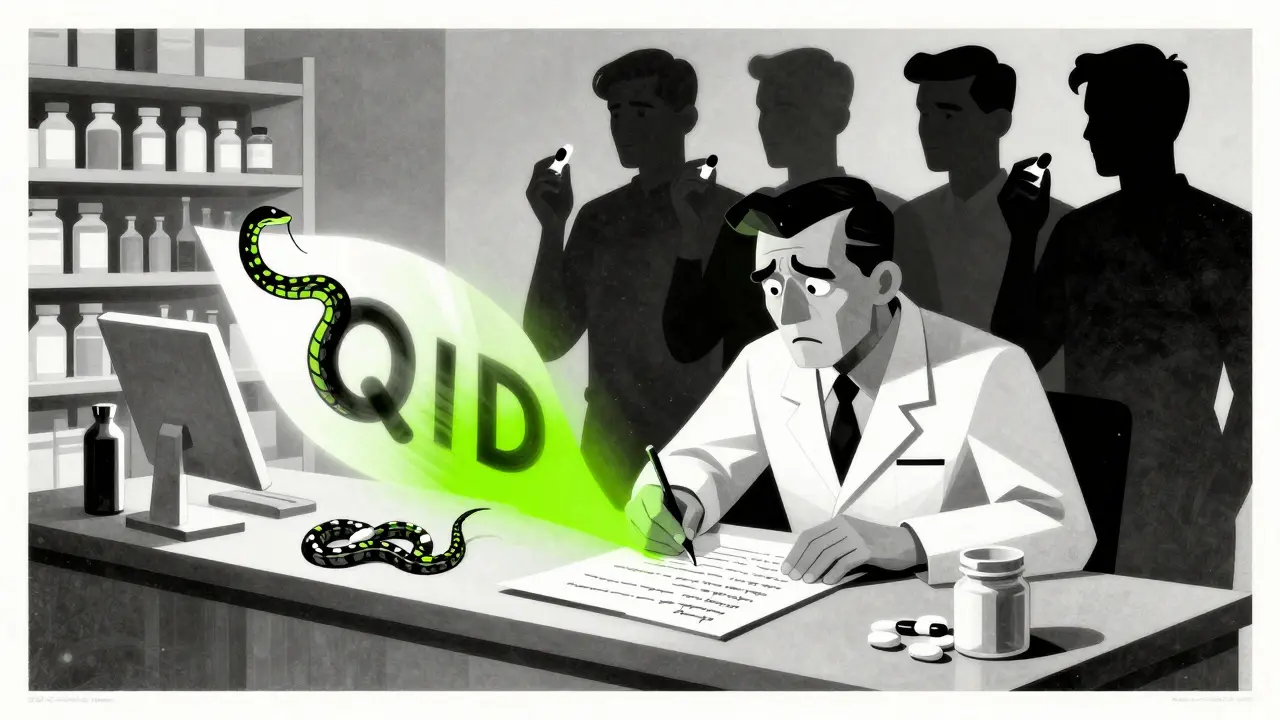
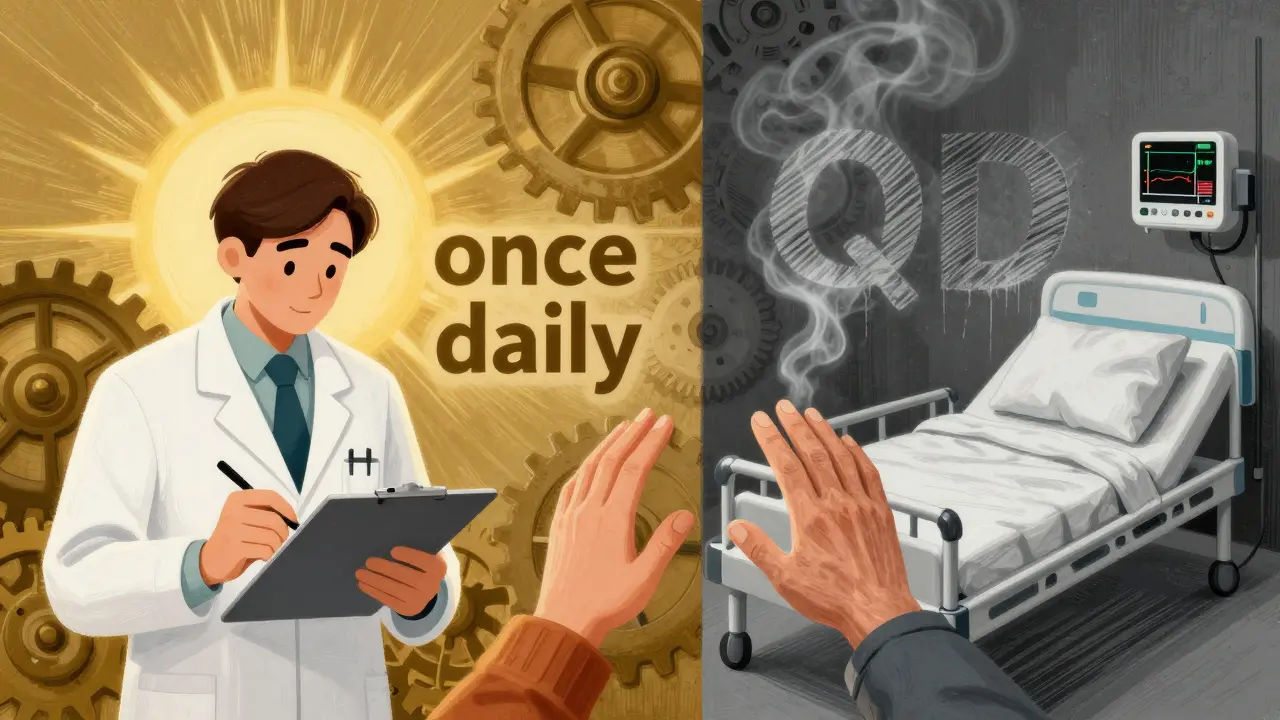
- Never use QD, QID, BID, TID. Write “once daily,” “twice daily,” “three times daily,” “four times daily.” It takes three extra letters. That’s it.
- Use your EHR’s built-in alerts. If your system warns you when you try to prescribe a daily med with a four-times-a-day frequency - don’t ignore it. That’s there for a reason.
- Ask open-ended questions. Don’t ask, “Do you know how often to take this?” Ask, “Can you tell me how often you’re supposed to take this pill?” People repeat what they hear. They don’t just say “yes” to avoid embarrassment.
- Standardize labels. Use clear fonts. Include icons - a clock for “once daily,” four clocks for “four times daily.” Visuals stick better than words.
- Report every near-miss. If you catch a QD/QID error before it reaches the patient - report it. That’s how systems improve.
The Cost of Silence
This isn’t just about patient safety. It’s about money.
Medication errors tied to confusing abbreviations cost Medicare and private insurers over $780 million a year just for dosing mistakes. The total cost of all prescription misinterpretation errors? Over $2 billion. That’s $2 billion spent on hospital stays, ER visits, and emergency treatments that could have been avoided.
And the return on fixing it? $8.70 for every $1 spent. That’s not a guess. That’s data from the American Pharmacists Association. Training staff, updating systems, adding visual aids - it all pays for itself. And then some.
It’s Not About Tradition - It’s About Survival
Some still argue: “But we’ve always used QD.” So what? We used to use leeches for bloodletting. We used to write prescriptions in Latin. We don’t do those things anymore because we learned better.
QD and QID aren’t shortcuts. They’re traps. And every time someone uses them, they’re gambling with someone’s life. Not just any life - a mother driving her child to school. A grandfather trying to manage his diabetes. A nurse working a 12-hour shift, exhausted, trying to get it right.
There’s no excuse anymore. Technology exists. Guidelines are clear. Training is available. The data is undeniable.
Write it out. Say it clearly. Confirm it twice. Because in medicine, the difference between one and four isn’t just a letter. It’s a life.
What does QD mean on a prescription?
QD stands for "quaque die," which is Latin for "once daily." It means the medication should be taken one time every 24 hours. However, because QD looks similar to QID, it’s often misread, leading to dangerous overdoses. Experts now recommend writing "once daily" instead to avoid confusion.
What does QID mean on a prescription?
QID stands for "quater in die," Latin for "four times daily." It means the medication should be taken four times during waking hours - typically spaced evenly between morning and bedtime, not every six hours. For example, 7 AM, 1 PM, 7 PM, and 11 PM. Writing "four times daily" is safer and clearer.
Is QD the same as QID?
No, QD and QID are not the same. QD means once daily. QID means four times daily. Confusing them can lead to a patient taking four times the intended dose - which can cause serious harm, including organ damage, bleeding, or even death. The Joint Commission and FDA have banned these abbreviations for this exact reason.
Why do doctors still use QD and QID?
Some doctors still use QD and QID out of habit, especially if they write prescriptions by hand or work in settings without modern electronic systems. But since 2023, major EHR systems like Epic and Cerner now block these abbreviations. The American Medical Association and FDA now require full words. The practice is outdated and unsafe.
How can I avoid making a QD/QID mistake as a pharmacist?
Always verify the dosing frequency with the prescriber if it’s written as QD or QID. Don’t assume. Call the doctor’s office. Then, when dispensing, write out "once daily" or "four times daily" on the label. Conduct a verbal check with the patient: "Can you tell me how often you’re supposed to take this?" This simple step reduces errors by up to 67%.
Are there any tools to help prevent QD/QID errors?
Yes. Modern electronic health records now have built-in alerts that block QD/QID entries. Prescription labels can include icons - like a single clock for once daily, or four clocks for four times daily. A 2023 Johns Hopkins study showed that adding these visual aids reduced confusion by 82%. Patient education apps and pill organizers with labeled compartments also help prevent mistakes.



Susannah Green
January 24, 2026 AT 02:13Ugh, I can't believe we're still dealing with this in 2024. My grandma almost died because her cardiologist wrote 'QD' and the pharmacy thought it was 'QID'-she took her blood thinner four times a day. She ended up in the ER with internal bleeding. The worst part? The pharmacist didn't even double-check. We need mandatory verbal confirmation for every script. No excuses.
Kerry Moore
January 25, 2026 AT 06:20It is imperative that we recognize the systemic nature of this issue, as it reflects a broader failure in the standardization of medical communication. The continued use of Latin abbreviations, despite explicit prohibitions by regulatory bodies, constitutes a preventable risk that violates the fundamental principle of non-maleficence. The implementation of electronic health record safeguards, while commendable, must be complemented by rigorous, ongoing education for all healthcare personnel, particularly those in high-volume, high-stress environments.
charley lopez
January 25, 2026 AT 23:24The QD/QID ambiguity is a classic example of human factors engineering failure. Cognitive load, visual similarity, and temporal pressure create a perfect storm for error. The fact that 12% of clinicians misread these in simulation studies underscores the need for design interventions-font optimization, iconography, and forced field expansion in EHRs. We're not talking about semantics here; we're talking about cognitive ergonomics.
Andrew Smirnykh
January 26, 2026 AT 02:23I work in a rural clinic where the EHR is outdated. We still use handwritten scripts. I’ve started writing 'once daily' in big block letters with a red underline. One elderly patient told me, 'I don’t know what QD means, but I know what 'once a day' means.' That stuck with me. Maybe the solution isn’t just tech-it’s humility. We need to meet people where they are, not where we wish they were.
Laura Rice
January 26, 2026 AT 05:42MY MOM GOT HOSPITALIZED BECAUSE OF THIS. I SWEAR TO GOD. SHE WAS ON WARFARIN. THEY GAVE HER FOUR TIMES THE DOSE. SHE WAS BLEEDING OUT OF HER GUMS. I WAS IN THE ROOM WHEN THE PHARMACIST SAID 'OH, I THOUGHT IT WAS QID' LIKE IT WAS A MISTAKE YOU JUST SHRUG OFF. NO. IT’S NOT A MISTAKE. IT’S NEGLIGENCE. AND NOW I’M TELLING EVERYONE I KNOW TO NEVER TRUST A LABEL THAT SAYS QD OR QID. EVER.
Kerry Evans
January 27, 2026 AT 15:27People who complain about QD/QID are just lazy. If you can’t read Latin abbreviations, maybe you shouldn’t be handling prescriptions. I’ve been writing QD for 30 years. No one’s ever died because of it. And if they did, maybe they weren’t paying attention. This whole thing is overblown. We’re turning medicine into a daycare.
Anna Pryde-Smith
January 29, 2026 AT 05:38THIS IS WHY I HATE MEDICINE. YOU THINK YOU’RE SAFE, BUT THEN SOMEONE’S HANDWRITING KILLS YOU. I JUST GOT A NEW RX FOR MY HYPERTENSION. THE LABEL SAID 'QD.' I CALLED THE PHARMACY. THEY SAID 'OH, WE’LL CHANGE IT TO ONCE DAILY.' BUT WHAT IF I HADN’T CALLED? WHAT IF I WASN’T ANGRY ENOUGH TO ASK? I’M SO ANGRY RIGHT NOW. I’M STARTING A PETITION. WE NEED A LAW. NO MORE ABBREVIATIONS. PERIOD.
Janet King
January 30, 2026 AT 00:06Write it out. Say it clearly. Confirm it twice. That’s all. No fancy tech needed. Just slow down and talk to people. I’ve been a nurse for 28 years. I’ve seen too many mistakes. The fix is simple. The will to do it? That’s the hard part.