
If you've been told you have sleep apnea, you're not alone. About 22 million Americans have it, and most don't even know it. The good news? CPAP therapy works-when you use it. The hard truth? Nearly half of people who start using a CPAP machine quit within three months. It's not because the machine doesn't work. It's because the mask feels weird, the air feels too forceful, or you wake up with red marks on your face. But here’s the thing: CPAP machines can change your life. Better sleep. More energy. Lower risk of heart attack. You just need to get past the first few weeks.
What Kind of CPAP Machine Do You Actually Need?
Not all CPAP machines are the same. There are four main types, and picking the wrong one can make you give up before you even get started.
Traditional CPAP delivers one fixed pressure all night. If your doctor says you need 10 cm H2O, that’s what you get-whether you’re sleeping deeply or tossing and turning. It’s the cheapest option, usually $500-$1,000. Brands like ResMed AirSense 10 and Philips DreamStation are common. But if your breathing changes at all-say, you snore more when you sleep on your back-this machine won’t adjust. That’s why 30-40% of users say they feel like they’re fighting the air.
APAP (Auto-Adjusting) is the smarter upgrade. It scans your breathing every few seconds and changes pressure automatically. Need 8 cm H2O tonight? It gives you that. Tomorrow, you have a cold? It bumps up to 12. Prices range from $1,700 to $3,000. Models like the ResMed AirSense 11 AutoSet are now the go-to for new patients. A 2021 study in Sleep Medicine Reviews found APAP users stick with therapy 15% longer than those on fixed-pressure CPAP. Why? Because it feels more natural.
BiPAP is for people who need more than just pressure. It gives you two settings: higher pressure when you inhale, lower when you exhale. That’s a game-changer if you’re on high pressure (over 15 cm H2O) and feel like you’re gasping for air. It’s also essential if you have COPD or heart failure. But it costs $600-$1,600, and you’ll need a second sleep study to fine-tune it. Not everyone needs it-but if you’ve struggled with CPAP, it might be your answer.
EPAP devices are tiny, cheap ($50-$150), and plug into your nostrils. They don’t use electricity. They just create resistance when you breathe out. Sounds too good to be true? It is-for moderate or severe sleep apnea. Studies show they work for about 45% of mild cases, but fail for 85% of moderate-to-severe cases. Skip this if your AHI score is above 15.
And then there’s the travel CPAP. The ResMed AirMini is the most popular. It’s smaller than a soda can, weighs less than a pound, and fits in your coat pocket. But it doesn’t have a built-in humidifier. You need to buy one separately ($80). And it’s louder-52 dBA versus 30 dBA for a standard machine. If you travel often, it’s worth it. If you’re at home? Stick with a full-size model.
Mask Fitting: The #1 Reason People Quit
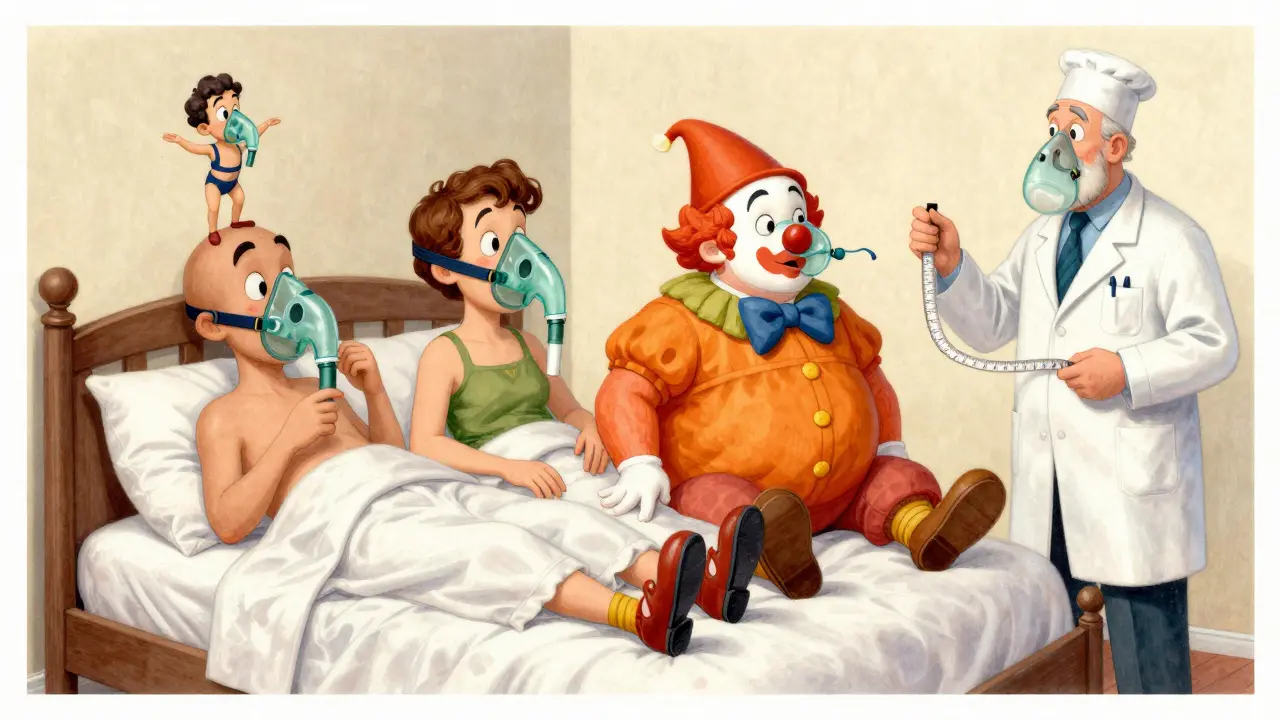
Here’s what no one tells you: 20-30% of people stop using CPAP because of mask fit-not pressure, not noise, not cost. It’s the mask. If it leaks, you wake up. If it pinches, you hate it. If it’s too big, you feel claustrophobic.
There are four main mask types:
- Nasal pillows: Tiny silicone tips that sit just inside your nostrils. Best for side sleepers. Only 32% of users pick these, but they’re the most popular among long-term users. Why? Less face contact. Fewer leaks. Less skin irritation. The AirFit P10 is the gold standard here.
- Nasal masks: Cover your nose only. 45% of users choose these. Good balance of comfort and seal. But if you breathe through your mouth, you’ll wake up gasping.
- Full-face masks: Cover nose and mouth. Only 18% of users. Necessary if you’re a mouth breather, or have chronic nasal congestion. But they’re bulkier, leak more, and cause more facial pressure sores. Studies show 35% more skin irritation than nasal pillows.
- Hybrid/oral masks: Cover your mouth with a chin strap. Used by just 5% of people. Usually a last resort.
Proper fitting isn’t guesswork. It’s measurement. Your nasal bridge width, cheekbone shape, and how far your chin juts out all matter. A bad fit causes 60% of leaks. ResMed says acceptable leak rates are under 24 liters per minute. If you’re hitting 30+? Your mask is wrong.
Real tip: Try on masks at night. Not in the doctor’s office. At home. With your pillow. Sleep with it for 10 minutes. Then 20. Then 30. If you’re still uncomfortable? Switch. Don’t suffer through it.
Adherence: How to Actually Use It Every Night
You don’t need to use CPAP perfectly from day one. You need to use it consistently. And that’s harder than it sounds.
Here’s what works:
- Start with daytime practice. Put the mask on while you’re awake. Turn on the machine. Breathe for 5 minutes. Do this three times a day for a week. Your brain needs to unlearn the fear of air in your nose.
- Use the ramp feature. Every machine has it. It slowly increases pressure over 5-45 minutes. Use it. 75% of users who do report better sleep onset.
- Heat the air. Dry nose? Sore throat? That’s why. Heated humidifiers cut those complaints by 50%. Set it between 86°F and 95°F. If your machine doesn’t have one, get one. It’s worth the extra $100.
- Use data tracking. Your machine records how long you used it, how many leaks you had, and your AHI score. Review it weekly. Seeing your AHI drop from 18 to 4? That’s motivation. ResMed’s myAir app gives personalized coaching and boosts adherence by 27%.
- Try a CPAP pillow. These have cutouts so your mask doesn’t get squished. Reddit user u/MaskMaster69 says it cuts leaks by 40%. Simple. Cheap. Game-changing.
One user on CPAP.com said: "I started with 2 hours a day, just sitting on the couch. After a week, I did 4 hours. Then I slept with it. Now I’ve gone 18 months without missing a night." That’s the path. Not perfection. Progress.
What’s New in 2026?
The tech keeps getting better. ResMed’s AirSense 11 uses AI to predict apnea events before they happen-and reduces your AHI by 22% compared to older models. Philips’ DreamStation 3 runs at 25 dBA, quieter than a whisper. Fisher & Paykel’s SleepStyle now drops pressure by up to 50% during exhalation, making it feel like you’re breathing normally.
Insurance rules changed too. Starting in 2024, Medicare and most private insurers require you to use your machine at least 4 hours a night, 70% of nights, to keep coverage. If you don’t, they’ll stop paying. That’s why data tracking isn’t optional anymore.
And the market is shifting. Younger people are using CPAP now. GoodRx reports a 40% jump in users aged 18-45 since 2020. Trucking companies require drivers with AHI over 20 to use CPAP. Why? Because sleepy drivers cause 32% more accidents. This isn’t just about sleep. It’s about safety.
When CPAP Isn’t Working
Let’s be honest. Some people just can’t tolerate it. If you’ve tried everything-different masks, humidifiers, ramp settings-and you’re still miserable, talk to your sleep doctor. You might need BiPAP. Or maybe you have treatment-emergent central sleep apnea, which affects 5-15% of CPAP users. That’s when your brain stops telling your body to breathe, even with air pressure. ResMed’s AirCurve 10 ASV machine can fix that-but it costs $2,800.
There are alternatives: oral appliances, positional therapy, weight loss. But none are as effective as CPAP for moderate-to-severe sleep apnea. That’s why doctors still call it the gold standard. It’s not perfect. But it’s the best we’ve got.
Don’t quit because of a leaky mask or a noisy machine. Fix it. Switch it. Adjust it. Your future self will thank you.
Donna Zurick
March 3, 2026 AT 11:47I started with a full-face mask and hated it. Switched to nasal pillows and now I sleep like a baby. No more waking up with red marks. Game changer.
Just give it a week. Your body will thank you.
RacRac Rachel
March 5, 2026 AT 00:40This is the most helpful CPAP guide I’ve ever read 😊
Heated humidifier? YES.
Ramp feature? YES.
CPAP pillow? ABSOLUTELY YES.
I went from 2 hours to 8 hours a night in 3 weeks. Don’t quit before the magic happens. You got this!
Jane Ryan Ryder
March 5, 2026 AT 09:55So we’re paying $3k for a machine that blows air up your nose and tracks your sleep like Big Brother?
Meanwhile, China’s got drones that can detect snoring from space. We’re stuck with silicone plugs and Medicare audits.
At least my dog doesn’t send me a weekly report on my AHI.
Callum Duffy
March 5, 2026 AT 16:26The data-driven approach outlined here is both scientifically sound and pragmatically oriented.
It is noteworthy that adherence metrics are now being integrated into insurance frameworks, which, while perhaps stringent, incentivizes consistent therapeutic engagement.
One might argue that the psychological barrier to use is often greater than the physical one.
Betsy Silverman
March 7, 2026 AT 04:05I’m from Mexico and we don’t have easy access to all this tech.
My cousin got a used AirSense 10 off Facebook Marketplace, cleaned it with vinegar and water, got nasal pillows, and now she sleeps 7 hours straight.
It’s not about the price tag. It’s about the will to try.
Ivan Viktor
March 8, 2026 AT 06:34I tried CPAP for two nights. Woke up like I was being attacked by a vacuum cleaner.
Put it in the closet.
Still snore. Still tired.
But at least I’m not married to a machine.
Matt Alexander
March 9, 2026 AT 06:23If you’re struggling, start with the ramp. Set it to 45 minutes. Just sit on the couch with it on. Breathe slow. Don’t fight it.
Do this for 5 days. Then try sleeping with it.
It’s not magic. It’s training.
John Cyrus
March 10, 2026 AT 23:42People think they need all these fancy machines when all they really need is to lose weight and stop sleeping on their back
CPAP is a crutch for lazy people who won’t change their lifestyle
My uncle had apnea and just started sleeping on his side and lost 60 pounds
Now he doesn’t need anything
Stop spending money on gadgets and start fixing the root problem