
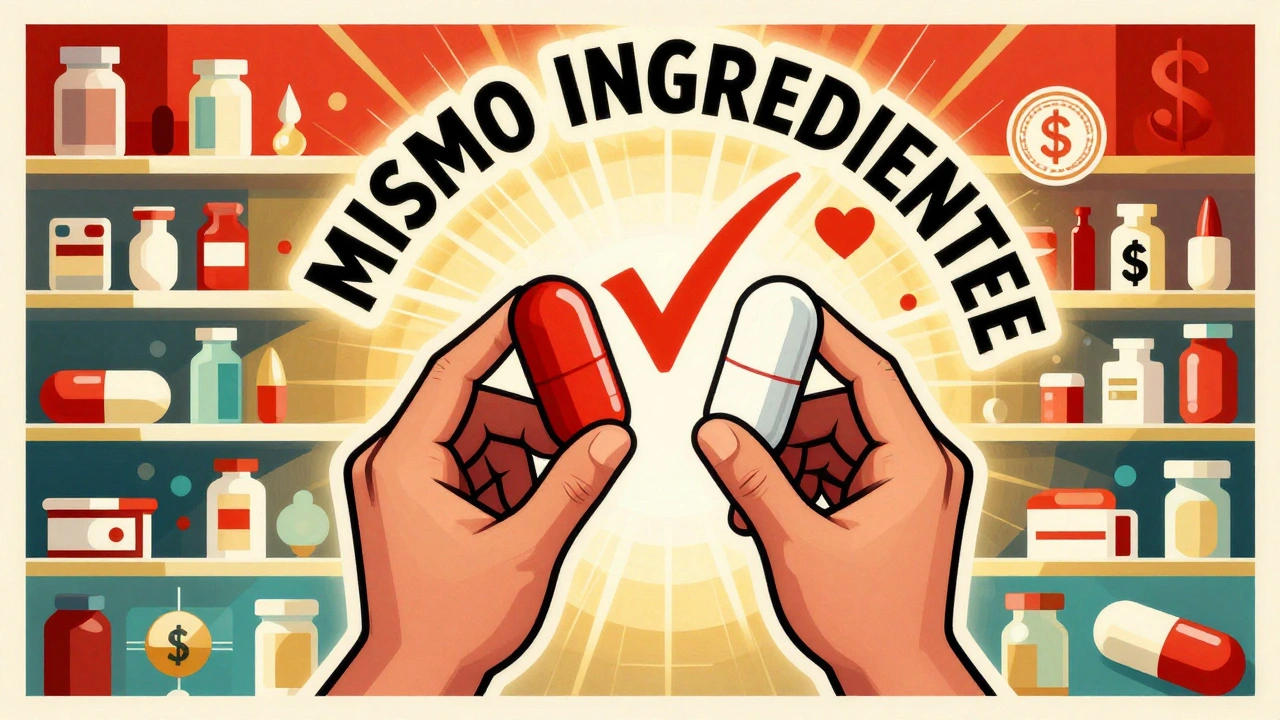
Many Spanish-speaking patients in the U.S. are told they can save money by switching to generic medications, but they don’t always understand what that really means. They see a pill that looks different-maybe a different color, shape, or size-and wonder if it’s the same medicine. Some stop taking it altogether, fearing it won’t work. Others don’t ask questions because they don’t know how to say, "Is this really the same as the brand?" or "Why does it look different?"
The truth is, generic medications contain the exact same active ingredients as brand-name drugs. They work the same way, in the same amount of time, and with the same safety profile. The only differences are in the inactive ingredients-like dyes or fillers-that affect how the pill looks or tastes, not how it works. But without clear, culturally appropriate information, patients are left guessing. That’s where Spanish-language resources come in.
What Spanish-Speaking Patients Need to Know About Generic Medications
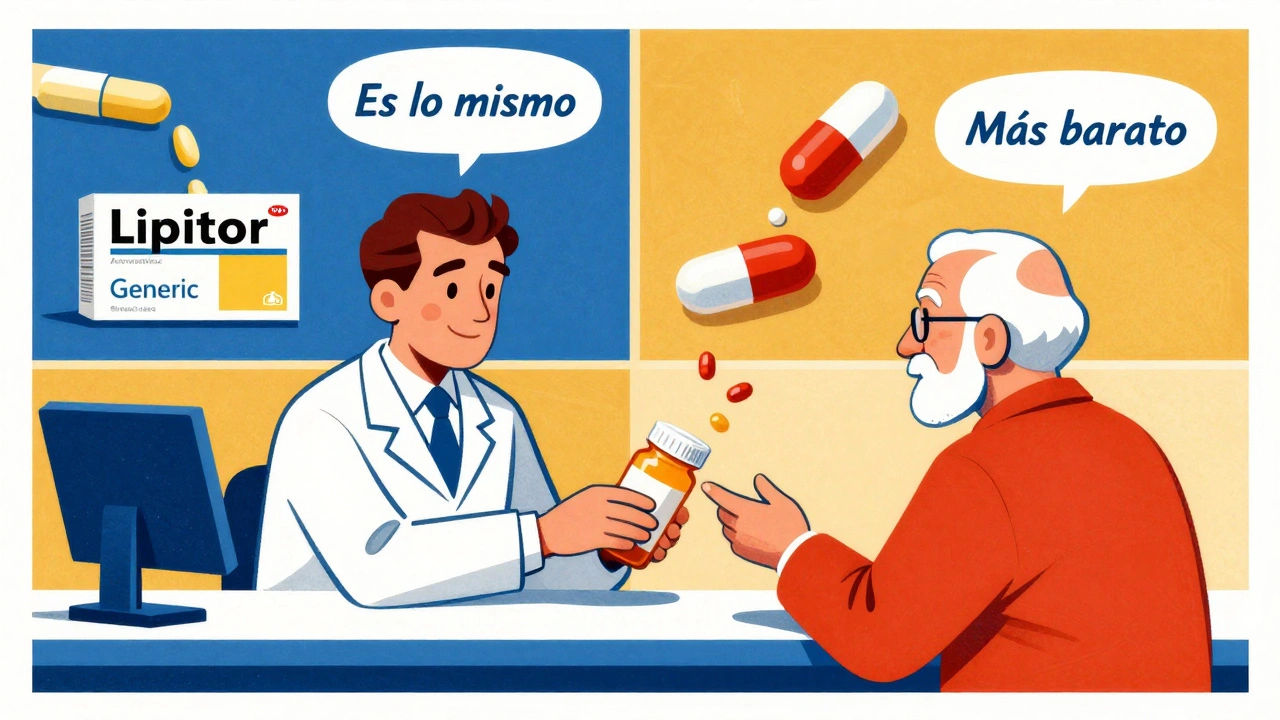
When a doctor prescribes a medication, the patient often hears the brand name: "Take Lipitor for your cholesterol." But when they pick it up at the pharmacy, they’re handed a pill labeled "atorvastatin." That’s the generic name. For someone who doesn’t speak English fluently, this switch can be confusing-and even scary.
Key facts every Spanish-speaking patient should understand:
- El medicamento genérico is the same medicine as the brand name, just cheaper.
- The FDA requires generic drugs to be bioequivalent-meaning they deliver the same amount of active ingredient into the bloodstream at the same rate.
- Generic versions may look different because of laws requiring visual distinction between brands and generics.
- Cost savings can be huge: generics cost, on average, 80-85% less than brand-name drugs.
- Switching between different generic manufacturers is safe-even if the pill looks different each time.
Patients often say: "La original es muy cara"-"The original is too expensive." That’s why they ask for generics. But without clear explanations, they fear they’re getting a weaker version. This fear leads to missed doses, treatment delays, and worse health outcomes.
Where to Find Trusted Spanish-Language Resources
Not all Spanish-language materials are created equal. Some are poorly translated. Others use regional terms that confuse patients from different countries. The best resources are clear, visual, and designed specifically for patient education.
Agency for Healthcare Research and Quality (AHRQ) offers a free, downloadable My Medicines List in Spanish. It’s one of the most practical tools available. Patients can write down:
- El nombre de marca (brand name)
- El nombre genérico (generic name)
- La razón por la que lo toma (why they take it)
- La dosis y frecuencia (dose and how often)
This simple list helps patients track their medications and talk clearly with pharmacists or doctors. It’s updated through December 2024 and used by clinics nationwide.
MedlinePlus.gov has a bilingual PDF guide titled Generic and Brand Name Medicines - español. It includes side-by-side comparisons of common drugs like metformin (Glucophage) and simvastatin (Zocor), showing both names and explaining equivalence in plain language.
Wake AHEC created a pocket-sized translation card for healthcare workers. It includes phrases like:
- "Esta medicina tiene una apariencia diferente, pero es lo mismo." (This medicine looks different, but it is the same.)
- "El medicamento genérico es igual de seguro y efectivo." (The generic medicine is just as safe and effective.)
These aren’t just translations-they’re tools to rebuild trust.
Why Visuals Matter More Than Words
Many patients don’t understand medical jargon, even in their native language. But they understand pictures.
A 2022 study from the University of Miami Miller School of Medicine found that using side-by-side images of brand and generic pills reduced confusion by 37%. That’s why Kaiser Permanente’s Spanish medication portal now includes photos of actual pills-both brand and generic-with labels showing the active ingredient.
One patient in Texas told her nurse: "Yo pensaba que las pastillas rojas eran más fuertes que las blancas." (I thought the red pills were stronger than the white ones.) She’d been switching between generics and assumed color meant strength. After seeing a visual chart showing that color only changed because of different manufacturers, she stopped skipping doses.
Resources that include QR codes linking to short videos in Spanish-showing real pharmacists explaining the difference-are becoming more common. The AHRQ updated its My Medicines List in February 2024 to include QR codes that play 60-second videos in Mexican, Puerto Rican, and Colombian Spanish dialects.
Regional Differences Can Confuse Patients
Not all Spanish is the same. A drug called "paracetamol" in Spain is called "acetaminofén" in Mexico, Colombia, and the U.S. The same pill. Different name. If a patient moves from Texas to Florida-or visits family in Puerto Rico-they might think they’re getting a different medicine.
Dr. Carlos Maldonado of the National Hispanic Medical Association says this is a major gap: "We have resources, but they rarely tell you that the same drug has different names in different countries. That’s not just confusing-it’s dangerous."
Some apps, like the NIH’s Medicamento Genérico app (launched in September 2023), now let users select their country of origin and show them the local name for each drug. It also includes audio pronunciations so patients can say the names correctly when asking for them at the pharmacy.
What Patients Are Really Saying
On Reddit’s r/MedicalSpanish forum, a thread titled "Generic med confusion" had 47 comments in just one month. Common themes:
- "El farmacéutico no me explicó que era lo mismo. Me dio otra pastilla y yo no la tomé." (The pharmacist didn’t explain it was the same. He gave me another pill, so I didn’t take it.)
- "Mi abuelo dejó de tomar su medicina porque dijo que era más débil. No sabía que era genérico." (My grandfather stopped taking his medicine because he thought it was weaker. He didn’t know it was generic.)
- "Me dieron un medicamento genérico y me dio náuseas. Pensé que era porque era más barato. Pero después supe que era un efecto secundario del mismo medicamento." (I got a generic and felt nauseous. I thought it was because it was cheaper. Later I learned it was the same side effect.)
One bilingual nurse shared: "I’ve had patients refuse generics because they thought different color pills meant different medicine. We need better visual resources explaining this."
A 2023 survey by the California Health Care Foundation found that 78% of Spanish-preferring patients felt more confident using generics after seeing bilingual guides. But 63% still worried they weren’t as effective. That’s not a failure of the medicine-it’s a failure of communication.
How Clinics and Pharmacies Are Getting Better
Some health systems are taking action. Kaiser Permanente’s Spanish medication portal, launched in late 2022, includes:
- Side-by-side photos of brand and generic pills
- Audio clips of medication names pronounced in Spanish
- A cost calculator showing monthly savings
- A chatbot that answers common questions in Spanish
In its first six months, patient calls about pill appearance dropped by 52%.
Other clinics now train staff for 10-15 hours on Spanish medication communication. Training includes:
- Recognizing regional terminology differences
- Using visual aids consistently
- Asking open-ended questions: "¿Qué le preocupaba sobre el medicamento genérico?" (What worried you about the generic medicine?)
And it’s working. Since 2015, bilingual medication resources have helped reduce medication errors by 23% among Spanish-preferring patients, according to Harvard Medical School.
What You Can Do Right Now
If you’re a Spanish-speaking patient or helping someone who is:
- Ask: "¿Tiene la versión genérica de esa medicina?" (Do you have the generic version?)
- Ask: "¿Es lo mismo que la marca?" (Is it the same as the brand?)
- Ask: "¿Por qué se ve diferente?" (Why does it look different?)
- Download the AHRQ My Medicines List in Spanish and fill it out with your medications.
- Use the NIH’s Medicamento Genérico app to check names, look at pill images, and hear how to say them.
If you’re a healthcare provider:
- Don’t assume patients understand the word "genérico." Show them a picture.
- Use the Wake AHEC phrases to explain equivalence.
- Keep printed copies of AHRQ and MedlinePlus guides in your waiting room.
- Ask: "¿Tiene alguna duda sobre los medicamentos que le dieron?" (Do you have any questions about the medicines you were given?)
Frequently Asked Questions
¿Qué es un medicamento genérico?
Un medicamento genérico es una versión más barata de un medicamento de marca que contiene el mismo ingrediente activo, en la misma dosis y forma. Funciona exactamente igual que la marca, pero no tiene el mismo color, forma o nombre comercial. La FDA lo aprueba como igualmente seguro y efectivo.
¿Por qué los medicamentos genéricos se ven diferentes?
Por ley, los medicamentos genéricos no pueden parecerse exactamente a los de marca. Por eso cambian el color, la forma o el sabor. Pero eso no significa que sean diferentes. El ingrediente que hace que funcione es el mismo. Muchos pacientes dejan de tomarlos por miedo, pero eso no es necesario.
¿Es seguro cambiar entre diferentes marcas de medicamentos genéricos?
Sí. Cada fabricante de medicamentos genéricos debe cumplir con los mismos estándares de la FDA. Si cambias de un genérico a otro, el efecto será el mismo. La única diferencia puede ser el color o la forma de la pastilla. No hay riesgo en cambiar entre fabricantes.
¿Qué pasa si en mi país se llama "paracetamol" y aquí me dan "acetaminofén"?
Son el mismo medicamento. "Paracetamol" es el nombre usado en España y algunos países europeos. "Acetaminofén" es el nombre usado en los Estados Unidos, México y la mayoría de América Latina. La FDA reconoce ambos nombres. Lo importante es que el ingrediente activo sea el mismo, no cómo se llama.
¿Dónde puedo encontrar una lista de medicamentos genéricos en español?
La Agencia para la Investigación y Calidad de la Atención Médica (AHRQ) tiene una lista gratuita llamada "Mi lista de medicamentos" en español. También puedes visitar MedlinePlus.gov y buscar "medicamentos genéricos y de marca". Ambos recursos incluyen nombres en español y explicaciones claras.

Yatendra S
December 13, 2025 AT 08:34This is so needed 💯 I saw my abuela throw out her blood pressure meds because the pills were blue instead of green. She thought the blue ones were "fake." We need more visual guides like this.
Lara Tobin
December 14, 2025 AT 01:14I work in a clinic and this hits home. So many patients just stop taking meds because they don't understand the difference. A simple picture can save lives. ❤️
kevin moranga
December 14, 2025 AT 01:28Man, I can't believe how much fear is out there just because of how a pill looks. I had a cousin who refused his diabetes meds for six months because the generic was round and white-he thought it was "water pills" or something. Once we showed him the FDA comparison chart? He cried. Not from sadness-from relief. We need to make these visuals standard in every pharmacy. It's not just education, it's dignity.
Keasha Trawick
December 14, 2025 AT 22:32This isn’t just about language-it’s about epistemic violence. The pharmaceutical-industrial complex weaponizes visual ambiguity to make patients feel like they’re getting the "cheap version" of their health. Color-coded placebo psychology meets bureaucratic inertia. And yet, the solution? A QR code and a photo. That’s the beauty of it. We don’t need more jargon-we need more *seeing*.
Alvin Montanez
December 15, 2025 AT 03:27Let’s be real-this whole issue exists because people won’t take responsibility for learning. If you can’t ask your pharmacist a simple question in English or Spanish, that’s on you. Why should the system bend over backward for people who refuse to engage? I’ve seen patients refuse to learn the names of their own meds. Then they wonder why they end up in the ER. This isn’t a systemic failure-it’s a personal one.
Tyrone Marshall
December 17, 2025 AT 00:54There’s a deeper layer here that nobody talks about: trust. For many immigrants, the pharmacy isn’t just a place to pick up medicine-it’s a symbol of whether this country will treat them fairly. If the pills look different every time, and no one explains why, it feels like a scam. That’s why the Wake AHEC cards matter. They’re not just translations-they’re reassurances. We’re not just teaching pharmacology. We’re rebuilding faith.
Tom Zerkoff
December 17, 2025 AT 21:14As a healthcare educator, I’ve trained dozens of staff on this exact issue. The most effective tool? A laminated card with side-by-side images of brand and generic pills, labeled in Spanish. We hand them out at discharge. The drop in follow-up calls was immediate. Formality doesn’t matter-clarity does.
Webster Bull
December 18, 2025 AT 09:36Just show the pics. That’s it. No lectures. No jargon. Just a photo and a "same medicine" stamp. Done. 🙌
Emily Haworth
December 18, 2025 AT 10:26Wait… what if the different pills are *actually* different? I heard a rumor that some generics are made in China and have fillers that cause inflammation. The FDA doesn’t test them the same way. I’ve seen people get rashes after switching. Are we being lied to?
John Fred
December 19, 2025 AT 08:10I love that the NIH app has audio pronunciations. My tía couldn’t say "acetaminofén" to save her life-she kept saying "acetaminophen" in English and the pharmacist didn’t get it. Now she just taps the app and shows them. Game changer. 📱❤️
Himmat Singh
December 19, 2025 AT 11:42One must question the underlying assumption that all patients are passive recipients of medical authority. The insistence on visual aids, while well-intentioned, may inadvertently infantilize Spanish-speaking populations. Should we not instead empower them through linguistic precision and critical engagement with pharmaceutical nomenclature? The solution is not simplification-it is intellectual emancipation.