
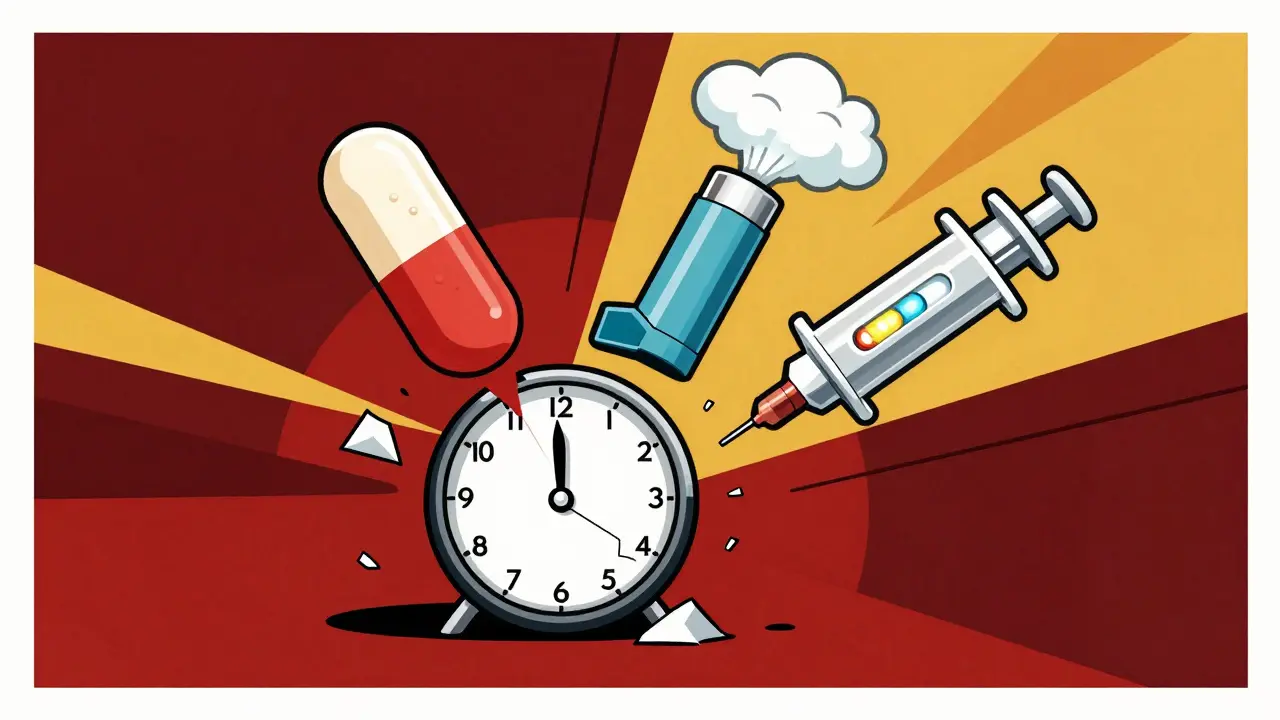
Generic drugs have long been the backbone of affordable healthcare. But the old model - copying a single active ingredient after patent expiry - is fading. Today, the real action is in generic combinations: smarter, more complex versions that combine multiple drugs, advanced delivery systems, or modified-release tech to deliver better outcomes. These aren’t just copies anymore. They’re upgraded versions designed to fix real problems: poor adherence, side effects, or ineffective dosing. And the market is responding fast.
What Exactly Are Generic Combinations?
Think of them as the next step beyond plain generics. A traditional generic pill has one drug, same dose, same shape as the brand. A generic combination does more. It might mix two drugs in one pill - like blood pressure meds - so patients take less often. Or it could pair a drug with a device, like an inhaler that automatically delivers the right dose every time. Some even change how the drug releases in your body: slow-release versions that last 12 hours instead of 4.
The FDA calls these combination products. They fall into three main buckets:
- Fixed-dose combinations (FDCs): Two or more drugs in one pill. Common in diabetes, hypertension, and HIV.
- Drug-device combinations: Drugs delivered through inhalers, auto-injectors, or pumps. Think EpiPen alternatives or insulin pens with built-in dose counters.
- Modified-release formulations: Extended-release, delayed-release, or targeted-release systems. These need advanced tech like hot-melt extrusion or lipid coatings to work right.
These aren’t easy to make. Getting them approved takes way more than proving chemical similarity. You need to show they work better - or at least as well - as the original brand. That means extra clinical studies, specialized testing, and detailed data on how the drug behaves in the body.
Why Are They Growing So Fast?
The numbers don’t lie. The super generics market - which includes all these advanced combinations - will hit $474.6 billion by 2035, up from $235.6 billion in 2025. That’s a 7.2% annual growth rate. Why? Three big reasons.
First, patent cliffs. Between 2025 and 2030, drugs worth $217-$236 billion in annual sales will lose patent protection. That’s a goldmine for companies that can build better versions. Take Trelegy Ellipta, a three-drug inhaler for COPD. It made $2.8 billion in 2024. A generic version that works just as well - but costs less - could capture a huge chunk of that market.
Second, patient needs. People don’t like taking five pills a day. They forget. They get side effects. Generic combinations solve this. A single pill with two blood pressure drugs cuts pill burden by half. An auto-injector with a built-in dose reminder helps diabetics stay on track. Better compliance means better outcomes - and fewer hospital visits.
Third, market pressure. Generics now make up 90% of U.S. prescriptions but only 20% of spending. That’s because most are cheap, low-margin products. Companies need to make more money per pill. Generic combinations deliver that. While regular generics lose 80-90% of their price within two years, complex versions hold onto 40-60% of their price for five years. That’s a game-changer.
How Do They Compare to Regular Generics?
Let’s break it down.
| Feature | Traditional Generics | Generic Combinations |
|---|---|---|
| Development Cost | $1-5 million | $15-50 million |
| Approval Time | 2-3 years | 4-7 years |
| Regulatory Hurdles | Standard ANDA | Complex ANDA + extra clinical data |
| Price Retention (5 years) | 10-20% | 40-60% |
| Market Share in Target Areas | 90%+ (low-margin) | 25-35% (high-margin) |
| Typical Competition | 15-20 manufacturers | 3-4 manufacturers |
Take bupropion, an antidepressant. The simple generic version sells for pennies. Total sales: $42 million. But Teva’s extended-release version, Budeprion XL, made $187 million before generics hit. Why? Because it worked better - slower release, fewer side effects, once-daily dosing. Patients and doctors preferred it. The price stayed higher. That’s the power of a smart combination.
But here’s the catch: these products aren’t for every drug. If a medicine has low sales or simple dosing, the cost to develop a combo just doesn’t pay off. They thrive where there’s high unmet need - like complex respiratory diseases, CNS disorders, or oncology combos. In those areas, only a handful of companies compete. That’s where margins stay healthy.
Regulatory Hurdles Are the Biggest Challenge
Getting approval isn’t just harder - it’s messier. The FDA doesn’t have one clear rulebook for these products. For a drug-device combo, they have to decide: Is this mainly a drug? Or mainly a device? That determines which team reviews it. The Office of Combination Products handles this, but it adds delays.
According to FDA data, 78% of failed applications aren’t because the drug doesn’t work. They fail because the delivery system doesn’t match the original. Maybe the inhaler doesn’t release the same amount. Maybe the tablet dissolves too fast. Even a 10% difference in dissolution can kill approval.
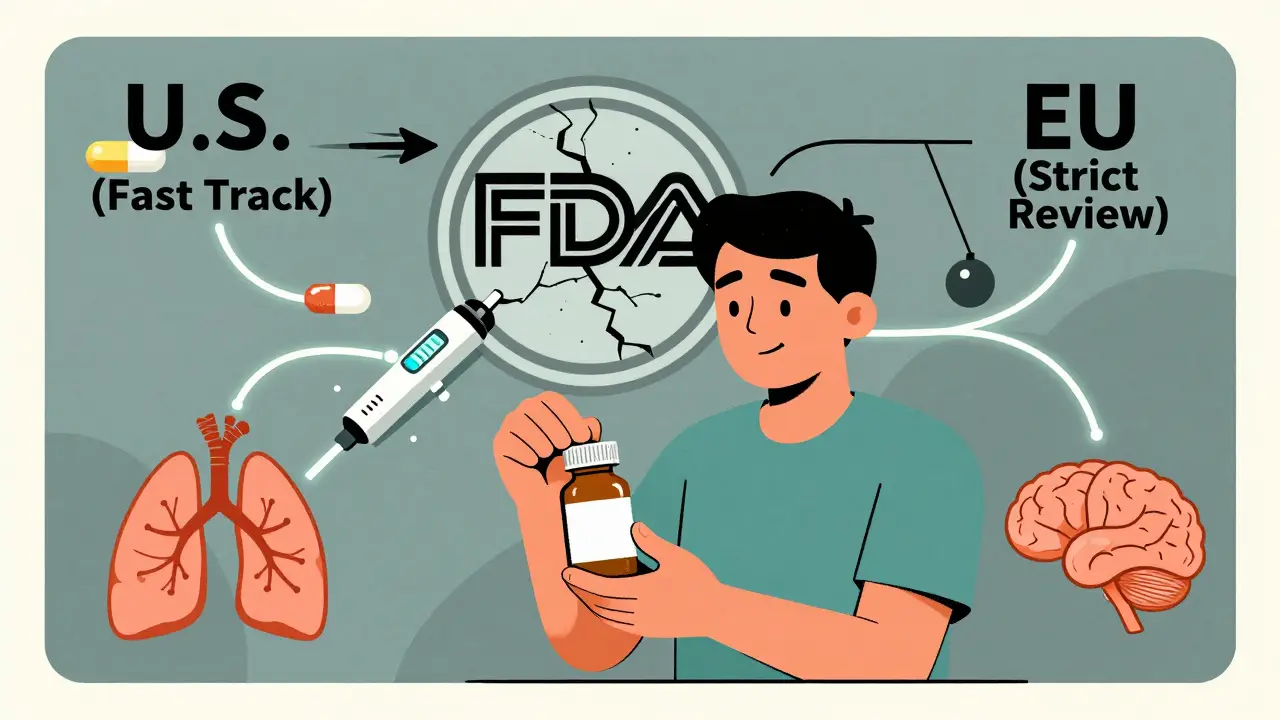
The EU is even stricter. Through Q1 2025, the U.S. approved 37 complex generic combinations. The EU approved 12. That gap isn’t random. It’s policy. The EMA demands more evidence. That means companies often launch in the U.S. first - then tackle Europe later. This regional split forces manufacturers to tailor their submissions. One product. Three different dossiers.
There’s hope, though. In October 2025, the FDA launched a pilot program to fast-track reviews for U.S.-made generic combinations. If you manufacture here, your review could be 3-6 months faster. That’s a big deal. It’s also a signal: the FDA wants more of these products made locally.
Who’s Leading the Charge?
The big players aren’t just chasing volume. They’re building expertise.
- Viatris - formed from the merger of Mylan and Upjohn - now focuses heavily on complex generics. Their $2.3 billion deal with Credence in 2025 was all about scaling up combo capabilities.
- Sandoz - now separate from Novartis - is betting big on high-value generics. They’re investing in inhalers, injectables, and modified-release tech.
- Aspen Pharmacare - one of the world’s largest generic manufacturers - is working on generic versions of semaglutide combos. That’s a $100+ billion market. If they nail it, they’ll control a major chunk of the obesity and diabetes space.
It’s not just pharma. Device makers are jumping in too. Catalent, a top contract manufacturer, is partnering with Hikma to build auto-injectors for generic insulin. These partnerships are becoming the norm. You can’t make a good drug-device combo without both sides working together.

The Future: Three Big Trends
What’s next? Three trends will shape the next decade.
- Increasing complexity premium. Products with two innovations - say, a combo pill with extended release and a tamper-resistant coating - will command 2-3x the price of a basic generic. That’s the new profit model.
- Regional regulatory divergence. The U.S. will keep moving faster. The EU and other markets will lag. Companies that can navigate both will win. Those who can’t? They’ll miss out on half the market.
- Strategic partnerships. Pharma + device + manufacturing = the new standard. No one can do it alone anymore. The winners will be the ones building alliances, not just pipelines.
By 2030, super generics could make up 35-40% of the total generics market value. That’s up from under 15% today. It’s not a side project anymore. It’s the core business.
Risks and Realities
Don’t get it twisted. This isn’t a free pass. IQVIA projects U.S. generic prices will jump 11.4% in 2025 - a big leap from last year’s 4.9%. But Morningstar warns: if companies don’t keep innovating, margins could drop 30% over the next decade. Why? Because competition always catches up. Once a combo patent expires, others copy the tech. The trick is to stay ahead.
Also, there’s a safety question. Harvard’s Dr. Aaron Kesselheim pointed out in NEJM 2025: we still don’t have clear standards for what makes a complex generic truly equivalent. A pill might look the same. But if it releases differently in older patients, or in people with kidney issues, it could fail silently. That’s a risk regulators are only starting to address.
Still, the direction is clear. The future of generics isn’t in making more cheap pills. It’s in making smarter ones. The patients who need them the most - those with chronic conditions, multiple meds, or complex health needs - deserve better. And the market is finally building it.
What’s the difference between a generic drug and a generic combination?
A generic drug copies a single active ingredient from a brand-name drug. A generic combination adds something extra: it might combine two drugs in one pill, use a special delivery system like an inhaler, or change how the drug is released in the body. These changes aim to improve effectiveness, reduce side effects, or make it easier for patients to take their medicine.
Why are generic combinations more expensive to develop?
They require advanced formulation tech - like lipid coatings or hot-melt extrusion - plus extra clinical studies to prove they work as well as the original. Testing how a drug is delivered through a device or how it releases over time takes more time, equipment, and expertise. That’s why development costs range from $15 million to $50 million, compared to $1-5 million for a simple generic.
Are generic combinations as safe as brand-name drugs?
Yes - if they’re approved properly. The FDA requires generic combinations to meet the same safety and effectiveness standards as the original brand. But because they’re more complex, the testing is more detailed. The risk comes from poorly designed products that don’t match the original delivery system. That’s why regulatory oversight is so critical.
Why is the U.S. market ahead of Europe in approving these products?
The FDA has taken a more flexible approach to reviewing combination products, especially since 2020. The EMA, by contrast, demands more evidence of clinical superiority and has stricter standards for equivalence. As of Q1 2025, the U.S. approved 37 complex generic combinations; the EU approved only 12. This gap gives U.S. manufacturers a head start.
Which therapeutic areas are seeing the most growth in generic combinations?
Oncology is growing fastest, at 11.3% CAGR, driven by combo therapies for cancer. Respiratory follows at 9.9% CAGR - think inhalers for COPD and asthma. CNS disorders like Parkinson’s and depression are growing at 8.7% CAGR. These areas have high unmet needs, complex dosing, and strong patient demand - making them ideal for advanced generics.
Can generic combinations replace branded drugs entirely?
They already are - in many cases. For example, when the branded version of a complex inhaler expires, the first generic combo often captures over 60% of the market within a year. Patients and insurers prefer them because they’re cheaper and just as effective. The difference is no longer about brand - it’s about innovation.
Generic combinations aren’t just a trend. They’re the new normal. The days of cheap, one-size-fits-all generics are ending. The future belongs to smarter, better-designed products that actually improve lives - and that’s exactly what’s being built right now.


Kandace Bennett
March 15, 2026 AT 02:46OMG this is literally the future 🥳 I’ve been saying this for YEARS! Who even cares about some boring old single-pill generic anymore? 🤡 It’s all about combos now - like, imagine a single pill that’s got BP meds + a slow-release timer + a built-in reminder chip? 🤯 We’re not just treating diseases, we’re upgrading the human experience. FDA better not slow this down or I’m moving to Canada. 🇺🇸💪
douglas martinez
March 15, 2026 AT 04:28While the innovation in combination products is commendable, one must not overlook the foundational principle of bioequivalence. The regulatory framework, though evolving, must remain anchored in rigorous pharmacokinetic and pharmacodynamic data. Any deviation risks compromising patient safety under the guise of innovation. The FDA’s pilot program is a step forward, but transparency in analytical validation remains paramount.
Devin Ersoy
March 16, 2026 AT 08:23Oh please. You think this ‘super generic’ nonsense is revolutionary? Nah. It’s just Big Pharma’s way of stretching patents with fancy packaging. Hot-melt extrusion? Lipid coatings? Sounds like a chemistry textbook chapter, not a medical breakthrough. And don’t get me started on ‘drug-device combos’ - you mean like an inhaler with a Bluetooth chip? Next they’ll sell you a pill that texts your therapist. 😏 The real innovation? Charging $12 for something that costs 7 cents to make. That’s the only combo that’s actually working.
Scott Smith
March 17, 2026 AT 13:51This is actually one of the most important shifts in healthcare I’ve seen in a decade. When patients can take one pill instead of five, adherence improves dramatically - and that’s not just a convenience, it’s a lifesaver. I’ve worked with chronic disease patients for 18 years. The difference between a 90% adherence rate and a 60% rate isn’t statistical - it’s clinical. These combinations aren’t just smart business. They’re ethical medicine. Let’s not get distracted by the cost or complexity. The outcome matters.
Sally Lloyd
March 18, 2026 AT 13:21Did you know the FDA’s ‘fast-track’ pilot is actually a backdoor for Chinese manufacturers to sneak in counterfeit devices? I’ve seen the reports. The ‘U.S.-made’ label is a joke. The real supply chain is in Shenzhen. This whole ‘super generic’ movement? It’s a smokescreen. The real agenda is replacing American jobs with automated factories and then billing Medicare for ‘innovation.’ I’m not paranoid - I’m informed.
Rosemary Chude-Sokei
March 18, 2026 AT 15:10It is undeniable that the convergence of pharmaceutical science with advanced delivery systems represents a paradigm shift in therapeutic accessibility. The structural complexity of these combination products necessitates a recalibration of regulatory paradigms, particularly in the context of bioequivalence metrics for non-systemic delivery. That said, one must acknowledge the disproportionate burden placed on smaller manufacturers who lack the capital to navigate the multi-jurisdictional submission requirements. The regulatory divergence between the FDA and EMA, while economically rational, may inadvertently entrench market monopolies rather than foster competition. A harmonized global framework - even if phased - would be a more equitable path forward.
rakesh sabharwal
March 18, 2026 AT 23:39Let’s be real - this whole ‘generic combo’ narrative is just corporate jargon for ‘we’re still selling the same drugs but now with a $20 markup.’ Hot-melt extrusion? That’s just a fancy term for ‘we heated it differently.’ And don’t get me started on ‘modified-release’ - it’s just a delayed-release with a patent on the word ‘smart.’ Meanwhile, real innovation - like gene therapy or CRISPR - is being sidelined because it’s too expensive for pharma to monetize. This isn’t progress. It’s rebranding. And the regulators are complicit.
Kathy Leslie
March 20, 2026 AT 11:17My grandma takes five pills a day. She forgets half of them. Last month she got a combo pill for her BP and diabetes - just one a day. She cried. Said she finally felt like she could breathe again. I don’t care if it’s ‘just’ a generic combo. It gave her back her life. That’s all that matters.