
Why expiration dates on medicine matter more than you think
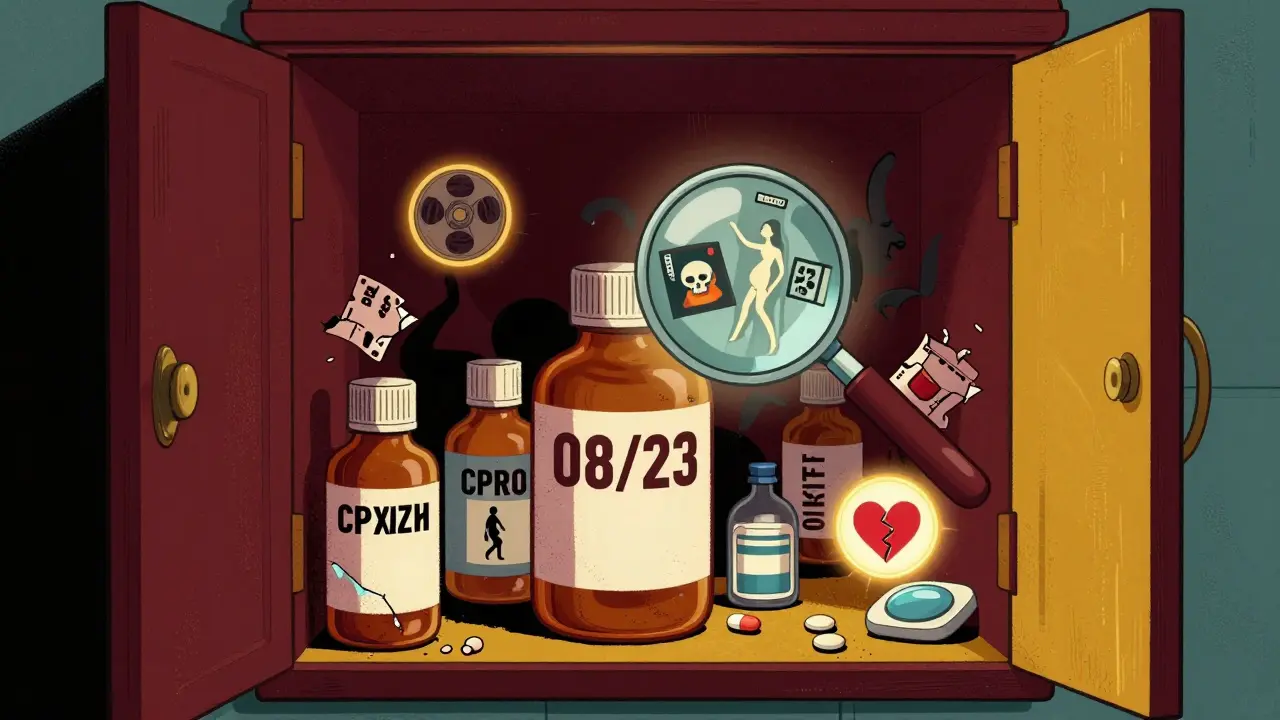
You grab your painkiller from the bathroom cabinet, notice the date on the bottle, and wonder: is it still good? Most people assume expired meds are just less effective. But that’s not the whole story. Some pills lose strength slowly. Others can turn dangerous. The difference between safe and risky isn’t always obvious - especially when labels use confusing formats like 08/23, Exp 2025, or Use By 12/24.
Manufacturers don’t pick expiration dates randomly. They test each drug under heat, humidity, and light for years to see how long it stays stable. The date you see is the last day they guarantee it will work as intended. After that, it might still be safe - but you can’t be sure. And for some medicines, being unsure isn’t worth the risk.
How to find the real expiration date on your meds
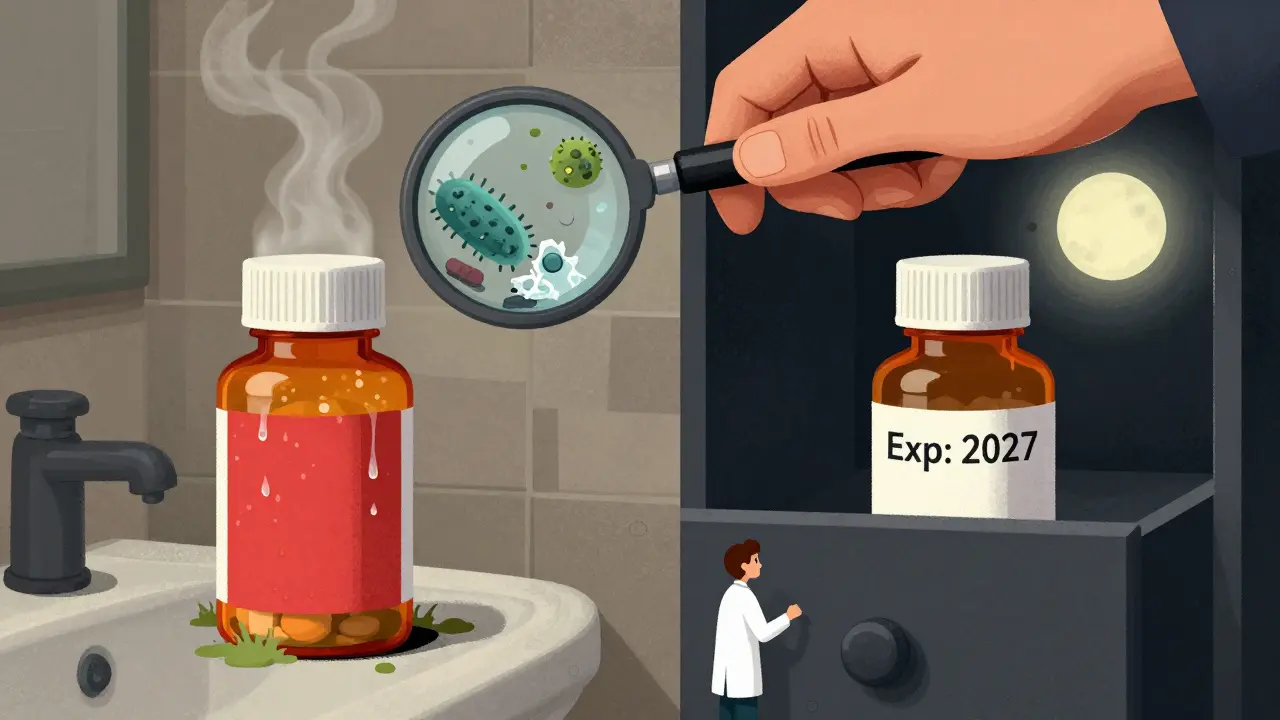
Look at two places: the original bottle from the pharmacy and the box the medicine came in. Often, the pharmacy label says "Discard after 12/25" - but that’s not the manufacturer’s date. It’s a pharmacy rule. Most pharmacies set a 1-year limit for prescriptions, even if the drug itself lasts longer. For example, your antibiotic might have a manufacturer expiry of 2027, but the pharmacy puts "do not use after 12/25" because liquid antibiotics break down fast.
Check for these common labels:
- Exp: 08/23
- Expiry: August 2023
- Use by: 2025-07-15
- Expires: 15/07/2025
If you see just a month and year - like 08/23 - it means the medicine expires on the last day of that month. So 08/23 = August 31, 2023. Don’t assume it’s August 1st.
Some countries use different formats. In Australia and Europe, it’s usually day/month/year. In the U.S., it’s often month/year. If you’re unsure, check the box or call your pharmacist. The FDA requires clear dates in the U.S., but not all labels follow that perfectly.
What happens when medicine expires?
Most expired drugs don’t turn toxic. But they do lose strength. That’s a big deal. If your antibiotic is only 70% as potent, it might not kill all the bacteria. That’s how antibiotic resistance starts. Your body ends up fighting a stronger infection because the medicine didn’t work right.
Some meds degrade into harmful chemicals. Tetracycline was once known to cause kidney damage after expiration - but modern versions don’t have that problem. Still, other drugs can grow mold or bacteria if preservatives break down. Eye drops are especially risky. Once opened, they’re exposed to air and germs. Even if the date hasn’t passed, if it looks cloudy or smells weird, toss it.
Temperature matters. If you left your insulin in a hot car or your thyroid pills in a steamy bathroom, they can break down long before the printed date. Always store meds where it’s cool, dry, and dark. The fridge is fine for some, but not all. Read the label.
Which medicines are dangerous after expiration?
Not all expired drugs are equal. Some are fine. Others could kill you.
Avoid expired versions of these:
- Insulin - loses potency fast. A weak dose can send blood sugar dangerously high.
- Birth control pills - even slight degradation can lead to unintended pregnancy.
- Thyroid meds - if you’re not getting the right dose, your metabolism goes haywire.
- Anti-platelet drugs (like aspirin for heart health) - if they’re weak, you’re at higher risk of clotting.
- Epinephrine auto-injectors (EpiPens) - if they don’t work during an allergic reaction, it’s life-threatening.
For common painkillers like ibuprofen or acetaminophen, a few months past expiry is usually okay if stored well. But if it’s been years? Don’t risk it. You might not get relief - and you’ll be tempted to take more, which increases side effects.
How to avoid confusion at the pharmacy
When you pick up a prescription, ask the pharmacist: "Is this the manufacturer’s expiry date?" Many pharmacies only print their own "discard after" date. That’s fine for most cases - but not if you’re traveling, storing meds long-term, or need to know if it’s still good after a year.
Request that they write the original manufacturer’s date on the bottle. If they say no, keep the original box. That’s your backup. Same with OTC meds. Don’t throw away the box. You’ll need it when you’re checking dates months later.
Also, look for the DIN (Drug Identification Number) on Australian labels. It’s a 8-digit code that tells you the product is approved by Health Canada or the TGA. If it’s missing, the product might not be legitimate.
Storage is just as important as the date
Your medicine might expire in 2027 - but if you keep it in a sunny windowsill or a steamy bathroom, it could be ruined by next year. Heat, moisture, and light are the enemy.
Store pills in a cool, dry drawer. Not the bathroom. Not the kitchen. Not the car. A bedroom drawer or a cabinet away from the sink is ideal. Some meds - like insulin, certain antibiotics, and suppositories - need refrigeration. Check the label. If it says "refrigerate," keep it between 2°C and 8°C. Don’t freeze it.
Pro tip: If you’re going on a trip, carry meds in your carry-on. Checked luggage can get too hot or too cold. Airplane cargo holds can hit -20°C or over 40°C. That’s enough to ruin most drugs.
What to do with expired medicine
Don’t flush it. Don’t throw it in the trash. Don’t give it to someone else.
In Australia, take expired or unwanted meds to any pharmacy for free disposal. They have special bins for safe destruction. Some local councils also run drug take-back days. The goal is to keep them out of waterways and off the streets.
If you can’t get to a pharmacy, mix pills with coffee grounds or cat litter in a sealed bag before tossing. This makes them unappealing and harder to misuse. Liquid meds? Pour them into a sealed container with sawdust or dirt. Label it "Do Not Use."
Smart tools to track your meds
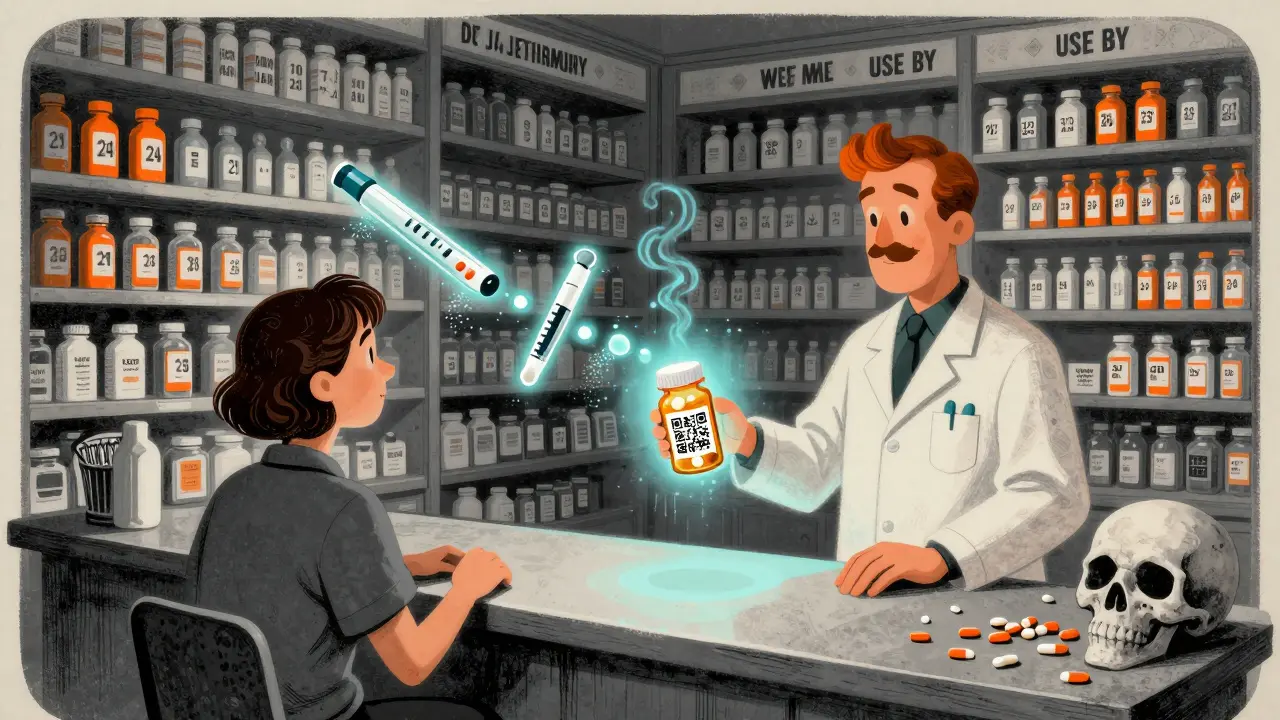
Trying to remember which pill expires when? Use an app. MedSafe (Australia), MyTherapy, or Medisafe let you scan barcodes or enter dates. They send alerts before your meds expire.
Or go old-school: write the expiry date on masking tape and stick it to the bottle. Do it the day you get it. That way, you never have to dig through old boxes.
Some pharmacies now offer digital labels with QR codes. Scan it, and you’ll see real-time expiry info, storage tips, and recall alerts. It’s still rare, but it’s coming. Merck started using smart labels for insulin in late 2022. Expect more in 2025.
What experts say about expired meds
A 2023 study by the FDA found that 90% of drugs tested were still effective years after expiry - if stored perfectly. But that was in military stockpiles, sealed, climate-controlled. Your medicine? Not the same.
Dr. Sarah Pace, an internal medicine doctor, says: "I tell patients to never take expired insulin, birth control, or heart meds. For ibuprofen? If it’s been 6 months past the date and stored in a cool drawer, it’s probably fine. But if it’s been 5 years? Toss it. Better safe than sorry."
And here’s the truth: most people don’t know the difference between "use by" and "expiry." A 2022 study found 68% of older adults thought expired medicine was instantly dangerous. It’s not. It’s just unreliable. That’s why clear labeling matters.
Final checklist: Are your meds still good?
Before you take any pill, ask yourself:
- Is the date clearly printed? (If it’s smudged, toss it.)
- Is it past the manufacturer’s expiry date? (Not just the pharmacy’s discard date.)
- Is it one of the high-risk meds? (Insulin, birth control, thyroid, EpiPen?)
- Has it been stored properly? (No heat, no moisture, no sunlight?)
- Does it look, smell, or feel weird? (Discolored, cracked, powdery, cloudy?)
- Do I have the original packaging or a DIN number to verify it?
If any answer is "no," don’t take it. Go to your pharmacy. They’ll replace it for free if it’s expired and you’re still using it. No judgment. Just safety.

Rich Robertson
December 16, 2025 AT 12:10I used to toss all my meds the second they hit expiry, but after reading this I realized I was being way too paranoid. My ibuprofen from last year? Still fine. My EpiPen? Definitely not. Learned the hard way when my dog got stung and I almost used an expired one. 🤦♂️
Now I keep the original boxes and write the real expiry on masking tape. Game changer.
Tim Bartik
December 17, 2025 AT 17:42USA RULES!!! We got the BEST meds in the world, no one else even comes close. Those damn Europeans with their day/month/year nonsense? Pure chaos. And why the hell are we listening to Australia? They think kangaroos are medical advisors. 🇺🇸💪
Sinéad Griffin
December 18, 2025 AT 19:02OMG YES!! I just threw out my birth control last week bc the date was smudged 😭 my pharmacist was like 'honey, it's fine' but I was like NOPE. I'd rather be on Plan B than risk it. 💊🫀 #betterSafeThanSorry
Edward Stevens
December 19, 2025 AT 16:43Ah yes, the classic 'pharmacy discard date' vs 'real expiry date' confusion. I love how we’ve turned healthcare into a scavenger hunt where the prize is not dying from a weak antibiotic. 🎉
Also, why is it that the only people who actually read the fine print are the ones who already have a PhD in pharmacology?
Daniel Thompson
December 21, 2025 AT 13:13The scientific literature on pharmaceutical stability is extensive and well-documented. The FDA’s Shelf Life Extension Program demonstrates that under controlled conditions, many compounds retain potency beyond labeled expiration dates. However, real-world storage variables-such as thermal cycling, humidity exposure, and light degradation-introduce significant uncertainty. Therefore, while the data supports potential efficacy, clinical prudence dictates adherence to manufacturer-recommended timelines for high-risk medications.
Daniel Wevik
December 22, 2025 AT 07:26Let me break this down for you: Expiration dates are not arbitrary. They’re the result of accelerated stability testing under ICH guidelines. The degradation kinetics of active pharmaceutical ingredients are modeled using Arrhenius equations. For high-risk meds like insulin or epinephrine, the margin of error is nanograms per milliliter. You don’t gamble with pharmacokinetics. Period.
And yes-bathroom storage is a death sentence for most pills. Moisture = hydrolysis = loss of potency. Simple chemistry.
Rulich Pretorius
December 24, 2025 AT 01:15I’ve been a pharmacist in Cape Town for 22 years. I’ve seen people take expired antibiotics because they couldn’t afford a new script. It’s heartbreaking. The science says it might still work-but the human cost? That’s the real expiration date.
Don’t just check the label. Ask yourself: is this worth my life? If the answer isn’t a hard yes, walk to the pharmacy. They’ll help you. No shame.
Thomas Anderson
December 25, 2025 AT 13:48I just keep all my pills in a shoebox under my bed. Cold, dry, no sun. I write the date on the bottle with a sharpie. Done. No apps needed. If it looks funny, smells weird, or I can’t read the date? Toss it. Simple.
Wade Mercer
December 25, 2025 AT 20:34People who take expired meds are just one step away from being the reason we have superbugs. You think you're saving money? You're just funding the next pandemic. Wake up.
Dwayne hiers
December 26, 2025 AT 14:04The degradation profile of tetracycline derivatives is well-characterized in the literature-epimerization at C4 leads to anhydrotetracycline, which is nephrotoxic. Modern formulations mitigate this, but the degradation pathways for beta-lactams, nitroglycerin, and insulin remain clinically significant. Always verify storage conditions per USP <659>. If the label says 'refrigerate,' do not deviate.
Jonny Moran
December 28, 2025 AT 07:20I used to be the guy who hoarded every pill I ever got. Then my grandma got sick from an expired thyroid med. She didn’t make it. That day I stopped being lazy and started being responsible.
If you’re reading this and you’ve got a drawer full of old bottles? Do yourself a favor. Clean it out. It’s not about being neat-it’s about being alive.
Sarthak Jain
December 28, 2025 AT 08:21I live in India and we get a lot of fake meds here. So I always check the DIN or the batch number. If it’s not there? I don’t touch it. Also, my pharmacist told me to store my asthma inhaler in the fridge if it’s hot outside. I didn’t know that! Thanks for the tip 🙏
Alexis Wright
December 28, 2025 AT 11:11Let’s be brutally honest: the entire pharmaceutical industry is built on fear. They want you to believe your ibuprofen turns into poison after 12 months so you’ll buy new ones. The FDA’s own data shows 90% of drugs are still potent years later. But they won’t tell you that, will they? Because profit > safety.
And yet, you’ll still blindly trust a pharmacy’s 1-year discard date because you’re too scared to think for yourself. Pathetic.