
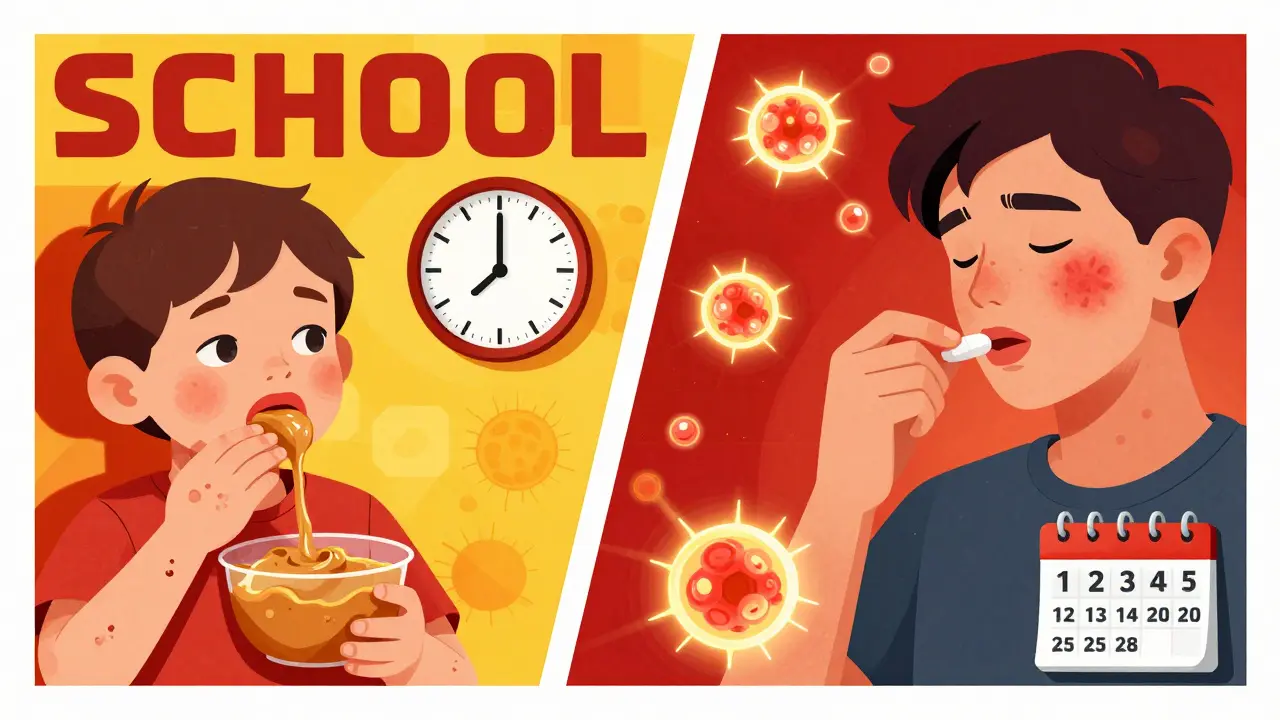
When your body reacts badly after eating something or taking a pill, it’s easy to assume it’s an allergy. But not all reactions are allergies-and mixing up food allergies with medication allergies can lead to serious mistakes. One person avoids peanut butter because they broke out in hives after eating it. Another refuses all antibiotics because they got a rash after taking amoxicillin. Sounds similar? They’re not. The way your immune system responds to food versus medicine is different, and knowing the difference could save your life-or at least keep you from missing out on safe, effective treatments.
How Food Allergies Work
Food allergies happen when your immune system sees a harmless food protein as a threat. The most common type is IgE-mediated, which triggers a rapid response. In 90% of acute food reactions, your body releases histamine and other chemicals within minutes. That’s why symptoms like itching in the mouth, swelling of the lips or tongue, hives, vomiting, or trouble breathing show up so fast-usually within 20 minutes and almost always within two hours.
Eighty percent of childhood food allergies start before age five. Milk, eggs, peanuts, tree nuts, soy, wheat, fish, shellfish, and sesame are the top culprits. What’s surprising is how often kids outgrow them. About 80% of children with milk or egg allergies lose their sensitivity by age five. That’s why regular follow-ups with an allergist matter-you don’t want to avoid safe foods for life just because you had a reaction once as a toddler.
Not all food reactions are allergies. Some people have intolerances-like lactose intolerance-where the gut can’t digest a sugar, leading to bloating or diarrhea. But there’s no immune system involvement. The key difference? Intolerances don’t cause anaphylaxis. Only true allergies do. And if you’re not sure which one you have, don’t guess. Keep a food-symptom diary. Write down exactly what you ate, how it was prepared, and when symptoms started. Precision matters. A reaction that happens every time you eat grilled chicken but never when it’s boiled? That’s a clue.
How Medication Allergies Are Different
Medication allergies aren’t as straightforward. They can be IgE-mediated, like food allergies, but they’re often T-cell mediated, which means the reaction is delayed. That’s why a rash from an antibiotic might not show up for days-or even weeks. You might take amoxicillin for a sinus infection, feel fine for three days, then break out in a full-body rash. That’s not a bug or a heat rash. It’s a delayed immune response.
While food allergies usually hit the skin, mouth, and gut, medication allergies often involve the skin and system-wide symptoms. Think fever, swollen lymph nodes, joint pain, or liver inflammation. Conditions like DRESS (Drug Reaction with Eosinophilia and Systemic Symptoms) or Stevens-Johnson Syndrome can be life-threatening. These aren’t typical food allergy patterns.
Here’s the kicker: up to 90% of people who say they’re allergic to penicillin aren’t. They had a rash as a kid, were told to avoid it, and never got tested. Years later, they’re stuck with expensive, less effective antibiotics that increase their risk of dangerous infections like C. diff. A simple skin test or oral challenge under medical supervision can clear that up. The FDA-approved ImmunoCAP® Penicillin blood test, introduced in 2023, is 98% accurate at ruling out true penicillin allergy. If you’ve been avoiding penicillin for decades, get tested. It’s safer than guessing.
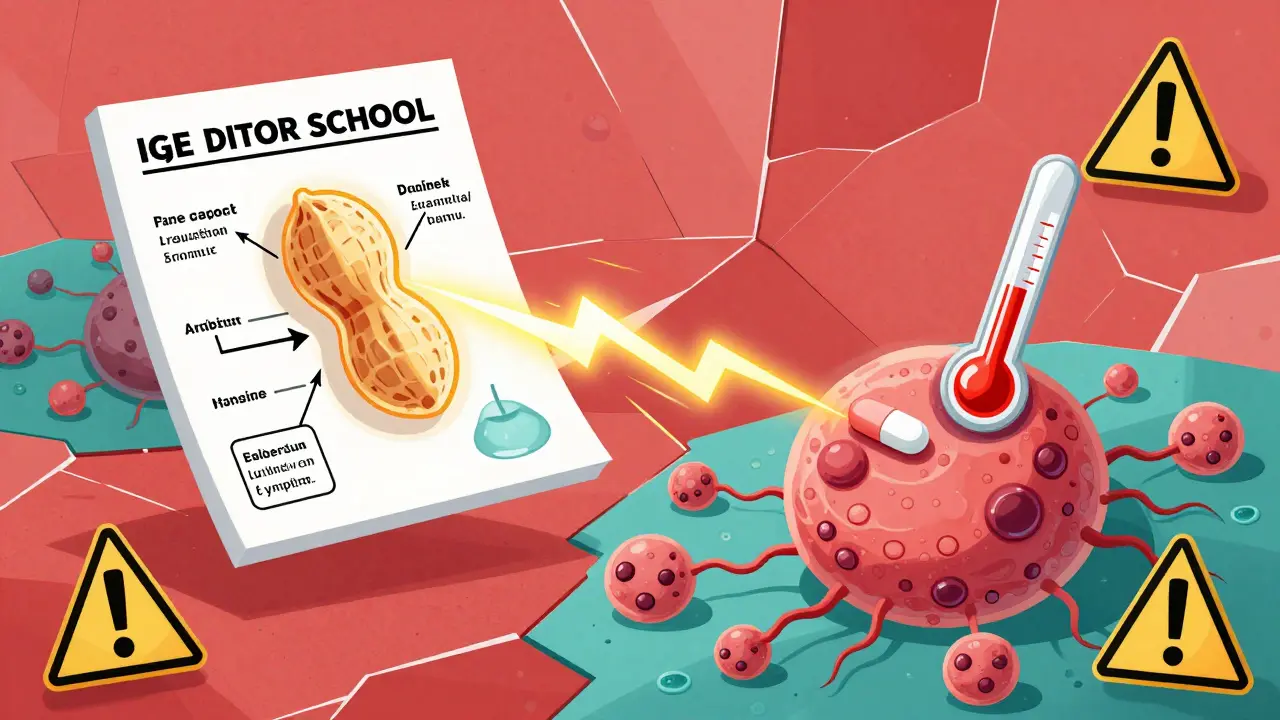
Timing Is Everything
One of the clearest ways to tell them apart is timing. Food allergies almost always strike fast. 95% of reactions happen within two hours. If you eat shrimp and your throat closes up 45 minutes later? That’s a food allergy. If you took a new painkiller and got a rash five days later? That’s likely a medication reaction.
Medication allergies have two distinct windows: immediate (within an hour) and delayed (48 to 72 hours or longer). Immediate reactions look like hives, wheezing, or low blood pressure-similar to food allergies. But delayed reactions? They’re more likely to be rashes, blistering, or organ inflammation. The same drug can cause two completely different reactions in the same person, depending on how the immune system responds.
Food allergies? Reproducible. If you react to peanuts once, you’ll likely react every time. Medication reactions? Not always. You might take ibuprofen once and get a rash. Take it again next month, and nothing happens. That doesn’t mean you’re safe-it means the immune system didn’t fully engage that time. That’s why doctors don’t just rely on your word. They look at patterns over time.
Diagnosis: What Tests Actually Work
For food allergies, skin prick tests and blood tests (like IgE-specific tests) are reliable. But the gold standard is the oral food challenge-eating the suspected food under medical supervision. It’s not risky if done right. In fact, it’s the only way to confirm if you’ve outgrown an allergy. Over 95% of these challenges give clear answers.
For medications, it’s trickier. Skin tests work well for penicillin and some other drugs. But for many others, like sulfa drugs or anticonvulsants, there’s no reliable skin or blood test. That’s where drug provocation testing comes in-giving you a tiny, controlled dose under watchful eyes. It’s not done lightly, but for someone who’s been labeled allergic to a life-saving drug, it’s worth it.
Component-resolved diagnostics (CRD) are changing food allergy testing. Instead of just testing for “peanut,” you test for specific proteins like Ara h 2 (true allergy) or Ara h 8 (cross-reactivity with birch pollen). That means you might test positive for peanut but actually be fine eating it. You just have pollen allergies. This level of detail prevents unnecessary food avoidance.
What Happens When You Get It Wrong
Misdiagnosing a food allergy as a medication allergy-or vice versa-has real consequences. Someone told they’re allergic to penicillin might be given vancomycin instead. Vancomycin is more expensive, harder on the kidneys, and increases the risk of antibiotic-resistant infections. A 2022 study in JAMA Internal Medicine found that 15-20% of antibiotic avoidance was based on false allergy labels.
On the flip side, someone who thinks their stomach ache is just indigestion but is actually having a food allergy reaction might delay epinephrine. That’s deadly. In the U.S., 150-200 people die each year from food-induced anaphylaxis, mostly because they didn’t recognize the signs or didn’t carry their epinephrine auto-injector.
And then there’s the emotional toll. Food allergy sufferers live with constant anxiety. 65% worry about accidental exposure at restaurants or school. Medication-allergic people? They worry about emergency care. Both are valid. But if you’re mislabeled, your anxiety is based on a mistake.
What You Can Do Right Now
- If you suspect a food allergy, keep a detailed diary: food, time, symptoms, preparation method. Don’t guess. Track.
- If you think you’re allergic to a medication, don’t just avoid it forever. Ask your doctor about testing. Especially for penicillin.
- Never self-diagnose. A rash after a pill doesn’t automatically mean allergy. Viral infections can cause rashes too.
- Bring your list of suspected allergies to every doctor visit. Say: “I’ve been told I’m allergic to X, but I’ve never been tested.”
- If you’ve had anaphylaxis, carry two epinephrine injectors. Always. And teach someone how to use them.
Bottom line: Food allergies are fast, repeatable, and often childhood-onset. Medication allergies are slower, more varied, and can develop at any age. The biggest myth? That if you had a reaction once, you’re always allergic. Not true. Especially with meds. The best defense? A specialist. An allergist doesn’t just test for allergies-they help you understand them. And that’s worth the appointment.
Can you outgrow a medication allergy like you can with food allergies?
Yes, but it’s less common and harder to confirm. Unlike food allergies, where children often outgrow milk or egg allergies by age five, medication allergies don’t follow the same pattern. Some people lose sensitivity over time, especially if they avoid the drug for years. But without formal testing-like a drug challenge-you can’t be sure. For penicillin, studies show up to 80% of people who had a reaction 10+ years ago can tolerate it again. That’s why retesting is recommended, especially before surgeries or if you need antibiotics.
If I had a rash after taking an antibiotic, does that mean I’m allergic?
Not necessarily. Many rashes after antibiotics are not true allergies. In fact, up to 90% of people who report a penicillin allergy aren’t allergic when tested. Viral infections like mononucleosis or roseola can cause rashes when combined with antibiotics. The rash isn’t caused by the drug-it’s caused by the virus. That’s why doctors look at timing: if the rash appeared during a viral illness and faded after stopping the drug, it’s likely not an allergy. Only a specialist can tell the difference.
Are food allergy tests always accurate?
Skin and blood tests for food allergies are good but not perfect. They can give false positives-meaning you test positive but can eat the food without a reaction. That’s why the oral food challenge is the gold standard. It’s the only test that proves whether your body truly reacts. If you’ve been avoiding a food for years because of a positive test, talk to an allergist about a challenge. You might be able to eat it safely again.
Can you be allergic to a medication without knowing it?
Yes. Many people don’t realize they’re allergic until they’re exposed again. A mild rash or stomach upset might have been dismissed as something else. But the next time you take the drug, your immune system may react more strongly. That’s why it’s important to report even minor reactions to your doctor. A small rash, nausea, or dizziness after a new medication could be the first sign of a true allergy. Don’t wait for anaphylaxis to get tested.
What should I do if I think I’m allergic to a medication I need?
Don’t refuse it outright. Ask your doctor to refer you to an allergist. For many drugs, especially antibiotics, there are safe ways to test whether you’re truly allergic. Penicillin testing, for example, involves skin tests and a supervised oral dose. If you pass, you’re no longer labeled allergic. This opens up safer, cheaper, more effective treatment options. Avoiding a necessary drug because of a false allergy is riskier than the allergy itself.

Andrew Poulin
March 7, 2026 AT 14:25Food allergies hit fast. Medication reactions? Could be days later. Stop mixing them up. Your life depends on it.
Simple. Clear. Done.
Weston Potgieter
March 7, 2026 AT 21:21Bro I had a rash after amoxicillin at 12 and now I avoid all antibiotics like they're poison. Turns out it was mono. No one told me. Now I'm stuck with vancomycin every time I get sick. Cost me $2k last year. And I still don't trust doctors. 😑
Vikas Verma
March 8, 2026 AT 03:19It is imperative to recognize the immunological distinction between IgE-mediated food reactions and T-cell-mediated drug hypersensitivities. Misclassification leads to suboptimal therapeutic outcomes and increased healthcare expenditures. Consultation with clinical immunology specialists is strongly advised for accurate diagnosis and de-labeling.
Sean Callahan
March 9, 2026 AT 20:02i had a rash after penicillin when i was a kid and now i cant take any abx without panicking. i just got a UTI and my doc said 'maybe try cipro?' and i just cried in the waiting room. i dont even know if im allergic anymore. help?
phyllis bourassa
March 10, 2026 AT 23:17Ugh. I hate when people say 'I'm allergic to penicillin' like it's a badge. 90% of you aren't. And now you're getting clindamycin or azithromycin? Bro that's worse. You're literally choosing MRSA over a simple skin test. Wake up. Stop being lazy. Get tested. Or don't. But don't act like you're a hero for avoiding 'the evil drug'.
Ferdinand Aton
March 12, 2026 AT 09:03Actually, some food allergies can be delayed too. Like eosinophilic esophagitis. And some drug reactions are immediate. This whole post is oversimplified. Just because it's popular doesn't make it true.
William Minks
March 14, 2026 AT 06:05Big respect for this post 🙌 I had no idea about component-resolved diagnostics. My kid tested positive for peanut but could eat it fine after the challenge. Life-changing. Thanks for sharing the science! 🥳
Jeff Mirisola
March 15, 2026 AT 11:06This is exactly the kind of info we need more of. Too many people live in fear because they got mislabeled as allergic. I had a cousin who avoided all dairy for 15 years because of one bad reaction at age 3. Turned out she was lactose intolerant. She gained 30 lbs after reintroducing yogurt. This post saved her. Thank you.
Susan Purney Mark
March 15, 2026 AT 12:28I’m so glad someone wrote this. My daughter had anaphylaxis to eggs at 18 months. We thought she’d never eat them again. But after the oral challenge at 6, she’s fine. Now she eats scrambled eggs every morning. Please, if you’ve been avoiding something - get tested. Don’t live in fear. You’re not alone.
Ian Kiplagat
March 15, 2026 AT 19:47Penicillin testing is underused. UK guidelines recommend retesting after 10 years. Yet most GPs still just take your word for it. We need better systems. Maybe a national registry? Or automatic alerts when someone is prescribed a drug they're 'allergic' to? Just a thought.
Amina Aminkhuslen
March 17, 2026 AT 13:44Y’all are still missing the point. It’s not just about penicillin. It’s about the entire medical system treating patients like walking allergies. You get one rash? You’re banned from 80% of the pharmacy. No curiosity. No follow-up. Just fear. And then you’re stuck with toxic alternatives. This isn’t science. It’s lazy triage dressed up as safety.
amber carrillo
March 18, 2026 AT 17:36I’m a nurse and I’ve seen too many patients avoid life-saving meds because of a childhood rash. One man refused insulin for years because he thought his rash was from the needle. It was a virus. He almost lost his foot. Please. Talk to your doctor. Get tested. You’re worth it.