
When you’re tossing and turning every night, feeling exhausted even after eight hours in bed, or your partner says you stop breathing while you sleep - it’s not just bad sleep. It could be a sleep disorder. And if your doctor suspects something deeper than stress or poor habits, they’ll likely recommend a polysomnography - commonly called a sleep study. This isn’t a quick checkup. It’s a full-night, high-tech monitoring session that captures everything your body does while you sleep. Many people worry about the wires, the unfamiliar room, or whether they’ll even sleep. The truth? Most people do. And the data collected can change your life.
What Exactly Is a Polysomnography?
Polysomnography, or PSG, is the most complete way to study sleep. The word breaks down simply: poly (many), somno (sleep), and graphy (recording). So, it’s a recording of many bodily functions during sleep. Unlike home sleep tests that only check breathing and oxygen levels, a full polysomnography tracks at least seven key systems: brain waves, eye movements, muscle activity, heart rhythm, breathing patterns, blood oxygen, and body position. All of it. Together, this gives doctors a full picture of your sleep architecture - how you move through the different stages of sleep, whether you’re getting restorative rest, and what’s interrupting it.
This isn’t just about snoring. While sleep apnea is the most common reason for a sleep study, polysomnography can also uncover narcolepsy, restless legs syndrome, parasomnias (like sleepwalking or night terrors), and even nocturnal seizures. A home test might catch obstructive sleep apnea, but it can’t tell if you’re falling straight into REM sleep (a sign of narcolepsy) or if your legs are kicking every 30 seconds (restless legs). Only a full in-lab study can do that.
What Happens During the Study?
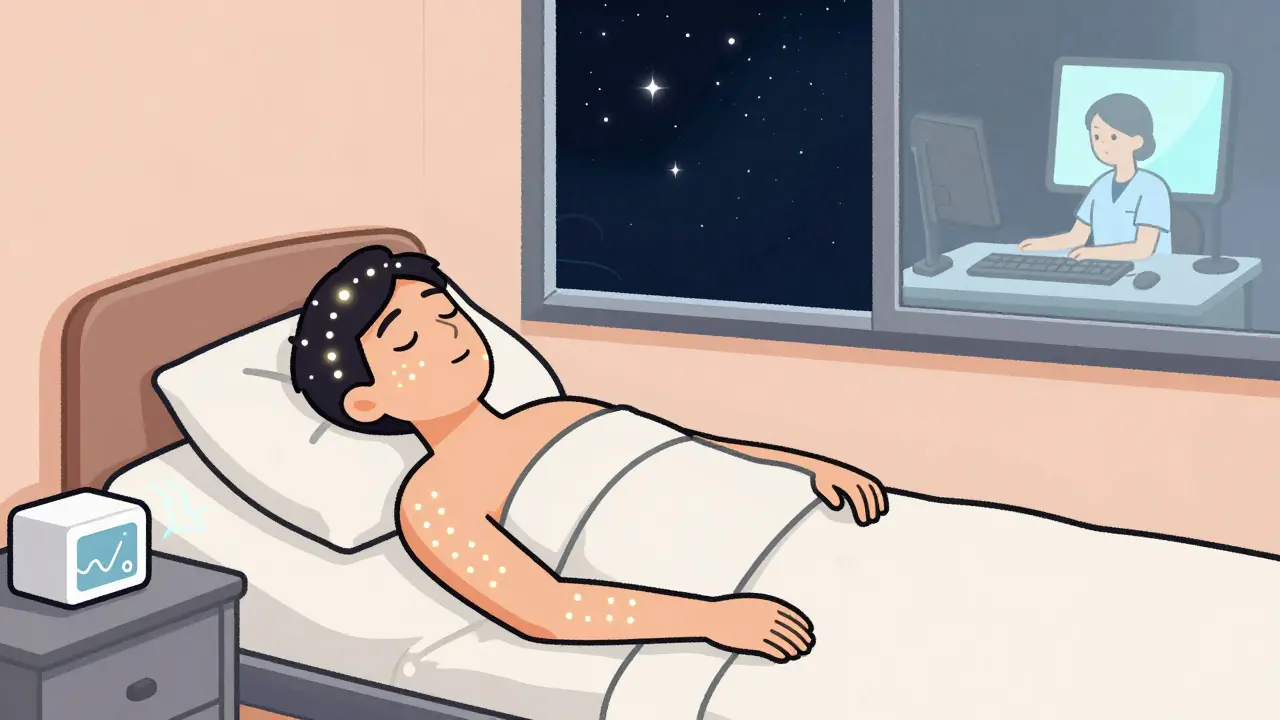
You’ll arrive at a sleep center - usually a quiet, hotel-like room with a comfortable bed - about an hour before your normal bedtime. A sleep technologist will meet you, explain everything, and start attaching sensors. Don’t panic: it’s not like a hospital ICU. There are no needles. No IVs. Just small, soft electrodes glued to your scalp, face, chest, and legs. A belt around your chest and abdomen measures breathing effort. A tiny sensor under your nose checks airflow. A finger clip tracks your blood oxygen. All of it connects to a small box beside your bed that wirelessly sends data to a monitoring station down the hall.
Most people have about 22 sensors, but newer systems are cutting that down. Some labs now use wireless patches that reduce wires to just five or six. The room is kept between 20-22°C (68-72°F) - cool enough to help you sleep, warm enough to stay comfortable. You can watch TV, read, or chat until lights out. The technologist will check on you, make sure everything’s working, and leave you alone to sleep.
They’re watching you the whole time. Not to judge - to help. If a sensor falls off, they’ll fix it. If you need to use the bathroom, they’ll unhook you and help you get around. You might not sleep as well as you do at home. That’s normal. The good news? You don’t need a full eight hours. Even three or four hours of good sleep data can be enough for a diagnosis. About 85% of patients get usable results, even if they’re nervous at first.
What Do the Results Show?
After your study, the raw data - which can be over 1,000 pages - goes to a board-certified sleep physician. They don’t just glance at it. They spend two to three hours analyzing every spike, dip, and pattern. Here’s what they’re looking for:
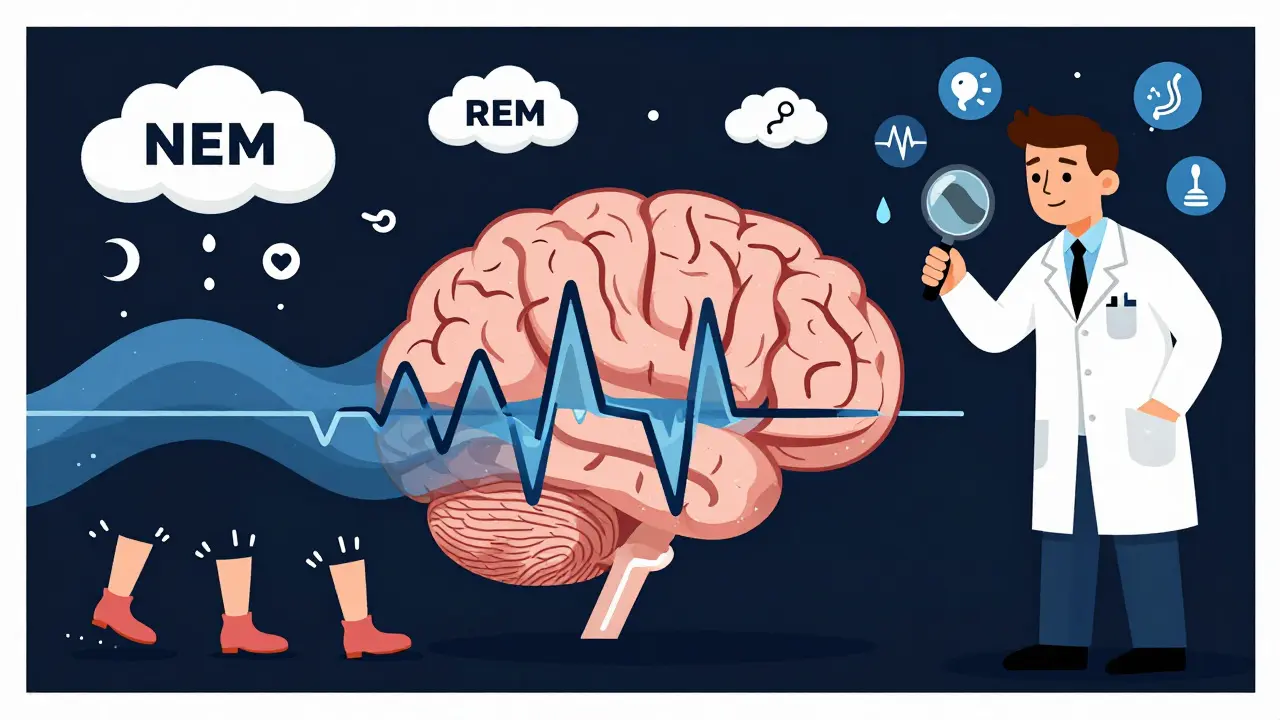
- Sleep stages: Did you cycle properly through NREM (light and deep sleep) and REM (dream sleep)? People with narcolepsy skip the usual progression and enter REM within minutes. That’s a red flag.
- Apneas and hypopneas: How many times did your breathing stop (apnea) or shallow (hypopnea)? If it’s more than 5 per hour, that’s sleep apnea. Over 15 is moderate. Over 30 is severe.
- Oxygen drops: Did your blood oxygen fall below 90%? How often? This tells doctors how hard your body is working to breathe.
- Leg movements: Are your legs jerking every 20-40 seconds? That’s restless legs syndrome.
- Heart irregularities: Did your heart skip, race, or slow down during sleep? Some arrhythmias only show up at night.
- Abnormal behaviors: Did video recording show you sitting up, yelling, or walking? That’s a parasomnia.
These aren’t just numbers. They’re clues. For example, if you have apneas but your chest is still moving, that’s obstructive sleep apnea - your airway is blocked. If your chest stops moving too, that’s central sleep apnea - your brain isn’t sending the signal to breathe. The treatment for each is completely different.
Split-Night Studies: Diagnosis and Treatment in One Night
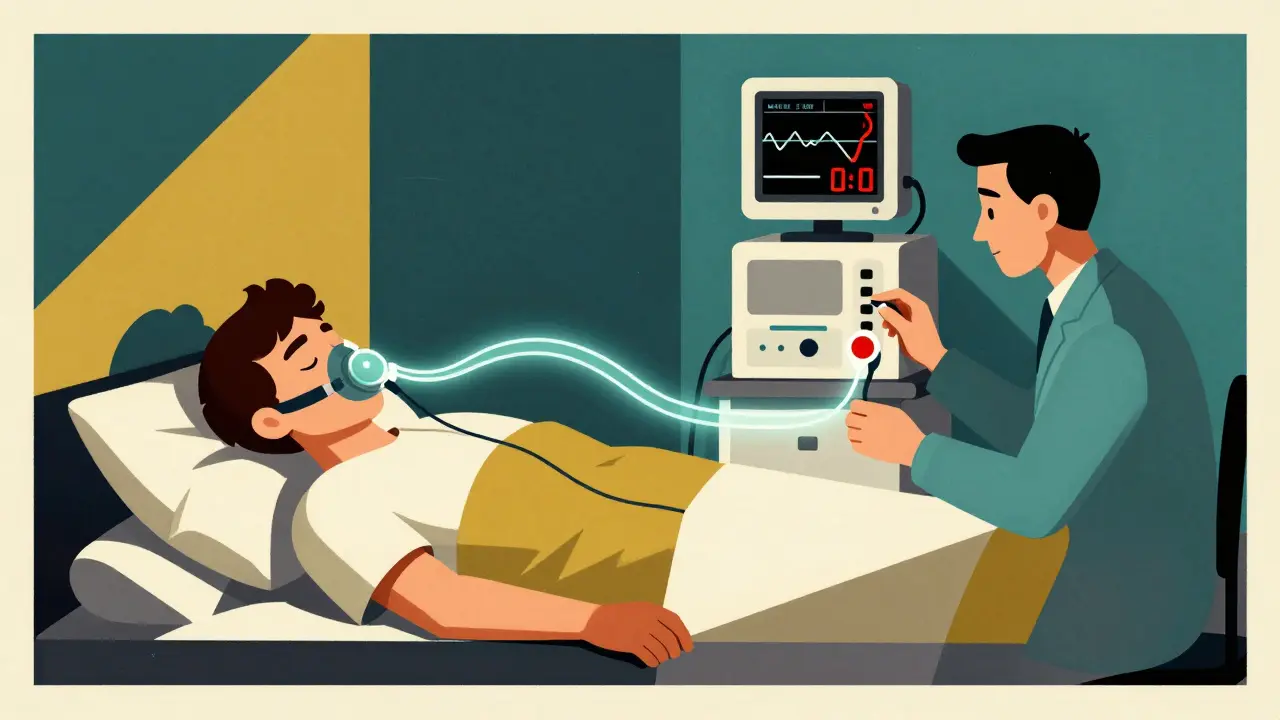
If your sleep study shows severe sleep apnea early on - say, more than 30 events per hour in the first two hours - the sleep center may switch to a split-night study. This means, after diagnosing the problem, they’ll wake you up and fit you with a CPAP mask. Then, they’ll adjust the air pressure while you sleep to find the lowest setting that keeps your airway open. This saves you a second trip. About 35% of diagnostic studies now include CPAP titration. It’s efficient. It’s common. And it means you might leave the sleep center with a prescription in hand.
How It Compares to Home Sleep Tests
Home sleep tests are cheaper and more convenient. But they’re limited. Most only record three or four things: airflow, oxygen, breathing effort, and heart rate. They’re great for straightforward cases - like a snoring, overweight man with daytime fatigue. But they miss everything else. If you have insomnia, night terrors, unusual movements, or heart issues during sleep, a home test won’t catch it. And they fail more often - up to 20% of them don’t collect enough data. In-lab polysomnography fails less than 5% of the time.
Also, insurance often won’t cover a home test unless you meet strict criteria. Medicare and most private insurers require polysomnography for anything beyond simple obstructive sleep apnea. If your doctor suspects narcolepsy, periodic limb movement disorder, or a seizure disorder, they’ll order the full study. There’s no shortcut.
What to Do Before and After
Preparing matters. Don’t change your sleep schedule. If you usually sleep at 11 p.m., don’t try to go to bed at 9 p.m. the night before. Avoid caffeine after noon. Skip naps. Don’t drink alcohol - it can mask sleep apnea and make results inaccurate. Bring your own pillow, pajamas, and anything that helps you sleep. You can shower before the test, but avoid lotions or hair products - they interfere with the electrodes.
After the study, you’ll get your results in 7-14 days. The report will say whether you have a sleep disorder, how severe it is, and what treatment is recommended. For sleep apnea, it might be CPAP. For restless legs, it could be iron supplements or medication. For narcolepsy, it might mean lifestyle changes and stimulants. The goal isn’t just to label your problem - it’s to fix it.
Who Needs a Polysomnography?
You don’t need one just because you’re tired. But if you have:
- Chronic snoring with pauses in breathing
- Excessive daytime sleepiness despite enough sleep
- Leg jerking or crawling sensations at night
- Unexplained insomnia or frequent awakenings
- Bed partner says you talk, yell, or move violently while sleeping
- History of stroke, heart failure, or neurological conditions
then it’s worth talking to a sleep specialist. The American Academy of Sleep Medicine estimates over 1.5 million in-lab sleep studies are done each year in the U.S. alone - and that number is growing. More people are realizing that sleep isn’t just downtime. It’s repair time. And when it’s broken, your whole body suffers.
Is It Worth the Inconvenience?
Yes. Even if you’re nervous, even if the room feels odd, even if you only sleep a few hours - the data is worth it. A sleep study doesn’t just confirm a diagnosis. It can prevent heart attacks, strokes, and accidents from drowsy driving. It can end years of fatigue. It can help you feel like yourself again.
Modern sleep centers are designed for comfort. Staff are trained to help you relax. The technology is less intrusive than ever. And the results? They’re life-changing.
Can I use my phone or watch TV during the sleep study?
Yes. Most sleep centers let you watch TV or read before bed. You’ll need to put your phone on airplane mode or leave it in another room once the study starts - the signals can interfere with the equipment. But you’re encouraged to do what helps you relax before sleep.
Will the sensors hurt or wake me up?
No. The sensors are small, adhesive, and non-invasive. They’re designed to be comfortable, even if you roll over. Most people report feeling them briefly, then forgetting they’re there. If something comes loose, the sleep technologist can fix it without waking you fully.
How long does it take to get results?
Results usually take 7 to 14 days. The data is reviewed by a board-certified sleep physician who spends 2-3 hours analyzing each study. This isn’t automated - it’s expert interpretation. You’ll get a full report with clear findings and treatment recommendations.
Is polysomnography covered by insurance?
Yes, if it’s medically necessary. Medicare typically covers 80% of the cost when ordered for diagnosed sleep symptoms like snoring, witnessed apneas, or excessive daytime sleepiness. Most private insurers require prior authorization, but they cover it for confirmed sleep disorders. Home sleep tests are often not enough for coverage unless the case is very straightforward.
Can a sleep study diagnose narcolepsy?
Yes. A polysomnography is the first step. It rules out other causes of daytime sleepiness like sleep apnea or poor sleep hygiene. If narcolepsy is suspected, you’ll usually follow up with a Multiple Sleep Latency Test (MSLT) the next day - a series of naps that measure how fast you fall asleep and whether you enter REM sleep too quickly.
What if I can’t sleep during the study?
It’s okay. Most people get enough sleep - even if it’s not perfect. Sleep technologists are trained to work with light sleepers. They can adjust sensors, offer calming techniques, or even let you get up briefly. Even 3-4 hours of data can be enough for a diagnosis. The goal isn’t to replicate your home sleep exactly - it’s to capture enough patterns to identify problems.

Darlene Gomez
March 23, 2026 AT 00:52Just had my first sleep study last month, and honestly? Way less scary than I thought. The techs were so chill - even helped me reposition when I rolled over and knocked a sensor loose. I thought I’d be wired like a sci-fi experiment, but it was more like being tucked in with a bunch of gentle robots. Slept maybe 4 hours, but they said it was enough. Got diagnosed with mild sleep apnea and started CPAP. Best decision ever. Woke up feeling human again. Seriously, if you’re nervous - just go. You’ve got nothing to lose but exhaustion.
Katie Putbrese
March 24, 2026 AT 09:41Why are we letting corporations turn sleep into a medical industry? They want you to believe you need a lab full of sensors just to sleep. I’ve been sleeping on my side with a pillow between my legs since 2012. No machines. No doctors. Just common sense. This whole polysomnography thing is just another way to bill insurance. They’re not fixing sleep - they’re monetizing it.
Jacob Hessler
March 26, 2026 AT 05:23lol i had one of these last year. they put all these wires on me and i was like 'bro i just wanna sleep' but then i woke up and they were like 'u stopped breathing 47 times' and i was like 'wait what?' turns out i was snoring like a chainsaw. cpap saved my life. no joke. now i feel like a new person. also the room had a tv. bonus.
Amber Gray
March 26, 2026 AT 06:02CPAP is a scam. I did the study, got the mask, hated it. Then I just started sleeping on my side and drinking ginger tea. No more snoring. No more daytime fog. No need for machines. They just want you dependent. Wake up. 🤡
Danielle Arnold
March 27, 2026 AT 01:16So… you pay $3000 to find out you should’ve just stopped drinking wine at 8 p.m.? Yeah. I’ll pass.
Donna Fogelsong
March 28, 2026 AT 21:46They’re tracking brainwaves? That’s not medicine - that’s surveillance. Who’s accessing this data? NSA? Pharma? Insurance companies? You think they’re just looking for apnea? Nah. They’re building sleep profiles. Your dreams, your REM cycles - it’s all being sold. You think you’re getting help? You’re being cataloged. Wake up.
Sean Bechtelheimer
March 30, 2026 AT 09:52They watch you sleep? 😳 I thought I was safe at night. What if they see me talking in my sleep? What if they record my nightmares? This isn’t health care - it’s psychological profiling. They’re mapping your subconscious. I’m not doing it. 🚫
Seth Eugenne
March 30, 2026 AT 19:36Hey, I just want to say - if you’re considering a sleep study, don’t let fear stop you. I was terrified too. I thought I’d be awake all night. But the staff treated me like a person, not a case. I didn’t sleep perfectly, but I slept enough. And when they told me I had PLMD - it made sense. The meds they prescribed? Changed my life. You’re not a lab rat. You’re someone who deserves rest. Go. You’ve got this.
Raphael Schwartz
March 31, 2026 AT 05:40cpap is the only way. i did it. now i dont fall asleep at red lights. no drama. just do it.
Rachele Tycksen
April 1, 2026 AT 15:38Wait so you’re telling me I’ve been tired for 10 years because I nap after lunch? 😂
Rama Rish
April 1, 2026 AT 22:49From India - we don’t have many sleep labs here. But my cousin did one in Chicago. She said the hardest part? Not sleeping. The easiest? Knowing what’s wrong. Now she sleeps like a baby. If you’re even a little unsure - go. It’s worth it.