
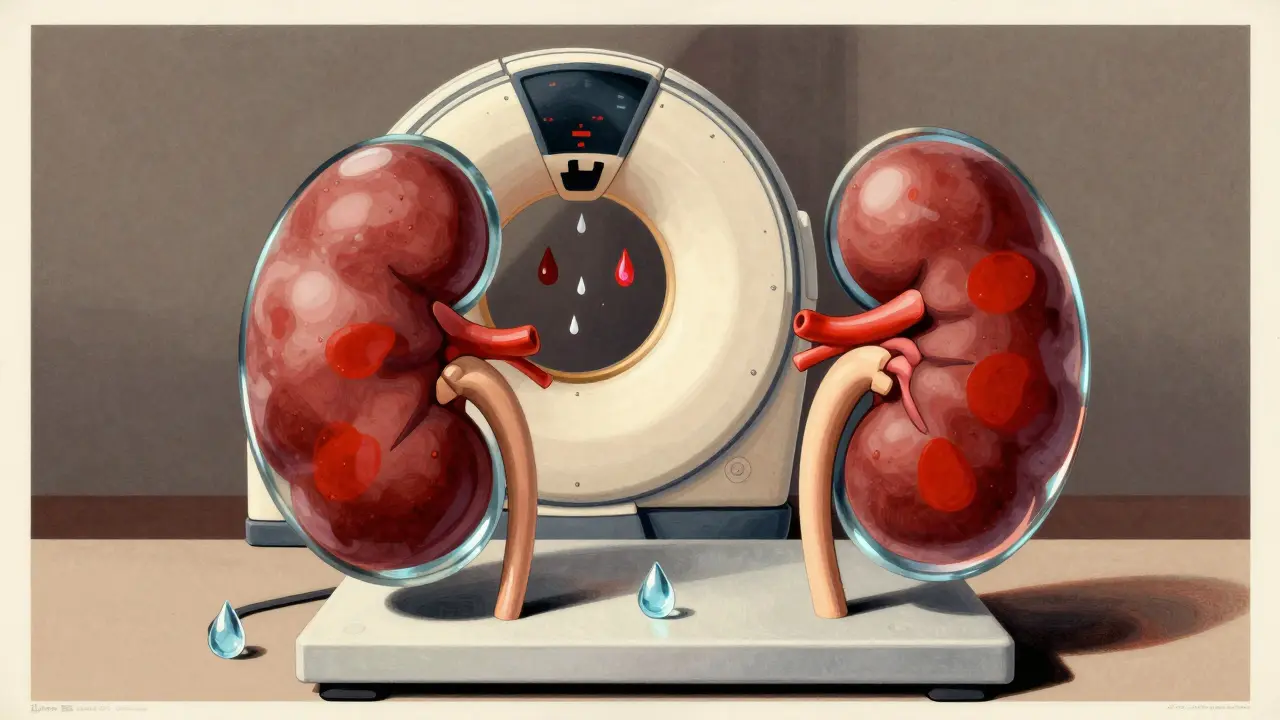
When you have chronic kidney disease (CKD), even small changes can push your kidneys into acute failure. This is called AKI on CKD-an acute injury happening on top of already damaged kidneys. It’s not rare. In fact, up to 50% of hospitalized CKD patients with stage 4 or 5 disease develop it after exposure to common medical procedures or drugs. And once it happens, the risk of permanent damage, dialysis, or even death jumps dramatically.
Why AKI on CKD Is So Dangerous
Your kidneys are already working at a reduced capacity if you have CKD. Normally, they filter waste, balance fluids, and regulate blood pressure. But when they’re weakened, they can’t handle extra stress. A single dose of contrast dye for a CT scan, a few days of ibuprofen, or even a change in blood pressure meds can trigger a sudden drop in function. This isn’t just a temporary blip-it can lead to lasting harm.According to the KDIGO 2012 guidelines, AKI is defined by a rise in serum creatinine of at least 0.3 mg/dL within 48 hours, or a 50% increase from your baseline. For someone with CKD, that small change could mean losing 30% or more of their remaining kidney function. And once you lose that, it rarely comes back.
Studies show that 30% of AKI episodes in CKD patients lead to permanent kidney decline. About 10-15% will need long-term dialysis within five years. The mortality rate? Between 25% and 80%, depending on how sick the patient is overall. That’s not just a statistic-it’s a real risk you can control.
Contrast Dye: The Silent Threat
Iodinated contrast, used in CT scans, angiograms, and other imaging tests, is one of the top causes of AKI in CKD patients. It’s called contrast-induced acute kidney injury (CI-AKI). In healthy people, the risk is low-around 1-5%. But in someone with CKD, especially with diabetes or heart failure, that risk jumps to 12-50%.The KDIGO guidelines say: avoid contrast if possible. If you absolutely need it-say, for a life-threatening stroke or heart blockage-use the smallest amount possible (usually under 100 mL). Never use contrast if you’re dehydrated. Never use it without planning ahead.
Hydration is your best defense. The standard recommendation is to give isotonic saline (normal saline) at 1.0-1.5 mL per kg of body weight per hour, starting 6-12 hours before the scan and continuing for 6-12 hours after. This simple step can reduce your risk by 30-40%. Don’t rely on water alone. You need the right kind of fluid, given at the right rate.
Some hospitals still use sodium bicarbonate or N-acetylcysteine (NAC) to try to prevent CI-AKI. But recent studies show bicarbonate doesn’t help more than saline. NAC might help a little, but the evidence is mixed. Don’t waste time on unproven treatments. Stick to hydration and dose reduction.
Nephrotoxic Medications: The Hidden Killers
Contrast isn’t the only danger. Everyday drugs can be just as harmful-or worse.NSAIDs (like ibuprofen, naproxen, celecoxib) are the most common culprits. They block prostaglandins that help keep blood flowing to your kidneys. In CKD, that’s like turning off a lifeline. Studies show NSAID use in CKD patients increases AKI risk by 2.5 times. The Veterans Health Administration found that 1 in 4 AKI cases in CKD patients were linked to NSAIDs. If you have CKD, never take NSAIDs without your doctor’s approval.
ACE inhibitors and ARBs (like lisinopril, losartan) are usually good for your kidneys-they lower blood pressure and reduce protein in the urine. But during an acute illness, dehydration, or infection, they can cause your kidneys to shut down. If you’re sick, your doctor may temporarily stop these meds. Never stop them yourself. A sudden drop in kidney function after stopping them can mean your body was relying on them to maintain blood flow to your kidneys.
Aminoglycosides (gentamicin, tobramycin) are antibiotics used for serious infections. They’re toxic to kidney cells. Up to 25% of patients on a full course develop kidney damage. Vancomycin is another risk, especially if your blood levels go above 15 mcg/mL. Amphotericin B, used for fungal infections, damages kidneys in 30-80% of patients.
Even common drugs like metformin can be dangerous if your kidneys are failing. It’s not directly toxic, but if your eGFR drops below 30, it can build up and cause lactic acidosis. Your doctor should check your kidney function before prescribing it and adjust or stop it if your numbers fall.
What to Do Before Any Medical Procedure
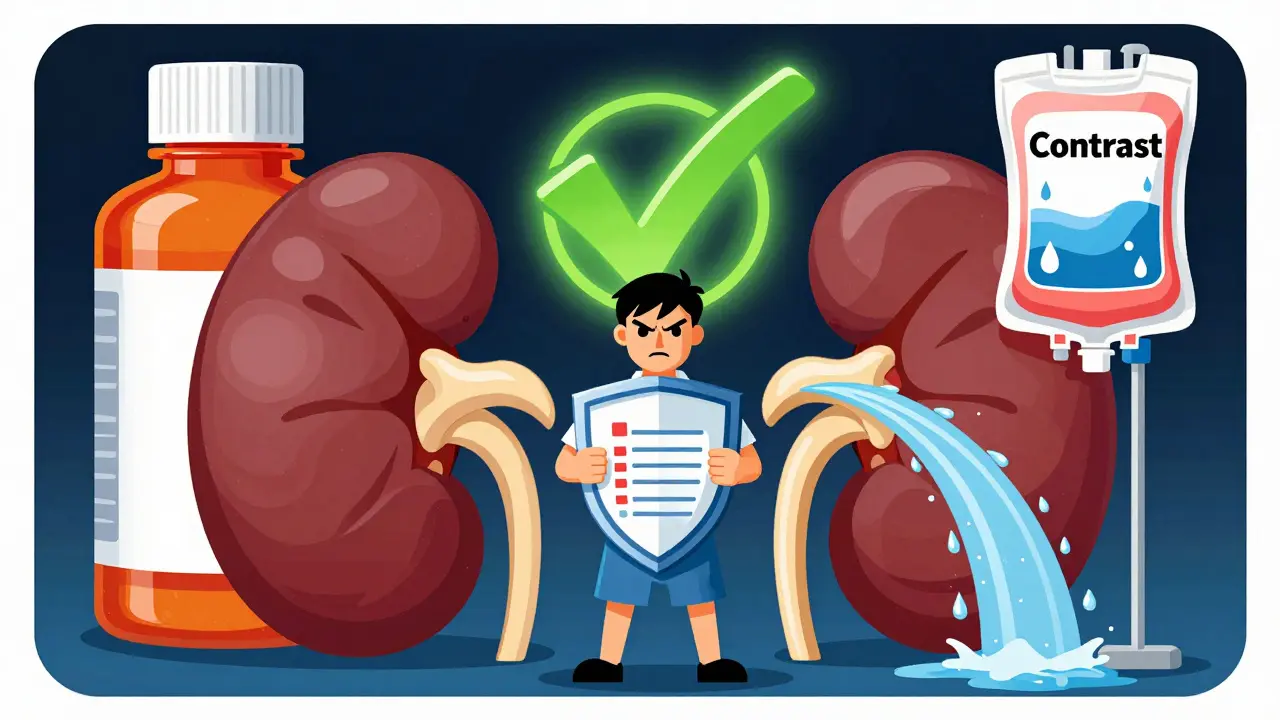
If you have CKD, you need to be proactive. Don’t wait for the hospital to ask you questions. Take control.- Know your eGFR. Keep a copy of your latest kidney test. Know if you’re in stage 3, 4, or 5. Stage 3 (eGFR 30-59) is high risk. Stage 4-5 (eGFR under 30) is very high risk.
- Ask: Is this test really necessary? Can an ultrasound or MRI (without contrast) do the job? Many scans don’t need contrast at all.
- Stop NSAIDs 3-5 days before any procedure. Talk to your doctor about alternatives like acetaminophen.
- Hydrate properly. Drink water, but also follow your provider’s instructions on IV fluids if you’re getting contrast.
- Bring your medication list. Include all prescriptions, OTC drugs, and supplements. Pharmacists can flag dangerous combinations.
One study showed that pharmacist-led reviews cut AKI rates in CKD patients by 22%. That’s because they catch what doctors miss-like a patient taking two NSAIDs at once, or a new antibiotic that interacts with their kidney meds.
Monitoring and Follow-Up After AKI
If you’ve had AKI on CKD, you’re not done. You need follow-up.KDIGO recommends checking your serum creatinine every 24-48 hours during hospitalization. After discharge, you need another test in 7 days, then again at 3 months. Why? Because if your kidney function hasn’t recovered after 7 days, you may have Acute Kidney Disease (AKD)-a new term for kidney damage lasting between 7 days and 3 months. AKD can turn into permanent CKD if not managed.
Don’t just rely on creatinine. Ask for a urine albumin-to-creatinine ratio (uACR). This test shows if your kidneys are leaking protein-a sign of ongoing damage. Even if your creatinine looks okay, protein in the urine means your kidneys are still under stress.
Some hospitals now use newer biomarkers like TIMP-2 and IGFBP7 to predict AKI before creatinine rises. These tests can warn you 12 hours in advance. Ask if your hospital offers them, especially if you’re in intensive care.
What Not to Do
There are a lot of myths out there. Don’t fall for them.- Don’t take diuretics (water pills) to "protect" your kidneys. They don’t help prevent AKI. If you’re not fluid-overloaded, they can make things worse by lowering blood pressure too much.
- Don’t use dopamine or fenoldopam. These drugs were once thought to help kidneys, but multiple trials show they do nothing. They’re a waste of time and money.
- Don’t wait for symptoms. AKI often has no pain, no swelling, no warning. By the time you feel tired or urinate less, it’s already advanced.
- Don’t ignore EHR alerts. Electronic systems flag nephrotoxic drugs for CKD patients. If your doctor overrides the alert, ask why. It’s not always right.
When to See a Nephrologist
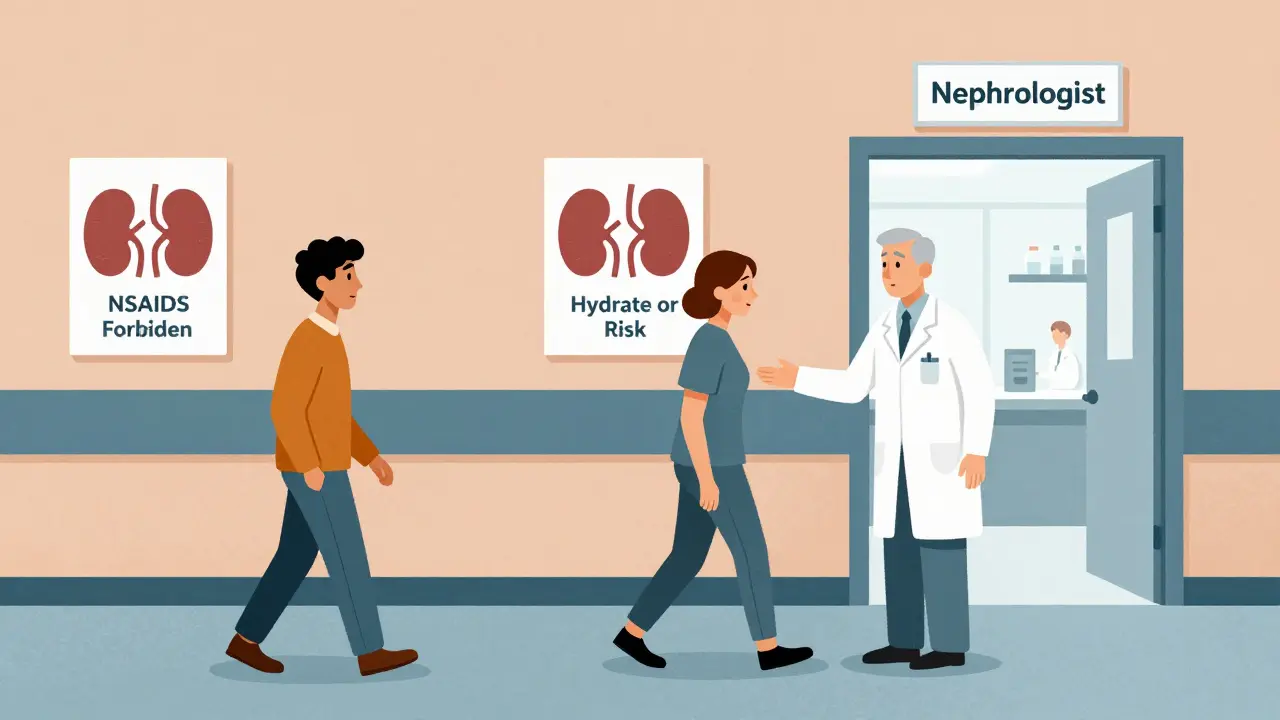
You don’t need to wait until you’re in crisis. If you have CKD stage 3 or worse, consider seeing a kidney specialist even if you feel fine. Studies show that patients who get nephrology care during AKI have 20% lower death rates.A nephrologist can help you:
- Adjust your meds safely
- Plan for imaging tests
- Monitor for early signs of AKD
- Teach you how to avoid triggers
Many people think nephrologists only handle dialysis. That’s not true. They’re your best defense against preventable kidney damage.
Education Saves Kidneys
One of the most powerful tools you have is knowledge. A 2017 study found that CKD patients who received clear, written instructions about avoiding NSAIDs and staying hydrated had 25% fewer AKI hospitalizations than those who didn’t.Ask your doctor for a simple handout. Write down:
- Which meds to avoid
- When to stop them
- How much water to drink daily
- When to call your doctor (e.g., if you’re sick, vomiting, or not urinating)
Keep it in your wallet. Show it to every doctor, pharmacist, and ER nurse. Most don’t know your kidney history unless you tell them.
The Bottom Line
AKI on CKD isn’t inevitable. It’s preventable. The biggest risks-contrast dye and nephrotoxic drugs-are known. The solutions-hydration, medication review, and careful planning-are simple. But they only work if you’re involved.You’re not just a patient. You’re the most important part of your own care team. Know your numbers. Ask questions. Say no to unnecessary tests. Speak up about your meds. Your kidneys can’t protect themselves anymore. But you can.


Joe Bartlett
December 17, 2025 AT 11:11Love this post. Simple, clear, and straight to the point. NSAIDs are a silent killer for CKD folks-stop them before they stop you.
Radhika M
December 17, 2025 AT 21:58As someone with stage 4 CKD, I’ve learned the hard way. I used to take ibuprofen for headaches. Now I use acetaminophen and drink water like it’s my job. Small changes save kidneys.
Sachin Bhorde
December 19, 2025 AT 15:49Big up to the author. This is gold. CI-AKI is underdiscussed. In India, docs still push contrast like it’s no big deal. Hydration protocols? Rare. I’ve seen patients crash after a CT without saline prep.
Pro tip: Always ask for the eGFR before any scan. If they don’t know it, don’t proceed. And ditch the NAC hype-it’s snake oil. Saline’s the real MVP.
Also, vancomycin levels above 15? That’s a death sentence for CKD. Monitor like your life depends on it-because it does.
Jonathan Morris
December 19, 2025 AT 18:31Let’s be real-this is all corporate propaganda. Contrast dye? Nephrotoxic meds? Who benefits? Pharma. Hospitals make billions off imaging. They’ll never stop pushing contrast. And don’t get me started on ‘hydration protocols’-it’s a money grab. They charge you for IV fluids while ignoring the real issue: systemic inflammation from processed food and glyphosate. The system is rigged. Your kidneys aren’t failing-they’re being poisoned by the machine.
Donna Packard
December 20, 2025 AT 13:40Thank you for writing this. I’ve been scared to get any scans since my diagnosis. Now I know exactly what to ask for. I printed this out and keep it in my purse.
Pawan Chaudhary
December 21, 2025 AT 00:31Hey everyone, if you’re reading this and have CKD-you’re not alone. I’ve been stage 3 for 5 years and still hiking, cooking, and laughing. It’s not the end. Just be smart. Skip the NSAIDs, hydrate, and tell every doc you meet: ‘My kidneys are fragile.’ You got this.
Jigar shah
December 21, 2025 AT 22:15Does anyone have data on how often nephrologists are consulted before elective procedures in real-world settings? The paper says 20% lower mortality with nephrology involvement-but is that just in academic centers? In rural India, most CKD patients never see a nephrologist until dialysis.
Philippa Skiadopoulou
December 22, 2025 AT 01:28Hydration remains the cornerstone of prevention. No exceptions. No alternatives. No magic pills. Just saline, timing, and discipline. This is not debatable. It is evidence-based medicine.
Jody Patrick
December 22, 2025 AT 21:14My uncle died after a CT with contrast. They didn’t check his creatinine. He was 68, diabetic, CKD stage 4. They said ‘he looked fine.’ He wasn’t. This post should be mandatory reading for every ER doc in America.
Sam Clark
December 23, 2025 AT 18:54Thank you for the comprehensive and clinically accurate overview. I would only add that patient education materials should be available in multiple languages and literacy levels. Many individuals with CKD, especially in underserved communities, lack access to clear, actionable guidance. A handout in plain language can be life-saving.
amanda s
December 24, 2025 AT 09:53YOU’RE ALL BEING MANIPULATED. The FDA knows contrast dye is dangerous. They’ve known for 20 years. Why are they still approving it? Because Big Pharma owns them. And your doctors? They’re paid to push scans. Wake up. This isn’t medicine-it’s a profit scheme. Your kidneys are collateral damage.
Patrick A. Ck. Trip
December 25, 2025 AT 15:20Thank you for this thoughtful, deeply informative post. I’m a caregiver for my mother with stage 5 CKD, and I’ve learned so much. I’ve already shared this with our primary care team. One small typo: ‘eGFR under 30’-should be ‘eGFR less than 30’ for precision, but the message is crystal clear. Your work here is helping people live longer. Thank you.