
Statin Discontinuation Risk Calculator
Calculate Your Risk of Stopping Statins
This tool helps you evaluate whether stopping statins might be appropriate for your situation based on current medical guidelines.
What this means
Based on your situation, your risk of having a heart event if you stop statins is 0% within the next year.
Recommendation
This is where your recommendation will appear.
Key considerations
- Heart disease history: No heart disease history.
- Life expectancy: Life expectancy is 2 years or more.
- Side effects: Side effects are not reported.
- Multiple conditions: Multiple chronic conditions are not reported.
Many people take statins for years without thinking twice. But what happens when you no longer need them? Or when the side effects outweigh the benefits? Stopping statins isn’t as simple as just skipping a pill. It’s a decision that needs to be made carefully-with your doctor, based on your health, age, and real risk of heart problems.
Why Do People Stop Statins?
One in five people who take statins stop them for at least a year. That’s not just a few outliers-it’s a widespread pattern. The biggest reason? Side effects. Muscle pain, weakness, or fatigue are the most common complaints. Some people worry about developing type 2 diabetes. Others just feel like they’ve been on medication for too long and want to see if they can feel better without it.
But here’s the catch: a lot of the time, people think they’re having side effects when they aren’t. In clinical trials, the rate of muscle pain in people taking statins is only slightly higher than in those taking a sugar pill. Still, when someone feels worse after starting a statin, they’re likely to stop. And once they stop, many never go back-even if their doctor says it’s safe.
When Is It Safe to Stop?
Not everyone should stay on statins forever. There are clear situations where stopping makes sense.
For older adults with limited life expectancy: If someone has a serious illness like advanced cancer, heart failure, or dementia and is expected to live less than two years, continuing statins often doesn’t add years to life. In fact, it adds daily pills, possible side effects, and unnecessary stress. A 2023 review from MyPCnow found that stopping statins in these cases is not only safe-it’s often the right choice.
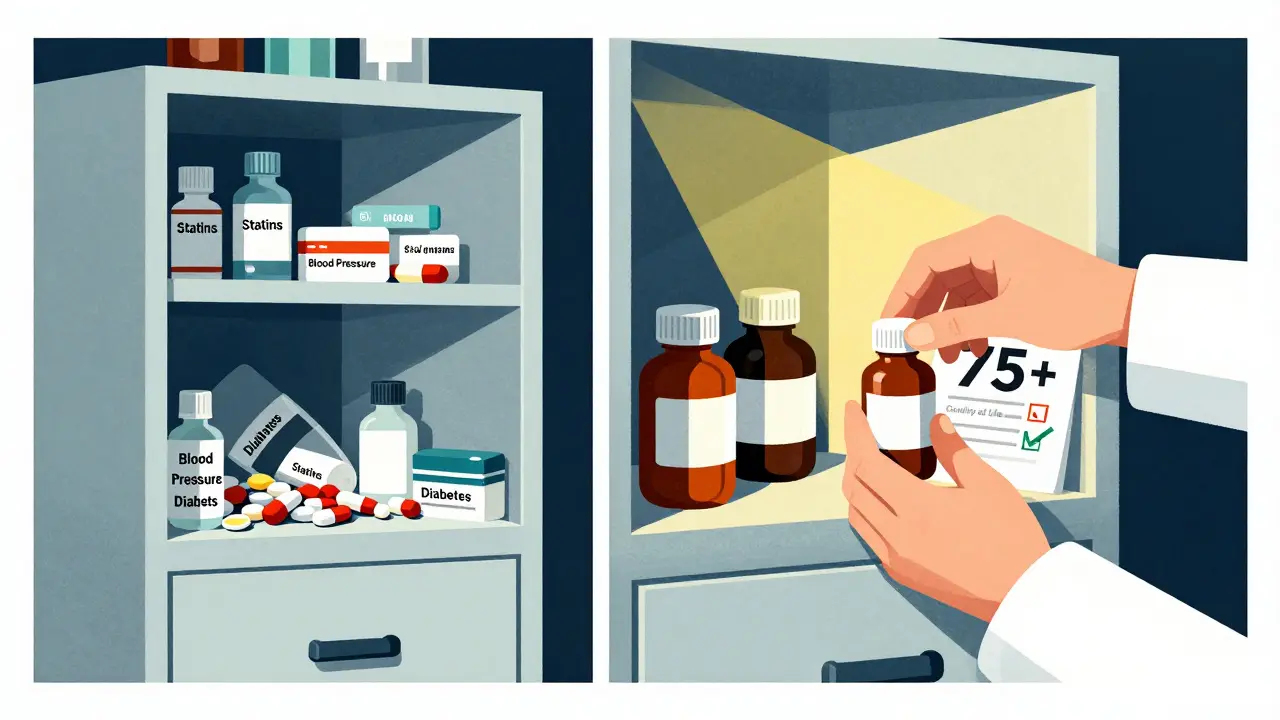
For people with multiple chronic conditions: If you’re taking eight or more medications, adding another pill just for cholesterol might not be helping. A 2020 review in the Journal of the American Geriatrics Society found that guidelines now support considering statin discontinuation in older adults with poor health status. The goal isn’t to chase perfect cholesterol numbers-it’s to improve quality of life.
For those who had a bad reaction: If you had severe muscle pain, liver issues, or other confirmed side effects, your doctor might recommend switching to a different statin, lowering the dose, or trying a non-statin option. But if you’ve tried everything and still feel awful, stopping may be the best path forward-especially if your heart disease risk is low.
What Happens When You Stop?
Stopping statins doesn’t mean your risk disappears overnight. But the consequences depend heavily on why you were taking them in the first place.
If you’re on statins for secondary prevention (meaning you’ve already had a heart attack, stroke, or had a stent placed), stopping is risky. A 2021 study in JAMA Network Open found that for every 77 people who stopped statins after having heart disease, one more had a major heart event within a year. That’s not a small number. For these patients, the benefits of statins are clear and strong.
If you’re on statins for primary prevention (meaning you’ve never had heart disease but have high cholesterol or other risk factors), the risk of stopping is lower. The same study found one extra heart event for every 112 people who stopped. That sounds less scary-but it still matters. If you’re 65 with high cholesterol, diabetes, and high blood pressure, stopping statins could still increase your risk. But if you’re 80 with no heart issues, no diabetes, and a life expectancy under five years? The numbers shift.
For end-of-life care, a 2024 review in the Journal of the American Geriatrics Society found no increase in short-term death risk after stopping statins-even in people who recently had a heart attack. If someone is in hospice and has only weeks to live, continuing statins doesn’t help. It just adds pills to a long list.
How to Stop Safely
You don’t just stop statins cold turkey. Here’s how to do it right.
- Talk to your doctor first. Never decide on your own. Bring up your concerns, symptoms, and reasons for wanting to stop. Your doctor can help weigh the risks.
- Check your real risk. Ask for a personalized risk calculation. Are you really at high risk for a heart attack? Or are you mostly on statins because your cholesterol number was high? Tools like the ASCVD Risk Calculator can help clarify.
- Try alternatives first. If muscle pain is the issue, ask about switching to a different statin (like pravastatin or fluvastatin), lowering the dose, or trying every-other-day dosing. Some people tolerate this just fine.
- Consider non-statin options. If you still need to lower cholesterol, options like ezetimibe or PCSK9 inhibitors exist. But they’re expensive and not always covered by insurance. Fibrates or omega-3s may help, but they don’t reduce heart attack risk like statins do.
- Monitor after stopping. If you stop, keep an eye on your symptoms. If chest pain, shortness of breath, or unusual fatigue returns, contact your doctor. Your cholesterol levels should also be checked in 3-6 months to see if they’ve gone back up.
What About Long-Term Effects?
Some people worry that stopping statins will cause a sudden spike in cholesterol or trigger a heart attack. That’s not how it works. Cholesterol doesn’t rebound overnight. It takes weeks or months. That’s why monitoring matters.
There’s also a myth that statins cause permanent damage. They don’t. Muscle pain, liver enzyme changes, or slight blood sugar increases usually go away once you stop. Your body resets.
But here’s what’s less talked about: the burden of taking pills every day. For older adults, managing dozens of medications is exhausting. A 2015 study in JAMA Internal Medicine called this “inappropriate polypharmacy”-and it’s a real quality-of-life issue. Stopping a statin that’s no longer helping can mean fewer pills, fewer side effects, and more energy.
What’s Happening Now?
Doctors are starting to rethink statins. A major clinical trial called Discontinuing Statins in Multimorbid Older Adults is underway across Europe, tracking 1,800 people over age 70 with multiple health conditions. The goal? To see if stopping statins is just as safe as continuing them-measured not just by heart attacks, but by how people feel: muscle strength, balance, sleep, and daily function. Results are expected in late 2025.
Meanwhile, companies are developing genetic tests to predict who’s likely to have side effects. That could help doctors choose the right statin-or skip it altogether-for each person.
What You Can Do
If you’re thinking about stopping statins:
- Don’t panic. Stopping doesn’t mean you’re giving up on your health.
- Don’t assume you need them forever. Your needs change as you age.
- Bring up the topic. Ask your doctor: “Based on my current health, do I still need this?”
- Be honest about side effects. Don’t downplay them.
- Ask about alternatives before quitting.
For many, stopping statins isn’t about rejecting medicine-it’s about choosing a simpler, more comfortable life. And if you’re past 75, have multiple health problems, and aren’t at high risk for heart disease? That choice might be the healthiest one you make.
Can I stop statins on my own if I feel fine?
No. Even if you feel fine, stopping statins without medical advice can be risky-especially if you have heart disease. Your doctor needs to evaluate your risk level, reason for taking statins, and whether stopping is safe for you. Self-discontinuation can lead to missed warning signs and unnecessary health risks.
Do statins cause long-term damage?
No. Statins don’t cause permanent damage. Muscle pain, elevated liver enzymes, or slight increases in blood sugar usually reverse after stopping. Some people worry about memory loss or nerve damage, but large studies haven’t confirmed these as direct, lasting effects. If symptoms go away after stopping, they were likely temporary side effects, not lasting harm.
Is it safe to stop statins if I’m over 75?
It can be. For people over 75 without existing heart disease, the benefits of statins become less clear. A 2023 review found that stopping statins in older adults with limited life expectancy or multiple chronic conditions is often safe and may improve quality of life. But if you’ve had a heart attack or stroke, stopping increases your risk of another event. Always discuss this with your doctor.
What happens to my cholesterol after I stop statins?
Your cholesterol will likely return to its pre-statin level within a few weeks to months. Statins don’t change your body’s natural cholesterol production-they just block it temporarily. Once you stop, your liver starts making cholesterol again. That’s why doctors often check your levels 3-6 months after stopping to see if you need another strategy.
Are there natural ways to replace statins?
Diet, exercise, and weight loss can help lower cholesterol, but they rarely match the heart attack risk reduction of statins-especially for people with established heart disease. Supplements like red yeast rice or plant sterols have mild effects but aren’t regulated like medications. Fibrates or ezetimibe are alternatives, but they’re not as effective as statins for preventing heart events. Don’t rely on natural methods alone if your risk is high.
Helen Brown
March 1, 2026 AT 08:28I stopped statins after my neighbor died from them. They're in the water. The FDA knows. They're making us weak so we'll take more pills. I don't trust doctors. I don't trust pharma. I don't trust anything anymore.
My muscles hurt? That's the proof.
John Cyrus
March 1, 2026 AT 19:36People stop statins because they're lazy and don't want to deal with their own health. You think your cholesterol is fine now because you feel good? That's not how biology works. You're just delaying the inevitable heart attack. Stop being so entitled to your own body. Get tested. Take the pill. Your future self will thank you.
John Smith
March 3, 2026 AT 10:46Man I love how we turn medicine into a cult. Statins? Nah. You wanna live? You gotta eat clean. You gotta move. You gotta sweat. You gotta stop letting Big Pharma turn your body into a vending machine. I went off statins last year. My energy? Skyrocketed. My cholesterol? Still better than half the office. I don't need a pill to tell me I'm alive. I feel it. I live it. I breathe it.
They call it side effects. I call it my body saying 'enough.'
Shivam Pawa
March 3, 2026 AT 22:27In India we have a phrase: 'Jugaad.' Fix it with what you have. Statins are not the only solution. Diet, walking, stress reduction. Many older patients here stop statins because they cannot afford them. But they live. They walk. They eat turmeric. They sleep well. Science says one thing. Life says another. Sometimes the body knows better than the algorithm.
Diane Croft
March 4, 2026 AT 15:58I'm 78 and stopped my statin last year. I didn't feel any different. But I stopped feeling like a walking pharmacy. Fewer pills. More coffee. More time with my grandkids. My doctor said it was fine. I'm not reckless. I'm just done letting numbers define my life.
Donna Zurick
March 5, 2026 AT 02:31I've been on statins for 12 years. Muscle pain? Yeah. But I had a stent. So I kept going. Then I switched to a lower dose. Now I feel 10x better. My doctor didn't push me. I asked. We talked. We adjusted. It's not about quitting. It's about finding what works for YOU. Don't be afraid to have the conversation.
Tobias Mösl
March 7, 2026 AT 00:07This whole article is a scam. Statins are a profit machine. They're pushing this 'stop statins' narrative because they're running out of new drugs to sell. You think your doctor cares about your quality of life? No. They get paid per prescription. You're a number. A statin is a $1200/year revenue stream. They don't want you to stop. They want you to stay dependent. Wake up. This isn't medicine. It's a business model disguised as care.
tatiana verdesoto
March 8, 2026 AT 10:49I'm a nurse. I've seen people stop statins and live better lives. I've also seen people die because they thought they were fine. It's not black and white. But I've learned one thing: the people who talk to their doctors, who ask questions, who listen - those are the ones who make it. You don't have to take the pill. But you do have to have the conversation.
Ethan Zeeb
March 9, 2026 AT 14:22I stopped statins because I was tired of being told I was 'at risk.' I'm 69. I hike. I garden. I eat vegetables. My cholesterol is 210. So what? I'm not a statistic. I'm not a risk factor. I'm a person. And I'm done letting labs dictate how I live my life. If I die tomorrow? Fine. At least I lived today.
Darren Torpey
March 10, 2026 AT 00:10I used to be one of those people who thought statins were magic. Then I started feeling like a zombie. I talked to my doc. We tried pravastatin. Then we dropped the dose. Then I went every other day. Now I feel like myself again. No magic. No miracle. Just a smarter approach. Don't be afraid to tweak. Your body isn't a machine. It's a garden. Sometimes you gotta prune.
Lebogang kekana
March 10, 2026 AT 02:59In South Africa we say 'Ubuntu' - I am because we are. But here's the truth: no one else feels your muscle pain. No one else carries your fear. I stopped statins because I couldn't lift my grandchild. My doctor said 'maybe.' I said 'enough.' Now I walk 5km every morning. My cholesterol? Still high. My life? Better. Sometimes the medicine is movement. Not a pill.
Jessica Chaloux
March 10, 2026 AT 20:43I cried when I stopped my statin. I felt so guilty. Like I was betraying my health. But then I slept through the night for the first time in years. My legs didn't ache. My brain didn't feel foggy. I didn't stop because I was scared. I stopped because I finally felt like me again. I wish I'd done it sooner.
Mariah Carle
March 12, 2026 AT 07:06We live in a world that equates health with numbers. Cholesterol. Blood pressure. BMI. But what about joy? What about peace? What about the quiet morning where you don't have to swallow a handful of pills just to feel like you're doing enough? Maybe the real risk isn't the cholesterol. Maybe it's the life you're losing trying to fix it.
Justin Rodriguez
March 13, 2026 AT 02:42I've been a primary care doc for 22 years. I've watched hundreds of patients stop statins. Most don't have heart events. Many feel better. But the ones who stop without talking to anyone? That's where the danger is. The key isn't stopping. It's deciding together. With data. With honesty. With respect. Not fear. Not rebellion. Just care.