
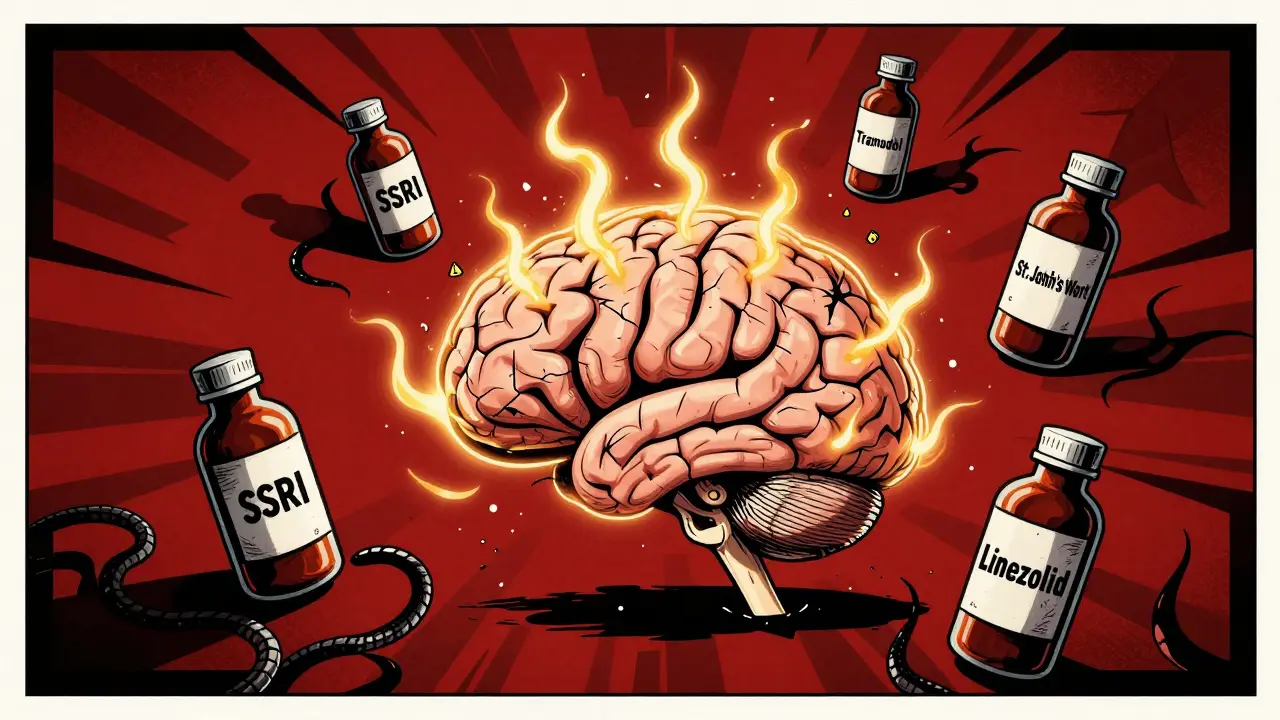
Every year, millions of people take SSRIs to manage depression, anxiety, or OCD. These medications work by boosting serotonin in the brain - a chemical that helps regulate mood. But when SSRIs mix with other drugs, supplements, or even over-the-counter pain relievers, they can trigger something dangerous: serotonin syndrome. It’s not rare. It’s not theoretical. It happens in real people, often because no one connected the dots between their medications.
What Exactly Is Serotonin Syndrome?
Serotonin syndrome isn’t just feeling “too wired.” It’s a medical emergency. Your body gets flooded with too much serotonin, and your nervous system goes into overdrive. Symptoms can start within hours - sometimes as fast as 30 minutes after taking a new drug. You might notice shivering, sweating, a rapid heartbeat, or muscle stiffness. In severe cases, your temperature spikes above 104°F, your muscles lock up, you get confused, or you have seizures. Without quick treatment, it can be fatal.The Hunter Serotonin Toxicity Criteria is what doctors use to diagnose it. You don’t need all the symptoms - just one key combination: involuntary muscle twitching (clonus) plus agitation or sweating, or high body temperature with muscle rigidity and clonus. If you’re on an SSRI and suddenly feel like you’re melting from the inside out, don’t wait. Go to the ER.
Which Medications Are Most Dangerous When Mixed with SSRIs?
Not all drug combinations carry the same risk. Some are quietly deadly.MAOIs are the worst. Mixing an SSRI with an MAOI - like phenelzine or selegiline - is a recipe for disaster. The FDA and every major medical guideline say this combination is absolutely contraindicated. Studies show mortality rates between 30% and 50% when this happens. Even a two-week gap between stopping one and starting the other isn’t always enough. With fluoxetine (Prozac), you need five weeks because it sticks around in your system for so long.
Tramadol, dextromethorphan, and pethidine are opioids, but they’re not like morphine or oxycodone. They also boost serotonin. A 2023 study found people taking SSRIs with tramadol had nearly five times the risk of serotonin syndrome. One Reddit user described being hospitalized after taking tramadol for back pain while on sertraline: “My legs wouldn’t stop shaking. I thought I was having a stroke.”
Linezolid - an antibiotic used for stubborn infections - is another hidden danger. It’s an MAOI in disguise. A 2022 study of older adults found that even a few days of linezolid with an SSRI doubled the risk of serotonin syndrome. Many patients don’t know they’re on an MAOI when they get this antibiotic.
SNRIs like venlafaxine or duloxetine are also serotonin boosters. Combining them with SSRIs increases risk by over three times. Doctors sometimes prescribe both for treatment-resistant depression, but they should be extra cautious. The FDA added a black box warning for this in 2006 - and it’s still ignored too often.
St. John’s wort - a popular herbal supplement for “mild depression” - is a major culprit. It’s sold as “natural,” but it acts like an SSRI. People take it alongside their prescription thinking it’s safer. That’s a myth. One user on Drugs.com said, “Three days after adding St. John’s wort to my Prozac, I couldn’t stop shaking. The ER doctor said I had early serotonin syndrome.”
Why Do So Many People Get This Wrong?
It’s not because patients are careless. It’s because the system is broken.Most people don’t tell their doctor about every supplement they take. They forget about that cough syrup with dextromethorphan. They don’t realize their new painkiller is risky. Pharmacists are overwhelmed. Electronic health records still miss interactions if drugs are entered under different names.
Doctors aren’t always trained to ask the right questions. A 2021 study found that 22% of Americans over 65 take five or more medications daily. That’s a perfect storm. An elderly person on sertraline for anxiety, oxycodone for arthritis, and melatonin for sleep might be fine - until they start taking tramadol for a flare-up. No one connects the dots.
Even the CDC now advises doctors to avoid tramadol, dextromethorphan, and pethidine in patients on SSRIs. Instead, they recommend morphine or oxycodone - which don’t interfere with serotonin. But many prescriptions still get written the old way.
What Should You Do If You’re on an SSRI?
Here’s what you need to know - no fluff, no jargon.- Don’t start any new medication, supplement, or OTC drug without checking with your doctor or pharmacist. This includes cold medicine, migraine pills, herbal teas, or CBD oil.
- Know your SSRI’s half-life. Fluoxetine (Prozac) lasts for weeks. If you stop it, it’s still in your system. Don’t switch to an MAOI or linezolid too soon.
- Learn the 5 S’s: Shivering, Sweating, Stiffness, Seizures (rare), Sudden confusion. If you notice two or more, seek help immediately.
- Keep a list of everything you take. Include doses and when you started. Bring it to every appointment.
- Ask your pharmacist to run a drug interaction check every time you get a new prescription. Most pharmacies will do this for free.
Pharmacists are your best defense. A 2023 study showed pharmacist-led reviews cut serotonin syndrome events by 47% in Medicare patients. That’s not a small number. That’s life-saving.
What About New Testing or Tech?
There’s hope on the horizon. The FDA is requiring all electronic prescribing systems to add mandatory serotonin syndrome alerts for high-risk combinations by 2026. Hospitals using Epic’s system already saw a 32% drop in dangerous SSRI-opioid prescriptions after updates.And in 2026, a new blood test called SerotoninQuant may become available. It’s still in trials, but it could measure serotonin levels directly - something doctors can’t do today. Right now, diagnosis is based on symptoms and history. That’s why so many cases are missed.
Genetics also play a role. People with a CYP2D6 poor metabolizer gene - about 7% of the population - break down tramadol slower. That means more serotonin builds up. If you’ve had bad reactions to painkillers before, ask your doctor about genetic testing.
How Common Is This Really?
You might think, “This sounds scary, but it’s rare.” It’s not.Studies estimate 0.5 to 1.5 cases per 1,000 people on SSRIs each year. That’s thousands of cases in the U.S. alone. The FDA’s adverse event database recorded over 1,800 serotonin syndrome reports linked to SSRIs between 2018 and 2022. And that’s just what got reported. Many mild cases go unnoticed. One GoodRx analysis found 14% of SSRI users taking opioids reported symptoms like sweating or tremors - but only 2% went to the doctor.
The cost? Around $28,745 per hospitalization. And 1,200 to 1,500 people are hospitalized every year because of this preventable condition.
Bottom Line: You’re Not Alone - But You’re Also Not Powerless
SSRIs save lives. But they’re not harmless. The real danger isn’t the drug itself - it’s the invisible web of interactions around it. The same person who carefully tracks their blood pressure meds might take a cough syrup without a second thought. That’s the trap.If you’re on an SSRI, treat every new medication like a potential landmine. Ask questions. Double-check. Keep a list. Trust your body. If something feels off - the shivering, the sweating, the stiffness - don’t wait. Go to the ER. Tell them you’re on an SSRI. That one sentence could save your life.
There’s no shame in asking for help. But there’s real risk in assuming everything’s fine because you’ve been taking your pills for years. Serotonin syndrome doesn’t care how long you’ve been on your meds. It only cares what you added to the mix yesterday.
Can you get serotonin syndrome from just one SSRI?
It’s extremely rare. Serotonin syndrome almost always happens when SSRIs are combined with other serotonin-boosting drugs - like other antidepressants, certain painkillers, or herbal supplements. Taking an SSRI alone, at the right dose, is generally safe. But if you overdose on an SSRI, it’s possible - though still uncommon.
How long does it take for serotonin syndrome to go away?
Mild cases usually resolve within 24 to 72 hours after stopping the offending drug. Severe cases need hospitalization and can take days to weeks. Treatment includes stopping the medication, giving fluids, controlling fever, and sometimes using drugs like cyproheptadine to block serotonin. The faster you get help, the quicker you recover.
Are all SSRIs equally risky?
No. Paroxetine has the strongest serotonin reuptake inhibition, making it slightly more likely to cause issues. Fluoxetine stays in your system for weeks, so the risk lingers even after you stop. Sertraline and escitalopram are generally considered lower risk, but no SSRI is completely safe when mixed with other serotonergic drugs.
Can I take ibuprofen or acetaminophen with an SSRI?
Yes. Regular painkillers like ibuprofen and acetaminophen do not affect serotonin levels and are safe to use with SSRIs. But avoid any painkiller with “dextromethorphan” or “tramadol” in it - those are dangerous combinations. Always check the active ingredients on the label.
Is serotonin syndrome the same as withdrawal?
No. Withdrawal from SSRIs causes dizziness, nausea, brain zaps, and irritability - but not muscle rigidity, high fever, or clonus. Those are signs of serotonin syndrome, not withdrawal. Confusing the two can delay life-saving treatment.
What should I do if my doctor prescribes a risky combination?
Ask why. Say: “I’ve read that combining this with my SSRI can cause serotonin syndrome. Is there a safer alternative?” Most doctors will reconsider - especially if you bring up CDC or FDA guidelines. If they refuse, get a second opinion. Your life is worth it.

Sherman Lee
February 3, 2026 AT 22:26I've been saying this for years. Big Pharma doesn't want you to know how many drugs are secretly serotonin bombs. 🤫 They make billions off the chaos. I saw a guy in the ER last year - shaking like a leaf, eyes rolling back. He was on Zoloft and took NyQuil. NyQuil. 😳 They discharged him after 48 hours. No one even mentioned the interaction. It's a cover-up.
Janice Williams
February 4, 2026 AT 11:30It is, of course, profoundly irresponsible to suggest that individuals should be left to navigate pharmacological interactions without professional oversight. The notion that laypersons can reliably self-assess drug risks is not only misguided-it is dangerously naive. The medical establishment exists for a reason.
Katherine Urbahn
February 5, 2026 AT 12:20I'm shocked-SHOCKED-that anyone would even consider combining SSRIs with over-the-counter medications without consulting a licensed physician. There are documented cases of death from this. You're not a biochemist. You're not a pharmacist. You're not even a medical student. Stop guessing. Stop Googling. Stop being a liability to yourself and others.
caroline hernandez
February 6, 2026 AT 12:03This is a textbook example of polypharmacy risk stratification. The key intervention here is proactive medication reconciliation-ideally conducted by a clinical pharmacist during every visit. The 47% reduction in serotonin syndrome events in Medicare cohorts? That's not anecdotal-it's statistically significant. You need to institutionalize this. Not just ‘ask your pharmacist’-but mandate it. Audit the scripts. Flag the combos. That’s how you scale safety.
Joseph Cooksey
February 7, 2026 AT 23:40Look, I get it. SSRIs are like the new multivitamin-everyone’s popping them. But here’s the kicker: the real danger isn’t the drugs. It’s the fact that doctors are treating depression like a plumbing issue. ‘Oh, you’re leaking serotonin? Here’s a pipe cleaner. Now go fix your life.’ Meanwhile, they’re slapping on tramadol like it’s ibuprofen. And don’t even get me started on how St. John’s Wort is sold like a spa treatment. It’s not a tea. It’s a chemical grenade with a herbal label. I’ve seen too many people walk out of the ER on a gurney because someone thought ‘natural’ meant ‘safe.’ It doesn’t. It means ‘unregulated.’
Meenal Khurana
February 8, 2026 AT 23:53Thank you for this. I will share with my sister in the US.
Antwonette Robinson
February 9, 2026 AT 14:04Oh wow. So now we're supposed to read the entire FDA warning before taking a cough drop? Next they'll make us pass a pharmacology quiz to buy Advil. Can we get a QR code on every pill bottle that plays a 10-minute TED Talk? 🙄
Ed Mackey
February 11, 2026 AT 04:18i had a friend who took tramadol with citalopram and ended up in the er. he said his legs felt like they were made of metal. he thought it was just anxiety. i told him to stop the tramadol and he did. he was fine in 2 days. but no one told him it was risky. even his dr didn't ask about his meds. it's scary how easy it is to miss this.
Mandy Vodak-Marotta
February 12, 2026 AT 19:28I used to be one of those people who thought ‘natural’ meant ‘harmless’ until I took St. John’s wort with my Lexapro and spent 36 hours feeling like I was being electrocuted from the inside. My heart was racing, I couldn’t stop sweating, and I swear I saw colors I didn’t know existed. I thought I was dying. I didn’t go to the hospital because I was too embarrassed. But I wish I had. I’m telling you now: if you’re on an SSRI and you think herbal stuff is ‘just a little boost,’ you’re playing Russian roulette with your nervous system. It’s not a vibe. It’s a medical emergency waiting to happen.
pradnya paramita
February 13, 2026 AT 04:47From a clinical pharmacology perspective, the CYP2D6 poor metabolizer phenotype is critical here. Tramadol is a prodrug requiring CYP2D6 for conversion to O-desmethyltramadol, the active serotonergic metabolite. In poor metabolizers, the parent compound accumulates, leading to direct SERT inhibition without the expected opioid effect. This creates a pharmacokinetic trap. Genetic testing should be standard before prescribing tramadol in SSRI users. The FDA’s 2023 update acknowledges this-but implementation remains patchy.
Prajwal Manjunath Shanthappa
February 13, 2026 AT 09:49It's rather amusing, isn't it, how the general public has developed this pathological aversion to authority-yet simultaneously believes they can intuitively understand neuropharmacology better than a board-certified psychiatrist? The notion that a Reddit post-however well-researched-is somehow equivalent to peer-reviewed clinical guidance is not just naive; it's emblematic of the intellectual decay of the digital age. We have pharmacists for a reason. We have physicians for a reason. And we have the Hippocratic Oath-for a reason.