

Over 1.5 billion people worldwide live with some level of hearing loss. That’s more than the entire population of the United States and Canada combined. Yet only about 34 million of them use hearing aids. Why? Too often, it’s not because they don’t need them-it’s because they don’t know what’s out there, how they work, or where to start. If you’re considering a hearing aid, you’re not alone. And you don’t need to be overwhelmed. This guide cuts through the noise and gives you the real, up-to-date facts on hearing aid types, how they’re fitted, and the technology making today’s devices smarter than ever.
What Are the Main Types of Hearing Aids?
Hearing aids aren’t one-size-fits-all. The style you choose depends on your hearing loss, lifestyle, ear shape, and even how visible you want the device to be. Here are the five main types you’ll see in 2026.
- Behind-the-Ear (BTE): These sit behind your ear and connect to an earmold or dome that fits inside the ear canal. They’re bulkier but pack the most power. Ideal for moderate to profound hearing loss. Models like the Phonak Naída Lumity L-UP is a behind-the-ear hearing aid designed for severe to profound hearing loss with IP68 water resistance and 1-3 weeks of battery life are built for active users who need durability and long battery life.
- Receiver-in-Canal (RIC): The most popular style today. The speaker sits inside the ear canal, connected by a thin wire to a small unit behind the ear. They’re discreet, comfortable, and support advanced features like Bluetooth and LE Audio. The Jabra Enhance Select 700 is a receiver-in-canal hearing aid with 24-hour battery life, IP68 rating, and LE Audio support is a top-rated OTC option that works well for mild-to-moderate loss.
- In-the-Ear (ITE): These fill the outer part of your ear. They’re larger than canal styles but easier to handle than tiny models. Good for people with dexterity issues. The Signia Active Pro IX is an in-the-ear hearing aid with 34 hours of battery life, IP68 protection, and Bluetooth 5.2 connectivity offers long battery life and seamless phone streaming.
- Completely-in-Canal (CIC) and Invisible-in-Canal (IIC): These are nearly hidden. They fit deep inside the ear canal and are great for cosmetic concerns. But they’re small, which means shorter battery life and fewer features. Brands like Eargo is an invisible-in-canal hearing aid designed for cosmetic appeal with 16-20 hours of battery life specialize here-but users often report battery life falls short of claims.
- Body-worn and Bone Conduction: Less common. Body-worn aids are used for profound loss or when ear anatomy prevents other styles. Bone conduction devices are for people with conductive hearing loss or single-sided deafness.
Not all styles work for everyone. If you have severe loss, CIC or IIC models won’t give you enough power. If you have small ear canals, BTEs might be the only option. A professional fitting helps avoid this mismatch.
How Are Hearing Aids Fitted?
Fitting isn’t just about putting a device in your ear. It’s a process that turns a generic tool into something personalized to your hearing profile.
If you’re buying an over-the-counter (OTC) hearing aid-like the Jabra Enhance Select 700 or Eargo-you’ll do most of the work yourself. You download the app, take a hearing test using your phone’s microphone, adjust volume and tone settings, and try different programs. According to HearingTracker’s 2025 tests, 85% of users complete this setup successfully on the first try. It takes about 2.5 hours total. But here’s the catch: 68% of users in NIH trials ended up with improper amplification because they misjudged their hearing loss level. OTC devices are great for mild-to-moderate loss-but if your loss is more complex, you’re risking poor results.
Prescription hearing aids go through a clinical process. You start with a full hearing evaluation by an audiologist. They map your hearing loss across frequencies (250 Hz to 8,000 Hz) and determine the exact amplification needed. Then, they take an ear impression or digital scan to ensure the device fits perfectly. After the device is programmed, you return for follow-up visits-usually 2 to 4 over 2 to 3 weeks. During these sessions, the audiologist fine-tunes the settings based on your real-world feedback. You might say, “I can hear people in the office, but the coffee machine is too loud,” and they’ll adjust the noise reduction algorithm. This level of customization is why prescription devices outperform OTC models in noisy environments.
One major issue? Earwax. It’s the #1 cause of hearing aid malfunctions. Around 42% of users experience blockages monthly. The fix? Weekly cleaning with the manufacturer’s tools. Clinical data shows this reduces device failures by 67%. Always keep a cleaning kit handy.
What’s New in Amplification Technology?
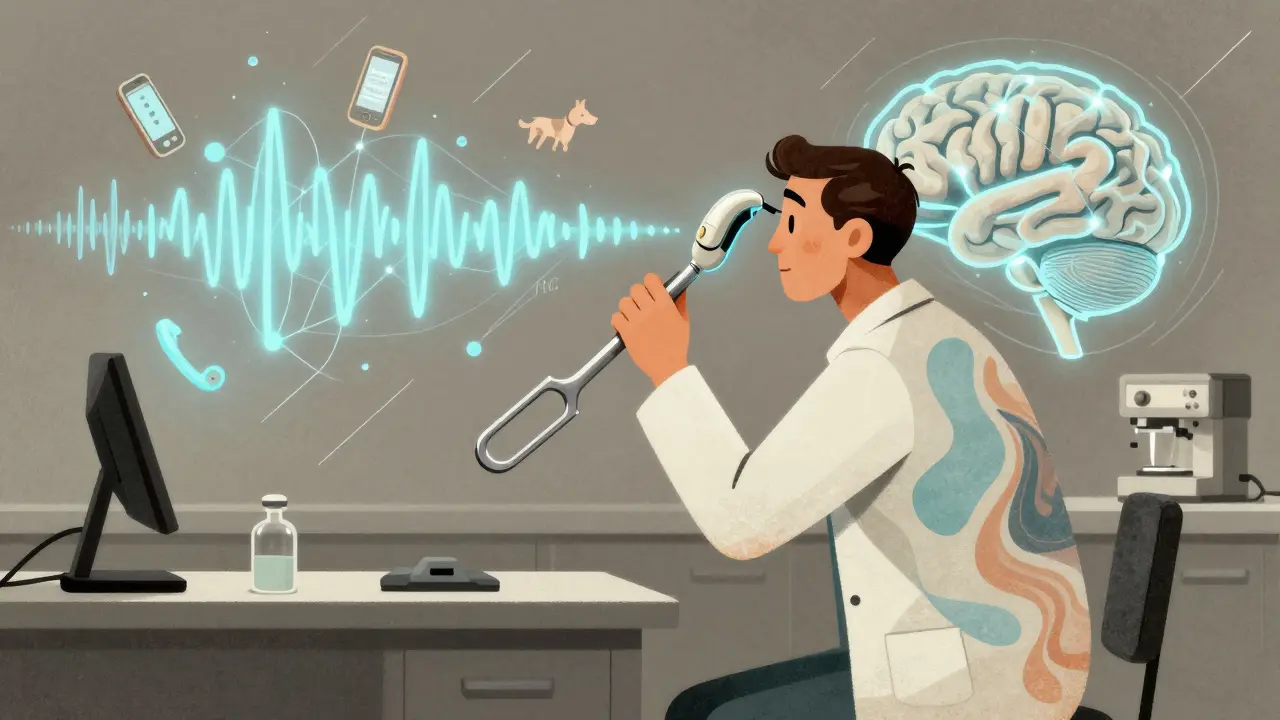
Modern hearing aids aren’t just amplifiers-they’re mini-computers. The old days of turning up the volume are gone. Today’s devices process sound in real time, using AI and advanced chipsets to make speech clearer and background noise quieter.
The biggest leap? Dual-chip architecture. Brands like Phonak now use two separate processors: one for handling sound input, the other for output. This cuts processing delay from 5-7 milliseconds down to just 0.4 milliseconds. That might sound tiny, but it’s the difference between hearing a voice naturally and hearing it slightly out of sync-like a bad Zoom call. Dr. Brian Taylor of HearingTracker calls this the current pinnacle of hearing aid tech.
Another game-changer: LE Audio and Auracast. Older Bluetooth only let you stream audio to one device at a time. LE Audio, introduced in 2024, allows multiple devices to connect simultaneously. You can stream music to your hearing aids while also connecting to a TV or phone. And with Auracast, you can join public audio broadcasts-like in a museum, airport, or restaurant-without needing to pair anything. About 42% of Starkey Edge AI users now use this feature in group settings.
Then there’s AI sound processing. The Starkey Edge AI is a hearing aid with AI-driven sound processing that analyzes 290 million data points per second to optimize sound quality in various environments listens to your surroundings 290 million times per second. It recognizes whether you’re in a car, a crowded room, or a quiet library-and adjusts instantly. It even learns your preferences over time. One user in Perth said, “It figured out I hate the sound of my dog barking in the backyard and quietly lowered it without me touching a button.”
Even battery life has improved. Premium RIC models now last 24-29 hours on a single charge. Some use rechargeable lithium-ion batteries that last 3-4 years before needing replacement. For users who forget to charge, models like the Phonak Naída Lumity L-UP offer weeks of use with standard zinc-air batteries.
Price Ranges and Where to Buy
Hearing aids can cost anywhere from $200 to over $7,500 per pair. The price doesn’t always mean better performance-but it does reflect the level of service and technology.
- OTC (Over-the-Counter): $199-$1,299 per pair. Jabra Enhance Select 700 is the most popular, with a 4.7/5 rating from over 1,200 users. These are great for mild-to-moderate loss and tech-savvy users who want app control.
- Telehealth Models: $1,000-$3,500. These are prescription-grade devices sold online with remote support. Companies like Audien and Lexie offer this model. You get professional programming without visiting a clinic.
- Costco and Retail Clinics: $1,399-$2,999. Rexton Reach models are sold here with in-store support. They’re a middle ground-affordable but still professionally fitted.
- Premium In-Clinic Brands: $3,500-$7,500+. Phonak, Oticon, ReSound, Widex, Starkey, and Signia dominate this space. The Phonak Audéo Infinio Sphere is a premium prescription hearing aid known for natural sound quality and priced at $6,000-$7,500 per pair leads in sound quality but comes at a premium.
Phonak holds 22.3% of the global prescription market, according to 2024 Statista data. But don’t assume brand = better. A $1,500 telehealth device might suit your needs just as well as a $6,000 model-if your hearing loss is mild and your environment isn’t overly noisy.
What Users Say (Real Feedback)
Real people, real experiences. Here’s what’s being said across forums, reviews, and clinics.
- Positive: “My Jabra hearing aids let me stream music from Spotify without lag. I didn’t think that was possible.” - Reddit user, r/Hearing
- Positive: “The Starkey Edge AI picked up my granddaughter’s voice in a noisy restaurant. I cried.” - HearingTracker review
- Negative: “Eargo’s battery dies by 4 PM, even after a full charge. I’m back to my old BTE.” - Trustpilot review
- Negative: “I bought an OTC device because I thought it was cheaper. Ended up needing a new prescription pair six months later.” - Journal of the American Academy of Audiology survey
Pro tips from users? Keep silica gel packets in your hearing aid case to fight humidity. Use the “Auracast” feature in public places. Clean your devices weekly. And don’t rush the adjustment period-it takes 2 to 4 weeks for your brain to adapt to new sound input.
What’s Coming Next?
Hearing aids are becoming health monitors. Starkey’s 2026 roadmap includes features like blood oxygen tracking and fall detection. ReSound’s new MAV technology reduces the “occlusion effect” (that plugged-up feeling) by 45%. And with 41% of buyers expected to choose telehealth by 2027, the future is moving away from clinics and toward apps.
But there’s a risk. A 2025 University of Michigan study found 12% of Bluetooth-enabled hearing aids are vulnerable to signal interception. While no major breaches have occurred, it’s something to consider if you’re using sensitive features like real-time translation or voice assistants.
The global market is growing fast. It’s projected to hit $14.3 billion by 2029. And with 2.5 billion people expected to have hearing loss by 2050, these devices aren’t going away-they’re getting smarter.
Can I use OTC hearing aids if I have severe hearing loss?
No. OTC hearing aids are only approved for adults with mild-to-moderate hearing loss. If you have severe or profound loss, you need a prescription device designed for higher amplification. Using an OTC model in this case can lead to inadequate sound quality and even further damage from over-amplification. Always get a professional hearing test first.
How long does it take to get used to hearing aids?
Most people need 2 to 4 weeks to fully adjust. Your brain has to relearn how to process sounds it hasn’t heard clearly in years. At first, everything might sound too loud or tinny. That’s normal. Stick with it. Use the device daily, even if just for short periods. Follow-up appointments with your audiologist help fine-tune the settings as you adapt.
Do hearing aids work with smartphones?
Yes, most modern hearing aids connect directly to iPhones and Android phones via Bluetooth. You can take calls, stream music, and adjust settings using apps. Newer models support LE Audio and Auracast, which allow you to connect to public audio systems in places like airports and theaters without pairing. Make sure your phone supports Bluetooth 5.0 or higher for the best experience.
Are rechargeable hearing aids better than battery-powered ones?
It depends. Rechargeable models (like most RIC and ITE styles) are more convenient-you just place them in a charger overnight. They last 24-29 hours per charge and the batteries last 3-4 years. But if you travel often or live in a place with unreliable power, zinc-air batteries (used in BTEs) are more reliable. You can swap them out quickly and carry extras. Rechargeable is better for daily use; disposable batteries are better for reliability.
What’s the difference between a hearing aid and a sound amplifier?
Hearing aids are medical devices regulated by the FDA and designed to treat hearing loss based on your unique hearing test. Sound amplifiers (like personal sound amplification products, or PSAPs) are general-purpose devices that just make everything louder. They’re not meant for people with diagnosed hearing loss. Using a PSAP instead of a hearing aid can delay proper treatment and worsen hearing over time.
How do I know which brand is right for me?
Don’t pick based on brand alone. Look at features: Do you need Bluetooth? LE Audio? Long battery life? Noise reduction? Then match those to your lifestyle. If you’re active outdoors, go for IP68 water resistance. If you’re in noisy environments often, choose a model with multi-microphone directional tech. Ask your audiologist for a demo. Try the device in real settings-not just in a quiet room. Your experience matters more than the name on the box.
Next Steps
If you think you need a hearing aid, start with a free hearing screening. Many pharmacies and audiology clinics offer them. Don’t wait until you’re struggling in conversations. The sooner you address hearing loss, the better your brain can adapt. If you’re unsure whether to go OTC or prescription, talk to an audiologist-even one visit can save you time and money in the long run. The right device isn’t about the price tag. It’s about fitting your life, your hearing, and your future.





Cam Jane
January 6, 2026 AT 16:57Just got my Jabra Enhance Select 700 last week and I’m already obsessed. Streamed my whole playlist through them during a cross-country flight-no lag, no weird echo, just clean sound. I used to hate phone calls, now I answer without cringing. Also, the app’s hearing test was shockingly accurate. No audiologist visit needed. OTC isn’t ‘cheap’-it’s accessible.
Isaac Jules
January 7, 2026 AT 19:27LOL you people act like OTC hearing aids are magic. 68% of users mess up their own fitting? That’s not a feature, that’s a liability. You think your phone mic can measure 250Hz–8kHz accurately? I’ve seen people crank these things to 11 and blow out what’s left of their hearing. Stop glorifying DIY medical devices. 😂
Tiffany Adjei - Opong
January 9, 2026 AT 08:33Oh please, Isaac, you sound like a FDA lobbyist. I had a BTE for 8 years and it sounded like I was underwater in a washing machine. The Jabra? It’s like someone turned on the volume on reality. And yeah, I did the app test myself-my audiologist later confirmed it was spot-on. If you’re too scared to try tech that doesn’t require a $3000 co-pay, that’s your problem, not mine. 🤷♀️
Amy Le
January 9, 2026 AT 23:04OTC hearing aids are a scam perpetuated by Silicon Valley to sell gadgets to old people who can’t read the fine print. 🇺🇸 The real solution? Universal healthcare that covers real audiologists-not apps that say ‘you have mild loss’ because you missed a tone at 4kHz while your dog barked. Also, LE Audio? Cute. But we still live in a world where 40% of seniors can’t figure out how to charge a phone. 🤦♀️
Pavan Vora
January 11, 2026 AT 22:10Wow, this is very informative, thank you so much! 😊 I am from India, and here, hearing aids are very expensive, and many people think it is a sign of weakness to wear them. But after reading this, I think my uncle should try a RIC model-he has mild loss and loves music. Also, I will tell him to clean it weekly, because here, everyone forgets and then says ‘it stopped working’ 😅
Stuart Shield
January 13, 2026 AT 15:34That dual-chip thing? Mind. Blown. I used to think hearing aids were just little amplifiers. Turns out they’re like tiny AI-powered neuro-surgeons for your ears. The 0.4ms delay? That’s the difference between hearing your granddaughter say ‘I love you’ and hearing it like a glitchy Zoom call from 2020. We’re not just fixing ears-we’re restoring moments. 🖤
Indra Triawan
January 14, 2026 AT 21:30I used to think hearing loss was just… aging. But now I realize it’s not about volume-it’s about connection. I lost my husband last year, and I didn’t realize how much I missed the sound of his laugh until I got my first aid. Now I hear it again-in the quiet moments. Not because the tech is fancy. But because it lets me remember.
Lily Lilyy
January 15, 2026 AT 12:35Everyone deserves to hear their loved ones clearly. Please don’t delay. Get a screening today. It’s not a luxury-it’s a lifeline. Your brain remembers what it hears. Don’t let silence steal your memories. 💛
Susan Arlene
January 16, 2026 AT 13:07the eargo battery thing is real. mine died at 3pm every day. i just went back to my old bte. at least it didn’t need charging. also, why does everything have to be bluetooth now? sometimes i just wanna sit in silence. 🤷♀️
Joann Absi
January 17, 2026 AT 23:04AMERICA IS THE ONLY COUNTRY THAT THINKS A PHONE APP CAN REPLACE A DOCTOR. 🇺🇸💥 The rest of the world knows you don’t treat medical conditions with tech bros and lithium-ion batteries. Starkey? Phonak? They’re all just corporate buzzwords. Real hearing care happens in a clinic, not in your pocket. Also, Auracast? Sounds like a sci-fi movie. 😭