
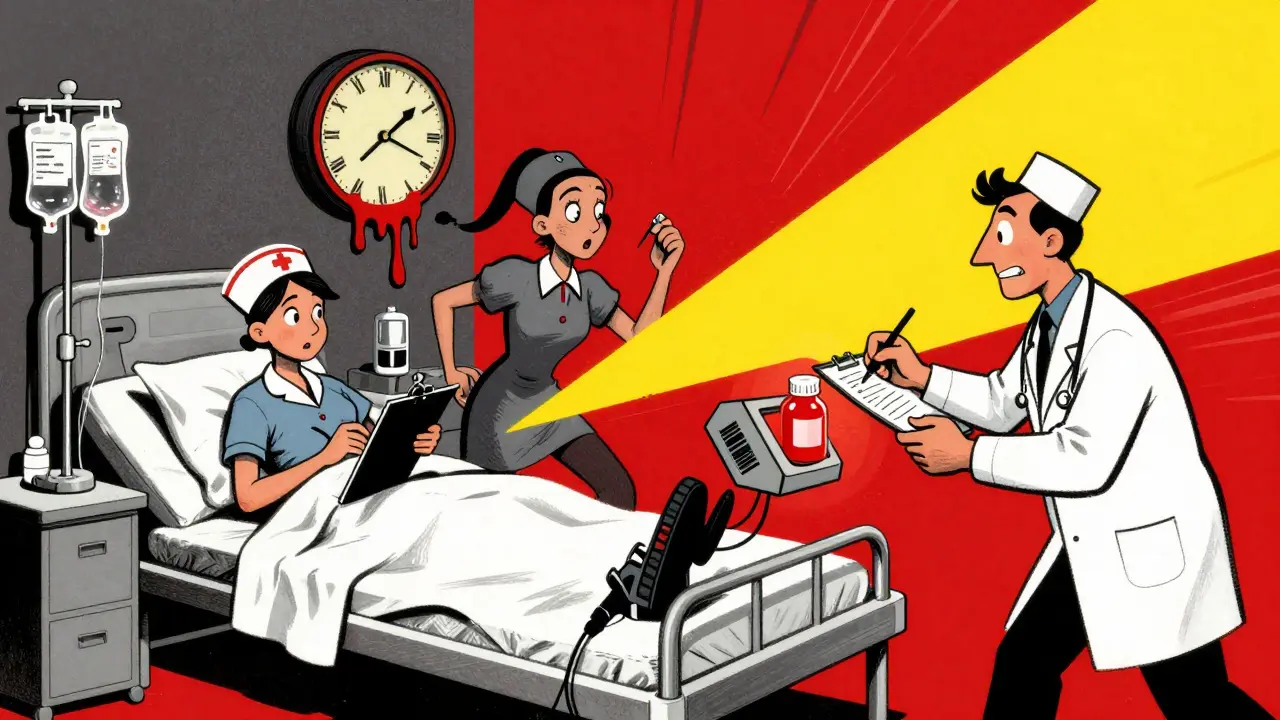
Every year, millions of people in the U.S. receive the wrong medication, the wrong dose, or wrong instructions - not because of bad luck, but because of systemic flaws in how medicines are handled. The scary part? It happens in both hospitals and your local pharmacy. But here’s the twist: the medication errors in these two places aren’t just different in number - they’re different in kind, in risk, and in how they slip through the cracks.
How Often Do Errors Happen?
In hospitals, mistakes are common. One major study found that nearly 1 in 5 doses given to patients contained some kind of error. That’s 20%. It could be the wrong drug, the wrong time, the wrong amount - or even the right drug given to the wrong patient. Nurses, doctors, and pharmacists are all part of the chain, and with shift changes, complex charts, and high patient loads, something’s bound to slip. Now, compare that to your neighborhood pharmacy. At first glance, it seems safer. Studies show community pharmacies make mistakes in only about 1.5% of prescriptions. That sounds low - until you realize how many prescriptions are filled every year. In the U.S., that’s 3 billion. So 1.5% equals roughly 45 million errors annually. That’s not a small number. It’s like every pharmacy in the country making one mistake every single day. Here’s the real difference: hospitals have layers of checks. A nurse double-checks the drug before giving it. A pharmacist reviews the order. A barcode scanner confirms the right patient gets the right pill. In a retail pharmacy? Once the pharmacist hands you the bottle, you’re on your own. No one’s there to ask if the label makes sense. No one’s checking if you’re supposed to take one pill a week - not a day.What Kind of Errors Happen Where?
In retail pharmacies, the most common errors are simple but deadly:- Wrong medication - you asked for insulin, you got metformin
- Wrong dose - 10 mg instead of 1 mg
- Wrong directions - "Take once daily" instead of "Take once weekly"
- Doctors write illegible orders
- Pharmacists misread them
- Nurses give the wrong drug at the wrong time
- Patients get the wrong IV bag because someone mixed up the labels
Why Do These Errors Happen?
In community pharmacies, the biggest culprits aren’t lazy staff - they’re bad systems. Pharmacists are under pressure. They’re filling 250 prescriptions a day. They’re interrupted by phone calls, customers asking for cough syrup, and managers pushing for faster service. A 2023 AHRQ report found that 80% of pharmacy errors come from cognitive overload - not from carelessness. The brain gets tired. The eyes skip lines. The computer auto-fills the wrong dose. Automation doesn’t always help. Some systems auto-populate doses based on weight or age, but if the patient’s weight isn’t entered correctly, the system just makes the mistake faster. In hospitals, it’s about communication. A doctor writes a prescription on paper. A nurse transcribes it into the computer. The pharmacist reviews it. Then another nurse gives it. Each step is a chance for miscommunication. And if the patient is confused, sedated, or nonverbal - they can’t speak up. One study found that 40% of hospital medication errors involved unclear handwriting or ambiguous abbreviations. "U" for units? "QD" for daily? Those shortcuts still exist - and they kill.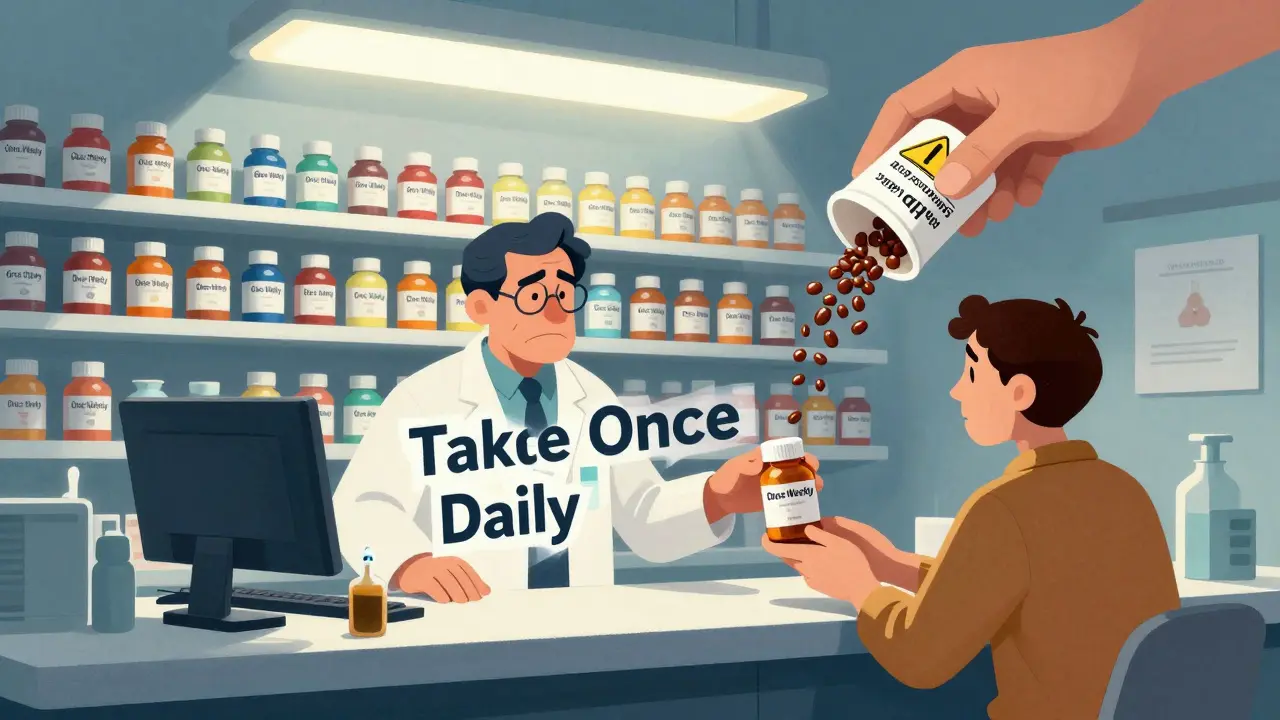
Who Notices the Mistakes?
This is where the biggest gap lies. In hospitals, there are safety nets. Nurses check the patient’s wristband. They scan the barcode on the pill. They cross-reference the order. If something’s off, they stop. They call the pharmacist. They ask the doctor. There’s a system designed to catch errors before they hurt someone. In retail pharmacies? The patient is the last line of defense. And most people don’t know what they’re supposed to be taking. They trust the label. They trust the pharmacist. They assume it’s right. And when they get home, they don’t compare the new bottle to the old one. They don’t check the dose against what their doctor said. They just take it. That’s why some of the most dangerous errors happen in community pharmacies - because they’re invisible until it’s too late. A patient takes a wrong dose of warfarin and ends up bleeding internally. Or takes too much insulin and goes into a coma. By the time they get to the ER, the damage is done.Are These Errors Reported?
Hospitals are required to report medication errors. They track them. They analyze them. They hold safety meetings. Big hospitals report over 100 errors a month - not because they’re bad, but because they’re looking. Community pharmacies? Not so much. Until recently, reporting was voluntary. Many pharmacies didn’t even have a system to log mistakes. California was one of the first states to require pharmacists to report dispensing errors to the board of pharmacy. Other states are catching up. But most still don’t. The FDA gets over 100,000 medication error reports a year. That sounds like a lot - until you realize it’s less than 1% of what actually happens. Most people don’t know they’ve been harmed. Or they think it was their fault. Or they’re too scared to complain.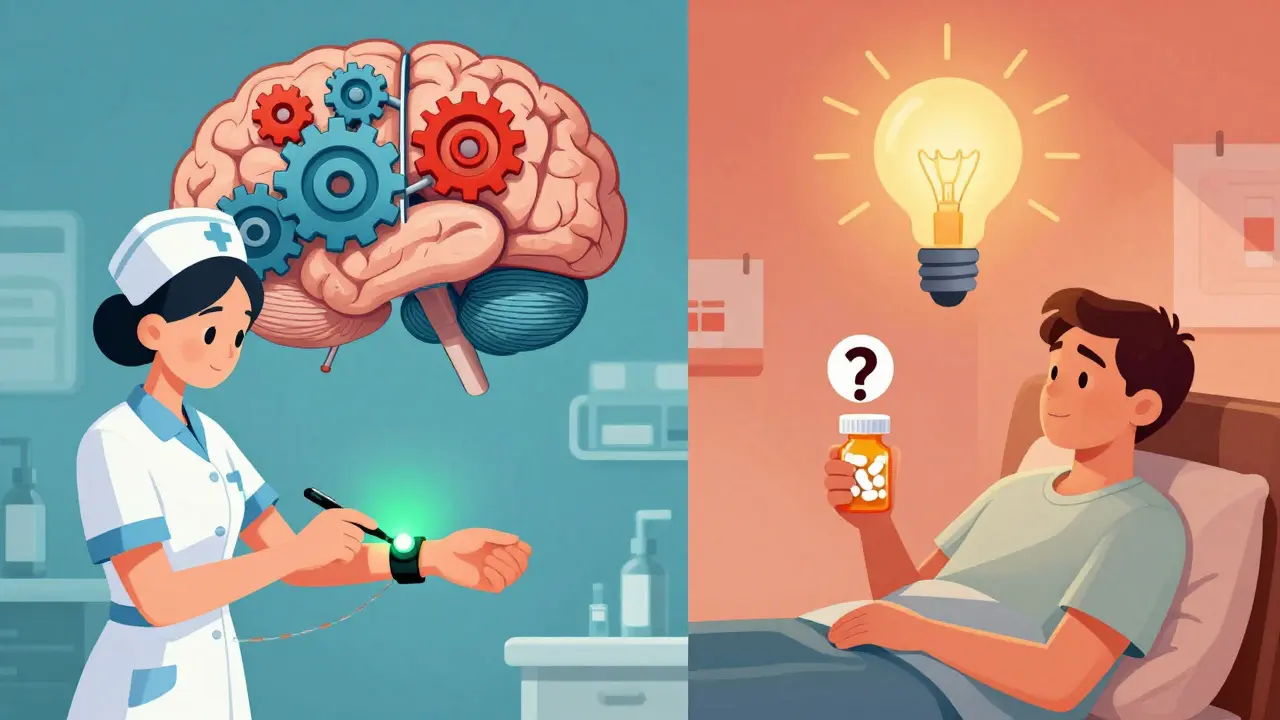
What’s Being Done to Fix This?
In hospitals, technology is making a difference. Barcode scanning systems have cut administration errors by up to 86%. Electronic prescribing eliminates handwriting issues. Integrated systems link the doctor’s order directly to the pharmacy’s dispensing system - no middlemen, no transcription errors. Mayo Clinic cut hospital medication errors by 52% just by linking their EHR and pharmacy systems. That’s huge. In retail pharmacies, AI is starting to help. CVS Health rolled out an AI-powered verification system in 2022. It flags mismatches between the prescription and the label. It checks for drug interactions. It catches wrong doses before they leave the counter. Their internal audit showed a 37% drop in dispensing errors. Pharmacists are also starting to offer medication therapy management - where they sit down with patients and go over every pill they take. It’s not just about filling prescriptions anymore. It’s about understanding what’s in the bottle. But the biggest fix isn’t technology. It’s culture. Both settings need to stop blaming the person who made the mistake - and start fixing the system that let it happen.What Can You Do?
You’re not powerless. Here’s how to protect yourself:- Always ask: "What is this medicine for?" and "How many times a day do I take it?"
- Compare the new bottle to the old one. Is the color, shape, or size different? Ask why.
- Take a picture of the label before you leave the pharmacy. Keep it on your phone.
- Use one pharmacy for all your prescriptions. That way, they can check for interactions.
- If you’re in the hospital, ask the nurse to show you the medication before they give it to you.
- Don’t be afraid to say: "That doesn’t look right. Can you double-check?"
Joseph Manuel
December 23, 2025 AT 05:51The data presented here reveals a critical dissonance between institutional accountability and consumer-facing systems. Hospital medication errors, while numerically higher, are mitigated by layered safety protocols-barcode verification, electronic prescribing, and multidisciplinary cross-checks. Retail pharmacies, despite lower error rates, operate with minimal redundancy. The absence of real-time verification at point-of-dispense transforms a 1.5% error rate into a public health crisis of unprecedented scale. The systemic failure is not human error-it’s architectural negligence.
Moreover, the reliance on patient vigilance as the final safeguard is ethically indefensible. Patients are not trained pharmacists. Expecting them to detect dose discrepancies between insulin and metformin, or to parse ambiguous abbreviations like 'QD' versus 'qd', is a form of institutionalized malpractice. The solution is not behavioral modification of consumers, but mandatory implementation of AI-driven verification engines at every retail dispensing terminal-identical to those already proven effective in hospital settings.
The FDA’s underreporting problem is not a data gap-it’s a symptom of systemic denial. Until mandatory error reporting is federally codified for all dispensing entities, regardless of setting, we are merely rearranging deck chairs on the Titanic.
Technological adoption is not optional. It is the baseline standard of care. The fact that CVS reduced errors by 37% using AI proves scalability. The question is no longer 'can we?' but 'why haven’t we yet?'
Bret Freeman
December 24, 2025 AT 08:00This is the exact reason I stopped trusting pharmacies after my aunt died from a wrong insulin dose. They treat you like a number, not a person. And don’t get me started on how they rush you out the door like you’re in a drive-thru. One minute you’re asking about side effects, the next they’re yelling at the next customer to stop using the pharmacy as a social club. No one’s checking if you’re even supposed to be taking that pill. It’s all about speed, profit, and covering their backs. And the worst part? They act like you’re crazy for asking questions. I swear, if I had a dollar for every time a pharmacist said 'Trust me,' I’d have retired by now.
niharika hardikar
December 25, 2025 AT 03:33From a pharmacoeconomic standpoint, the divergence in error architecture between institutional and community pharmacy environments reflects a fundamental misalignment in risk allocation. Hospitals internalize error costs through liability frameworks, regulatory oversight, and integrated clinical informatics. Community pharmacies externalize these costs onto the patient, who lacks the cognitive bandwidth, medical literacy, or institutional recourse to mitigate dispensing anomalies. The 1.5% error rate, when aggregated across 3 billion annual prescriptions, constitutes a population-level pharmacovigilance failure. The absence of mandatory error reporting in 47 states is not regulatory oversight-it is regulatory abandonment. The implementation of real-time, AI-augmented dispensing verification systems, coupled with mandatory patient counseling protocols under CMS guidelines, is not an enhancement-it is a minimum viable standard of care. Until regulatory bodies enforce this, the current paradigm remains a form of structural violence against vulnerable populations.
Rachel Cericola
December 26, 2025 AT 18:31I’ve been a pharmacist for 22 years, and let me tell you-this article nails it. But here’s what no one talks about: we’re not just overworked, we’re under-resourced. One pharmacy I worked at had 3 pharmacists handling 400 scripts a day. That’s over 130 scripts per person. You’re on the phone with insurance, answering questions, filling med packs, checking interactions, and then-bam-someone walks in asking for a new prescription for their dog. No one sees the mental load. We’re not robots. We’re human beings trying to do our best in a broken system.
But here’s the good news: change is happening. More pharmacies are now offering MTM (Medication Therapy Management) services. We sit down with patients, go through every pill, ask about supplements, check for duplicates. We’re starting to treat medication like a conversation, not a transaction.
And yes, AI tools are helping-CVS’s system flagged a mislabeling of warfarin 10x more accurately than manual checks. But tech alone won’t fix this. We need more staff, better pay, and a culture that says: it’s okay to slow down. It’s okay to say, ‘Let me double-check that.’
Patients: you’re not being paranoid if you ask questions. You’re being smart. And if a pharmacist rolls their eyes? Find another one. Your life matters more than their speed quota.
Blow Job
December 28, 2025 AT 09:01Just wanted to say thank you for writing this. I had no idea how bad it was out there. I used to just take whatever they handed me. Now I take a pic of every label, check the bottle against the doctor’s note, and ask the same question twice. Last week I caught a 10x overdose on my blood pressure med. The pharmacist said, 'Oh wow, that’s weird,' and just fixed it. I almost cried. You’re right-we’re not powerless. We just have to be loud. And if you’re scared to speak up? Just say, 'I’m not comfortable with this.' That’s all it takes.
Christine Détraz
December 30, 2025 AT 08:55I really appreciate how balanced this post is. It’s easy to blame pharmacies or hospitals, but the truth is both systems are trying to function under impossible conditions. I think the real takeaway is that we all need to be more patient-with each other, with the system, and with ourselves. Mistakes happen. What matters is how we respond. If we can create spaces where people feel safe to admit errors without fear, that’s when real change begins. Maybe we don’t need more tech. Maybe we just need more humanity.
John Pearce CP
December 30, 2025 AT 18:42The erosion of professional standards in American healthcare is a direct consequence of decades of liberal deregulation and the commodification of medical services. Hospitals, burdened by bureaucratic bloat and unionized inefficiency, are riddled with preventable errors-yet they are shielded by taxpayer-funded malpractice insurance and federal mandates. Meanwhile, the independent pharmacist, the last bastion of personal accountability in medicine, is being strangled by corporate chains that prioritize quarterly profits over patient safety. The solution? Abolish the FDA’s monopoly on pharmaceutical oversight. Restore state licensing authority. End the federal mandate for electronic prescribing. Let local pharmacists-trained, licensed, and accountable-serve their communities without corporate interference. Only then will the system regain its moral compass.
EMMANUEL EMEKAOGBOR
December 31, 2025 AT 21:29This is a very thoughtful analysis. In Nigeria, we don’t have the same level of technology or regulation, but we also don’t have the same volume of prescriptions. What I’ve noticed is that when errors happen, they’re often caught by family members or traditional healers who know the patient’s history. There’s a community-based safety net that’s informal but effective. Maybe the answer isn’t just more tech-but more connection. If pharmacists took time to know their patients by name, not just by script, maybe fewer mistakes would slip through. Technology helps, but trust matters more.
CHETAN MANDLECHA
January 1, 2026 AT 14:45My uncle died because of a pharmacy error. No one talked about it. No one got in trouble. I didn’t even know it was an error until years later, when I found the old prescription bottle. The label said 'take once daily'-but his doctor wrote 'once weekly.' No one caught it. No one apologized. Just another statistic. I wish more people knew how fragile this system is. You think you’re safe? You’re not. Always check. Always ask. Always keep a copy. Because if you don’t, who will?