
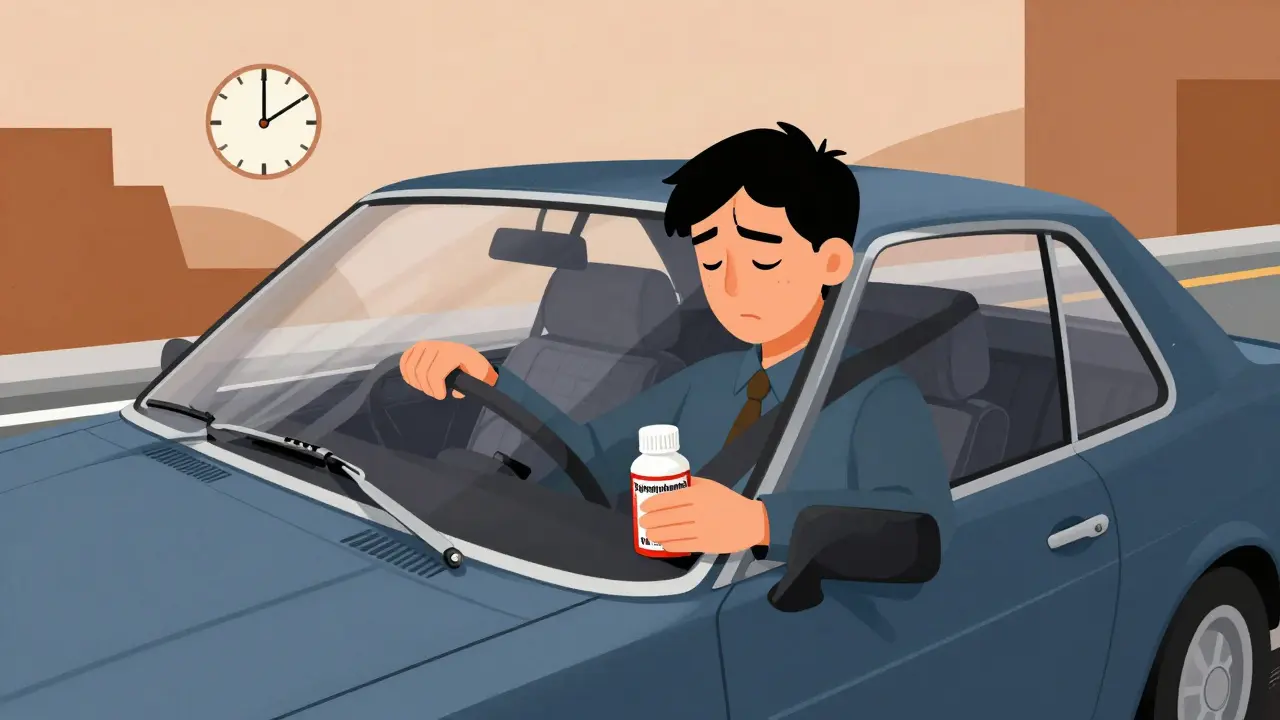
It’s 8 a.m. You took your nighttime sleep aid last night - the one with diphenhydramine. You feel fine. No drowsiness. So you hop in the car and drive to work. Two hours later, you’re pulled over. The officer says you failed the field sobriety test. You didn’t drink. You didn’t use drugs. But the test showed impairment. That’s the reality for thousands of drivers every year who don’t realize their medications are making them unsafe behind the wheel.
How Medications Slow You Down Without You Knowing
Many people think only alcohol or illegal drugs can impair driving. That’s not true. Prescription and over-the-counter meds can do the same thing - sometimes worse. Benzodiazepines like Xanax or Valium can slow your brain’s processing speed by up to 40%. That means if a car suddenly stops in front of you, your reaction time is delayed. Not by a fraction of a second - by half a second or more. At 60 km/h, that’s over 8 meters of extra stopping distance. That’s the length of a small car. Opioids like oxycodone or fentanyl don’t just cause drowsiness. They narrow your pupils, blur your vision, and make your eyelids feel heavy. Studies show they can increase reaction time by up to 300 milliseconds. That might sound small, but in a split-second decision, it’s enough to cause a crash. Even common painkillers like ibuprofen or naproxen carry hidden risks. Research from the University of Iowa found people taking NSAIDs had a 58% higher chance of being in a crash. Why? These drugs affect how your brain handles attention and coordination, especially if you’re older or taking more than one medication. And then there’s the stuff you pick up without a prescription. Cold and allergy meds with diphenhydramine - like Benadryl or Tylenol PM - are just as dangerous as alcohol. NHTSA found they can impair driving as much as a 0.10% blood alcohol level. That’s above the legal limit in every U.S. state. People think, “I took it last night, I’m fine now.” But diphenhydramine can stick around in your system for 8 to 11 hours. You might feel awake, but your brain isn’t fully back online.Who’s Most at Risk - And Why
People over 65 are at the highest risk. Why? As we age, our bodies change. Liver and kidney function slow down. That means drugs stay in your system longer. Your brain also becomes more sensitive to sedatives. A dose that was fine at 40 might knock you out at 70. The American Geriatrics Society’s Beers Criteria lists over 30 medications that older adults should avoid - not because they’re dangerous for everyone, but because they’re too risky for aging bodies. But it’s not just seniors. People taking three or more medications at once are in serious danger. The AAA Foundation found 70% of drivers who took multiple impairing drugs still got behind the wheel within two hours. They didn’t think it was a problem. They didn’t know the risks. And they weren’t warned. Even young, healthy people aren’t safe. Taking a sleep aid one night and driving the next morning? That’s a trap. One Reddit user, u/SafeDriver2023, described exactly this: took Tylenol PM, woke up feeling normal, drove to work, failed the sobriety test. The diphenhydramine was still in his system. He didn’t feel drunk. He wasn’t drunk. But his driving was impaired.What the Law Says - And How It’s Changing
In most places, driving under the influence of drugs - including prescription meds - is illegal. But here’s the problem: there’s no universal blood level that proves impairment, unlike alcohol’s 0.08% limit. For alcohol, the law is clear. For meds? It’s messy. Only 28 U.S. states have specific legal limits for prescription drugs. In the rest, prosecutors have to prove impairment based on behavior - field tests, officer observations, or toxicology reports. That’s hard. A person could have a high level of a drug in their blood but not be impaired. Or they could be severely impaired with low levels. That’s why roadside testing has been so slow to develop. That’s changing. In January 2023, NHTSA launched a $22 million initiative to create saliva-based tests that can detect 12 common prescription drugs on the spot. Early trials showed 92.7% accuracy. These tests could soon be as common as breathalyzers. And it’s not just about detection. All 50 states now include prescription drugs in their DUI laws. If you’re in a crash and drugs are found in your system - even if they were prescribed - you can be charged. Fines, license suspension, jail time - it all applies. And your insurance? They’ll likely deny your claim if impairment is involved.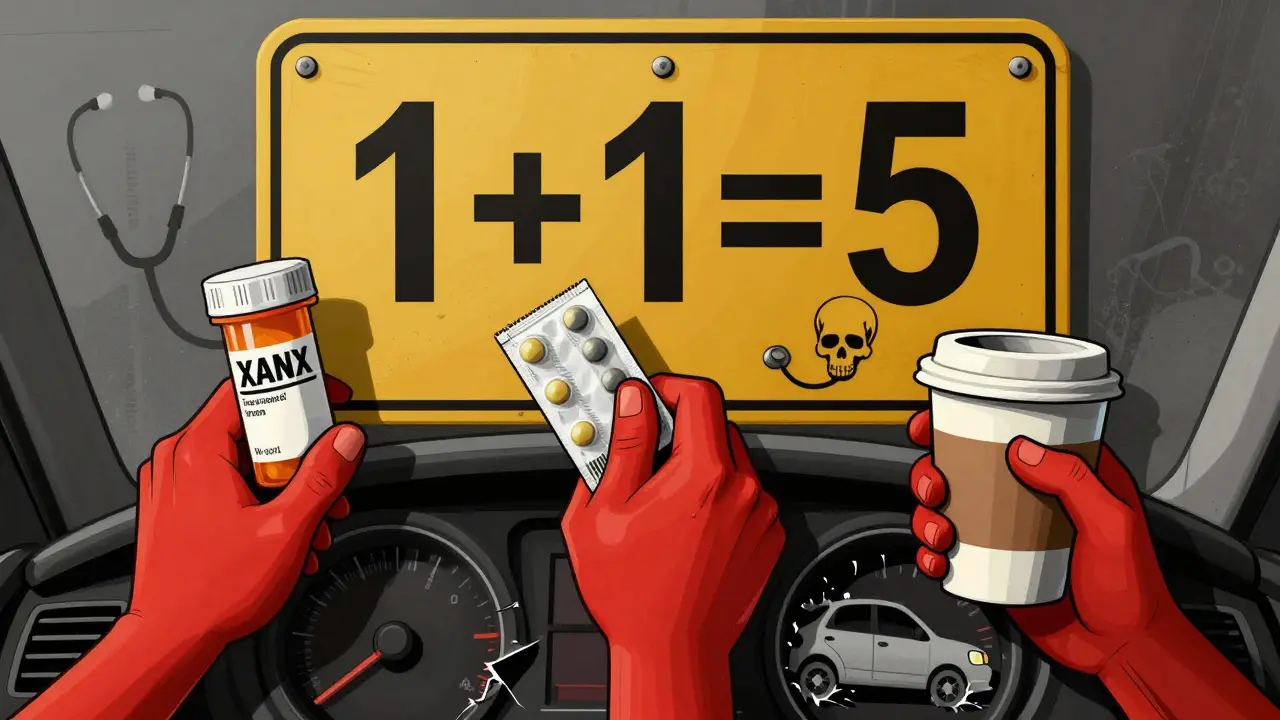
The Hidden Danger: Combining Drugs
The biggest risk isn’t one drug. It’s combinations. Alcohol + benzodiazepines. Opioids + sleep aids. Antidepressants + NSAIDs. These mixes don’t just add up - they multiply. Dr. Robert Voas’s research found 22% of drivers tested at trauma centers had multiple drugs in their system. The impairment wasn’t 1+1=2. It was 1+1=5. A study from the Canadian Centre on Substance Abuse showed that mixing alcohol with even a low dose of a benzodiazepine increased crash risk by over 200%. That’s not a typo. Two hundred percent. And here’s the kicker: most people don’t realize they’re doing it. They take their anxiety pill, their painkiller, their sleep aid, and their allergy med. They think each one is fine on its own. They don’t know the interactions. And their doctor didn’t tell them.What You Should Do - Practical Steps to Stay Safe
You don’t have to stop taking your meds. But you need to understand them.- Ask your doctor or pharmacist: “Can this medication make me unsafe to drive?” Don’t assume they’ll bring it up. Only 41% of doctors routinely discuss driving risks.
- Read the label - really read it. Look for words like “drowsiness,” “dizziness,” “blurred vision,” or “avoid operating machinery.” That includes driving.
- Wait longer than you think. If a med says “may cause drowsiness,” wait at least 6 hours. For sleep aids like zolpidem, wait 8 to 12 hours. Don’t trust how you feel. Test yourself: try a short drive in an empty parking lot. Can you focus? Are your reactions normal?
- Keep a medication log. Write down what you take, when, and how you feel afterward. This helps you spot patterns. Did you feel sluggish after taking that new antidepressant? Maybe skip driving for a few days.
- Use second-generation antihistamines. If you need allergy relief, choose loratadine (Claritin), cetirizine (Zyrtec), or fexofenadine (Allegra). They don’t cause drowsiness. Avoid diphenhydramine and chlorpheniramine.
- Don’t drive after taking more than one impairing drug. Even if each one is “safe alone,” together they’re not.
What’s Next - And What You Can Expect
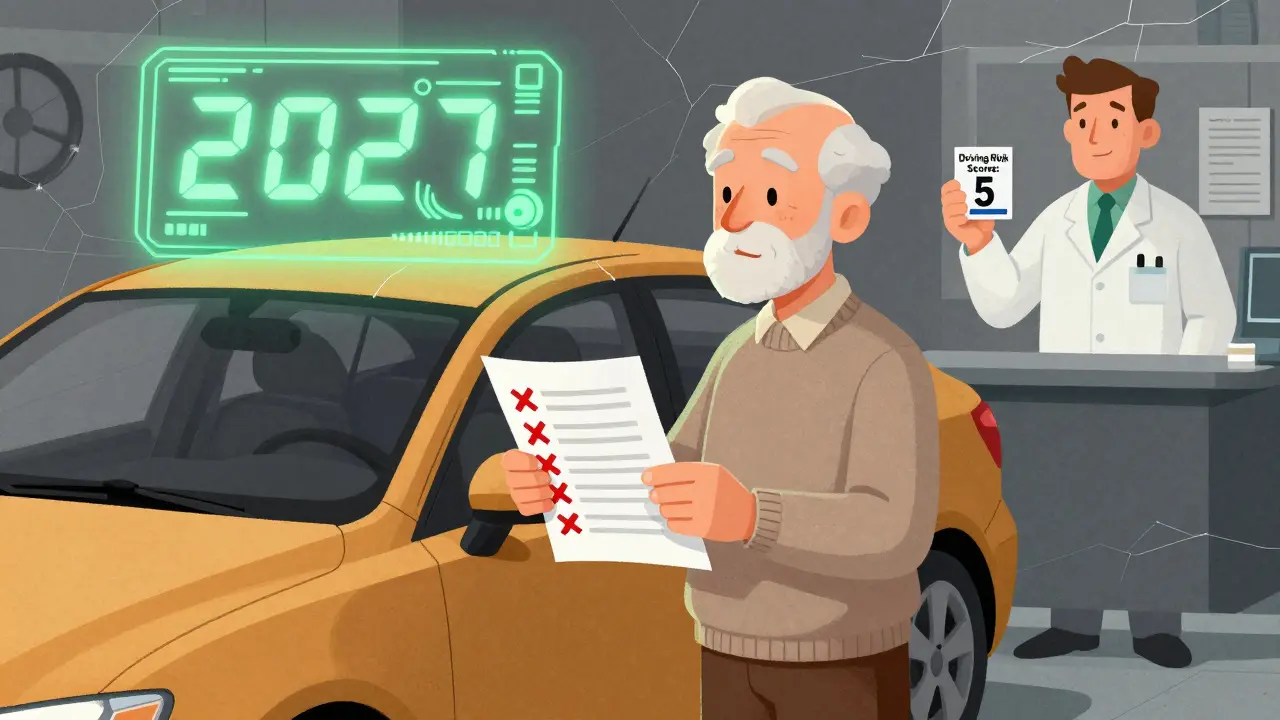
By 2027, 85% of new cars will have biometric systems that watch your eyes and steering patterns. If you’re drowsy or impaired, the car will alert you - or even slow down. It’s coming. But until then, you’re on your own. The FDA now requires “Driving Risk Scores” on all CNS-acting medications - a 1 to 5 rating. A score of 5 means “do not drive.” That’s new. That’s helpful. But it’s still early. Not all labels have it yet. The message is clear: driving on medication isn’t a gray area. It’s a safety issue. And the legal system is catching up. If you’re taking any drug that affects your brain - even if it’s legal - you need to treat it like alcohol. Test yourself. Wait it out. Ask questions. Don’t assume you’re fine just because you’re not drunk.Frequently Asked Questions
Can I drive if I take a prescription medication that says ‘may cause drowsiness’?
No - not without checking first. ‘May cause drowsiness’ is a red flag. It doesn’t mean it’ll happen to you, but it means it can. Wait at least 4-6 hours after taking the dose, and never drive after taking multiple drugs. If you’re unsure, skip driving that day. It’s not worth the risk.
Is it illegal to drive while taking prescribed medication?
Yes, if the medication impairs your ability to drive safely. Having a prescription doesn’t give you legal protection. If you’re involved in a crash and drugs are found in your system, you can be charged with DUI. Many states now treat drug-impaired driving the same as alcohol-impaired driving - fines, license suspension, and even jail time apply.
Do over-the-counter cold meds affect driving?
Absolutely. Medications with diphenhydramine - like Benadryl, Tylenol PM, or NyQuil - can impair driving as much as a 0.10% blood alcohol level. That’s above the legal limit. Even if you feel fine, your reaction time and coordination are still slowed. Use non-drowsy alternatives like Claritin or Zyrtec instead.
Why don’t doctors always warn patients about driving risks?
Many don’t. A 2022 survey found only 41% of physicians routinely discuss driving risks with patients. It’s not that they’re negligent - it’s that time is short, and they assume patients will read labels. But 68% of patients say they never received specific driving advice from their provider. That’s why you need to ask.
Can I be tested for prescription drugs while driving?
Yes. Police can request a blood or saliva test if they suspect impairment. While breathalyzers only detect alcohol, new roadside saliva tests for prescription drugs are being rolled out across the U.S. These tests can detect 12 common medications with over 90% accuracy. Refusing a test can lead to automatic license suspension, just like refusing a breathalyzer.
What should I do if I’m taking multiple medications?
Schedule a medication review with your pharmacist. They’re trained to spot dangerous combinations. Bring a list of everything you take - including supplements and OTC drugs. Ask specifically: ‘Could any of these make me unsafe to drive?’ If you’re over 65, ask if any of your meds are on the Beers Criteria list. Many can be replaced with safer options.
Scottie Baker
January 13, 2026 AT 14:14So let me get this straight - you’re telling me I can’t take my Benadryl for allergies and then drive to work? I’ve been doing this for 12 years and I’ve never crashed. You’re acting like I’m some drunk idiot. My grandma takes that stuff and still drives to bingo. Stop scaremongering.
lucy cooke
January 14, 2026 AT 05:51Oh sweet celestial irony - we’ve criminalized the body’s natural response to pharmaceutical manipulation while ignoring the systemic rot that forces people into these medications in the first place. We medicate anxiety, then punish the drowsiness. We industrialize sleep, then blame the sleeper. This isn’t about safety - it’s about control disguised as care. The car is the new church, and the state is the priest with a saliva swab.
Robin Williams
January 15, 2026 AT 09:22Bro I just took NyQuil last night and drove to work this morning. Felt fine. Like, zero drowsiness. Then I got pulled over for swerving - turns out the cop had a saliva test and found diphenhydramine. I was like ‘but I didn’t drink!’ He just laughed. Now I got a DUI. My job’s on the line. Don’t be me. Just don’t.
Anny Kaettano
January 16, 2026 AT 04:58As a clinical pharmacist, I see this daily. Polypharmacy in older adults is a silent epidemic. The Beers Criteria exists for a reason - and it’s not just for geriatricians. Primary care providers often miss drug-drug interactions because they’re juggling 20 patients an hour. But here’s the thing: pharmacists are trained to catch this. If you’re on 3+ meds, schedule a med review. It’s free at most pharmacies. Don’t wait for a crash to learn the hard way.
Kimberly Mitchell
January 16, 2026 AT 20:43Why are we still having this conversation in 2025? The science has been clear for a decade. The FDA has guidelines. The NHTSA has data. But no one wants to change their routine. People would rather risk their life than admit they need to wait 8 hours after a sleep aid. This isn’t ignorance - it’s willful negligence wrapped in denial.
Diana Campos Ortiz
January 16, 2026 AT 23:09I took Zyrtec instead of Benadryl after reading this. I didn’t even know the difference until now. Thank you for writing this. I’m 72 and on 5 meds. I never thought about how they might interact. I’ll bring my list to my pharmacist next week. Small step, but it matters.
laura Drever
January 17, 2026 AT 02:57So what youre saying is if i take a tylenol pm im basically drunk? and cops can test me for that? and i cant fight it because no one told me? wow. so the law is just a trap for the uneducated. great. just great. also my cat has more sense than my doctor.
Jesse Ibarra
January 18, 2026 AT 05:04You’re all missing the point. This isn’t about driving. It’s about the medical-industrial complex turning every human function into a liability. They sell you the drug, then charge you for the consequence. They don’t want you safe - they want you compliant. And now they’re installing biometric sensors in cars to monitor your pupils? Welcome to the pharmaceutical surveillance state. Wake up.
Randall Little
January 20, 2026 AT 04:11Interesting that the U.S. treats drug-impaired driving like it’s a moral failure, while countries like the Netherlands treat it as a public health issue. No jail time. No stigma. Just education and safer alternatives. We punish people for being patients. That’s not justice. That’s cruelty dressed up as policy.
Acacia Hendrix
January 20, 2026 AT 22:45The pharmacokinetic profile of diphenhydramine is well-documented in CYP2D6 poor metabolizers - particularly in geriatric populations with reduced hepatic clearance. When co-administered with CYP3A4 inhibitors like fluoxetine, the half-life extends beyond 11 hours, resulting in residual CNS depression even in the absence of subjective sedation. This is not anecdotal - it’s a validated clinical phenomenon.
James Castner
January 21, 2026 AT 19:54Let us not forget that the automobile, once a symbol of freedom and autonomy, has now become a vector of systemic risk - one that we have outsourced to pharmaceutical corporations and regulatory inertia. The individual is expected to navigate a labyrinth of contraindications, interactions, and legal ambiguities, while the institutions that profit from the drugs remain insulated from accountability. We have created a society where safety is commodified, and ignorance is criminalized - not because we lack knowledge, but because we lack the collective will to reform. The solution is not more tests. It is more transparency. More education. More dignity for the patient.
Adam Rivera
January 22, 2026 AT 23:18Hey I just wanted to say this post saved me. I was about to take my sleep aid before a road trip this weekend. Read this, checked the label, and switched to melatonin. Took the day off instead. Felt way better. Thanks for the real talk.
mike swinchoski
January 24, 2026 AT 17:54My cousin got arrested for driving after taking his ADHD med. He didn’t even know it could slow reaction time. He’s a doctor. A doctor. And no one told him. So now he’s on probation and can’t drive his kids to school. This isn’t about pills. It’s about the system failing everyone. And you? You’re just another person who read an article and felt smart. You didn’t help anyone. You just added to the noise.