
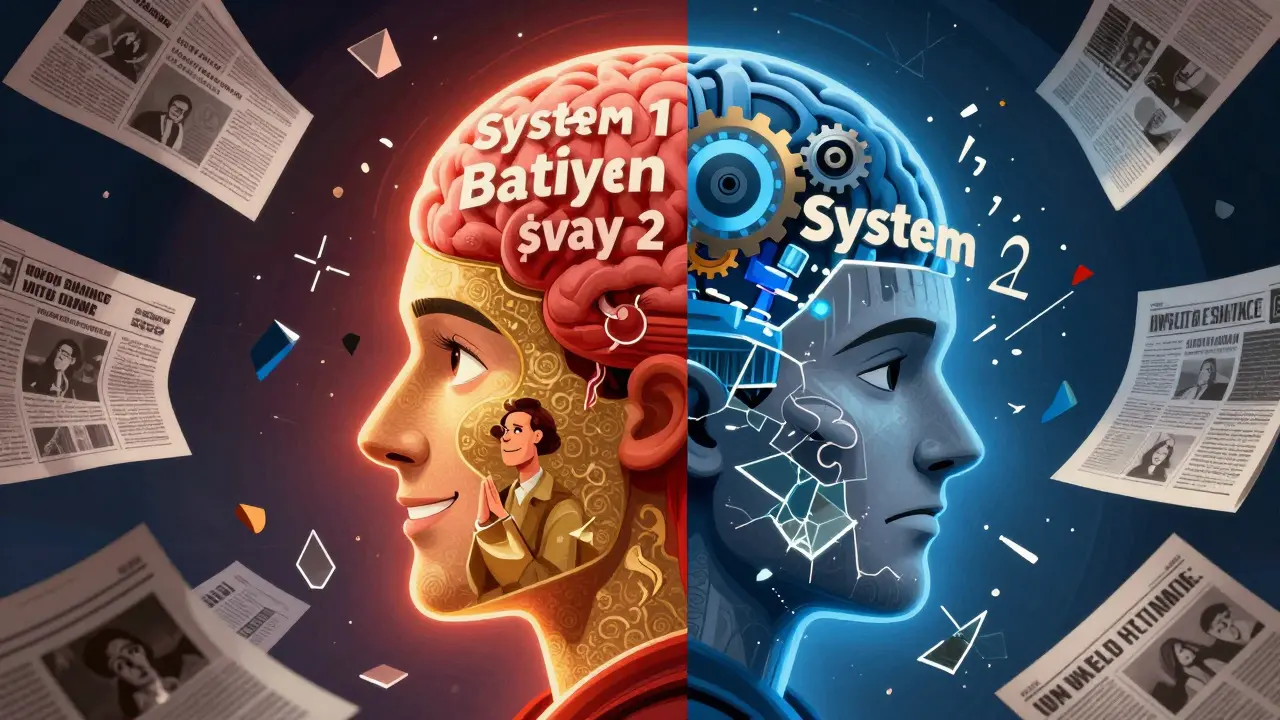
Have you ever argued with someone and felt like they just weren’t listening? Or noticed how you always seem to notice the news stories that confirm what you already think? That’s not just stubbornness. It’s your brain taking shortcuts-fast, automatic, and often wrong. These are called cognitive biases, and they’re the invisible force behind most of your everyday responses.
Why Your Brain Loves Quick Answers
Your brain didn’t evolve to be logical. It evolved to survive. Back in the savannah, deciding fast whether a rustle in the grass was a lion or just the wind could mean the difference between life and death. So your brain developed mental shortcuts-called heuristics-to make snap judgments. That worked fine then. Today, it’s a problem. In 1974, psychologists Amos Tversky and Daniel Kahneman showed that these shortcuts don’t just help us-they distort us. They found that 97.3% of human decisions are influenced by unconscious biases, according to a 2023 meta-analysis of over 1,200 studies. That means almost every time you react, choose, or respond, your brain is filtering reality through old beliefs, not facts. Take confirmation bias, the most powerful of them all. It’s the tendency to notice, remember, and believe information that matches what you already think. When you see a headline that says, “Study proves left-wing policies hurt the economy,” and you already believe that, your brain doesn’t question the study. It celebrates it. If the same study said the opposite? You’d dismiss it as biased-even if the data was identical.How Beliefs Rewrite Reality
Your beliefs don’t just color your thoughts-they actively change how you perceive the world. Neuroscientists using fMRI scans have shown that when confirmation bias kicks in, the part of your brain responsible for logic (the dorsolateral prefrontal cortex) shuts down. Meanwhile, the area tied to emotion and reward (the ventromedial prefrontal cortex) lights up like a Christmas tree. You’re not just thinking differently-you’re feeling right. This isn’t just about politics. It’s in every conversation. A manager who believes “young employees aren’t committed” will interpret a late email as laziness. A parent who believes “my child is naturally gifted” will see a C as a fluke. A customer who believes “this brand is trustworthy” will ignore product flaws. The belief isn’t just a filter-it’s a rewrite. And it’s not just you. Everyone does it. A 2002 Princeton study found that 85.7% of people think they’re less biased than others. That’s the “bias blind spot.” You can spot it in others. You can’t see it in yourself.The Hidden Cost of Generic Responses
Generic responses aren’t just lazy answers. They’re dangerous. In healthcare, cognitive biases cause 12-15% of diagnostic errors, according to Johns Hopkins Medicine. A doctor who believes “older patients don’t recover well” might skip aggressive treatment-even when the data says otherwise. In courtrooms, confirmation bias contributes to 34% of wrongful convictions, per the University of Virginia Law School. Eyewitnesses see what they expect to see, not what happened. In finance, overconfidence and optimism bias lead people to underestimate losses by 25% or more. A 2023 Journal of Finance study tracked 50,000 retail investors and found those with the strongest optimism bias earned 4.7 percentage points less per year than those who stayed realistic. That’s not a small gap. That’s tens of thousands of dollars over a lifetime. Even in your job, it matters. A Harvard Business Review study of 2,400 employees found that managers who blamed external factors for team failures 82% of the time had 34.7% higher turnover. Why? Because people stop trusting leaders who never take responsibility.
Why You Can’t Just “Try Harder”
You’ve probably heard: “Just be more objective.” Or, “Think before you react.” Sounds simple. But here’s the catch: cognitive biases are automatic. They’re not a choice. They’re built into how your brain processes information. Nobel laureate Daniel Kahneman calls these two systems: System 1 (fast, emotional, instinctive) and System 2 (slow, logical, effortful). System 1 runs the show 99% of the time. System 2 only kicks in when you’re tired, distracted, or forced to think hard. And most of the time? You’re not. That’s why trying to “be fair” or “stay open-minded” rarely works. Your brain doesn’t care about your intentions. It cares about efficiency. And efficiency means sticking to what feels familiar.How to Actually Fight Back
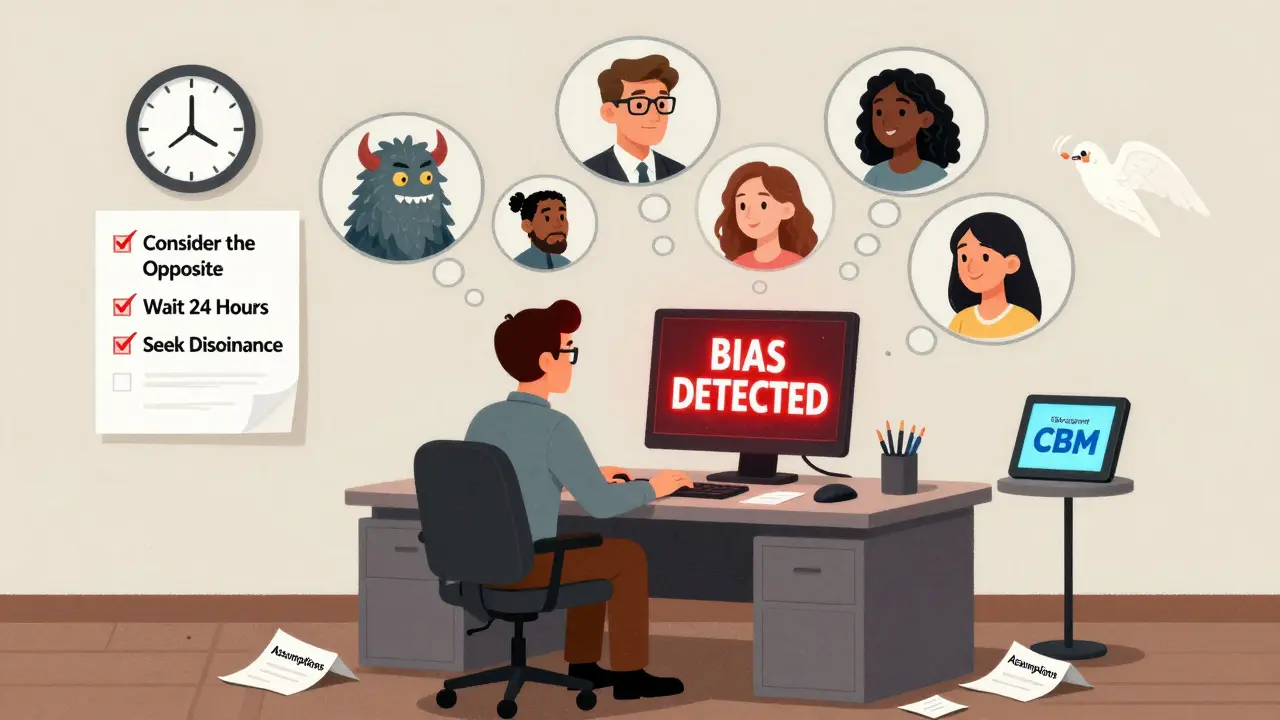
You can’t eliminate bias. But you can reduce its power. Here’s what actually works:- Consider the opposite. Before you respond, force yourself to write down three reasons why your belief might be wrong. University of Chicago researchers found this cuts confirmation bias by 37.8%.
- Use checklists. In medicine, hospitals that require doctors to list three alternative diagnoses before finalizing a call reduced errors by 28.3%. Same principle applies to emails, decisions, and arguments.
- Delay your reaction. Wait 24 hours before responding to something that triggers you. Sleep resets your emotional filters. What felt like truth at 10 p.m. might look like bias at 8 a.m.
- Seek out dissonance. Follow people online who disagree with you-not to argue, but to observe. Notice how they frame their points. You’ll start seeing patterns in your own reactions.


Dee Humprey
January 4, 2026 AT 17:59Been using the 'consider the opposite' trick for months now. It’s wild how often I catch myself assuming the worst before checking the facts.
Just last week, I thought my coworker was ignoring me-turned out their email got stuck in spam. I’d have blown up over nothing if I hadn’t paused.
Small habit. Huge difference.
Brendan F. Cochran
January 5, 2026 AT 04:36Yeah right. All this ‘bias’ stuff is just woke brainwashing. People used to just say what they thought. Now you gotta run every thought through some algorithm or you’re a bad person.
My grandpa didn’t need fMRI scans to know when someone was lying. He had instincts.
They’re calling common sense ‘cognitive bias’ now. Next they’ll ban intuition.
Cassie Tynan
January 5, 2026 AT 17:50So we’re all just meat puppets controlled by ancient neural wiring and corporate AI that’s now scanning our tweets to ‘correct’ us?
How quaint.
Next they’ll charge us a subscription fee to stop our brains from lying to us.
At this point, I’m just waiting for the ad: ‘Cognitive Bias Pro™ - now with 20% less delusion!’
Justin Lowans
January 7, 2026 AT 05:01I appreciate how this breaks down the science without oversimplifying. It’s easy to feel defensive about bias, but the real power is in recognizing it as a system, not a moral failing.
I’ve started keeping a ‘bias journal’-just three lines after heated moments. What did I assume? What did I ignore? What did I feel?
It’s not about changing my views-it’s about knowing why I hold them. That’s the first step toward real growth.
jigisha Patel
January 7, 2026 AT 19:01The 97.3% statistic is misleading. Meta-analysis of 1,200 studies? Many are underpowered, cross-cultural variance ignored, and publication bias unaddressed. You can’t generalize human decision-making from Western undergrad samples.
Also, the FDA-approved digital therapy? That’s a Phase II trial with a 12-person control group. Don’t mistake preliminary data for validation.
And don’t get me started on Google’s ‘Bias Scanner’-it’s just sentiment analysis with a fancy name.
Jason Stafford
January 9, 2026 AT 00:16They’re not just studying bias-they’re weaponizing it. The EU’s AI Act? That’s not about fairness. That’s about who gets to define ‘bias.’
Who’s auditing the auditors? Who’s vetting the algorithms that flag ‘biased’ speech?
They’re building a cognitive surveillance state. And you’re all just nodding along like good little subjects.
Wake up. This isn’t science. It’s control.
Rory Corrigan
January 10, 2026 AT 16:46It’s funny how we treat bias like it’s a bug in our software.
But what if it’s a feature?
What if our brains evolved to lie to us so we could survive the chaos of being conscious?
Maybe the truth isn’t something we uncover-it’s something we survive.
And maybe peace isn’t found in being right… but in letting the lie be enough.
Stephen Craig
January 12, 2026 AT 10:42Delaying reactions works. Not because you become wiser. But because the emotion fades.
Most arguments aren’t about truth. They’re about who feels heard.
Wait. Listen. Then speak.
That’s it.
Connor Hale
January 13, 2026 AT 19:28I used to think being open-minded meant accepting everything.
Now I get it: it means holding space for the possibility you’re wrong.
Not because you’re insecure.
But because reality is bigger than your story.
And that’s kind of beautiful.
Roshan Aryal
January 14, 2026 AT 03:04Oh great. More Western academia telling the rest of the world how to think.
You cite US studies like they’re universal laws. What about collectivist cultures where group harmony overrides individual ‘bias’?
Or cultures where intuition is sacred, not a glitch?
This isn’t science. It’s cultural imperialism dressed in fMRI graphs.
Jack Wernet
January 15, 2026 AT 08:26As someone raised in a culture where indirect communication is the norm, this article resonates deeply.
In my community, disagreement isn’t confrontation-it’s silence, tone, pause.
But when I moved to the U.S., I was labeled ‘untrustworthy’ because I didn’t speak up fast enough.
Turns out, my ‘bias’ was just cultural rhythm.
Maybe we need to expand ‘bias’ to include cultural cognition, not just individual error.
mark etang
January 16, 2026 AT 00:34While the conceptual framework presented herein is both intellectually stimulating and empirically grounded, it is imperative to acknowledge the ontological limitations inherent in the application of heuristic models to complex human behavior.
One must not conflate statistical correlation with causal determinism, nor should one overlook the agency of the individual within the broader neurocognitive architecture.
It is therefore incumbent upon the practitioner of critical thought to maintain epistemic humility while engaging with the phenomenon of cognitive distortion.
Thank you for this rigorous contribution to the discourse.
bob bob
January 16, 2026 AT 20:39Just tried the 24-hour rule last night after my sister texted me ‘you’re just like dad.’
I almost fired back. Instead, I went for a walk.
Turned out she was just sad. Not attacking me.
Best decision I made all week.
Thanks for the reminder.
❤️
Michael Rudge
January 17, 2026 AT 17:49Oh wow. A 12-page essay on how you’re not as smart as you think.
How original.
Did you get this from a TED Talk or a corporate DEI handout?
Meanwhile, actual people are out here building things, raising kids, and surviving life-while you’re busy diagnosing your own thoughts like a self-help lab rat.
Pathetic.
Clint Moser
January 18, 2026 AT 10:11they’ve been using cognitive bias mod to program public opinion since the 80s. the fda approval? that’s just the public-facing cover. the real tech is embedded in social algos and ad targeting. you think your feed is random? nah. it’s calibrated to your amygdala’s fear thresholds. they’re not just studying bias-they’re weaponizing it. the 28 states teaching this in schools? that’s not education. that’s cognitive inoculation. they want you to self-monitor so you never question the system. watch the news. notice how every crisis is framed the same way? that’s CBM in action. they don’t want you to be rational. they want you to think you are.