
Prescription Transfer Checker
Check Your Prescription Transfer Eligibility
Changing pharmacies sounds simple-just walk in, hand over your scripts, and done. But if you’re taking controlled substances, it’s not that easy. Federal rules changed in August 2023, and now how you transfer prescriptions depends heavily on what kind of medication you’re on. Get it wrong, and your refill gets stuck. Get it right, and you avoid days of waiting, phone calls, or worse-running out of medicine.
Know Your Medication’s Schedule
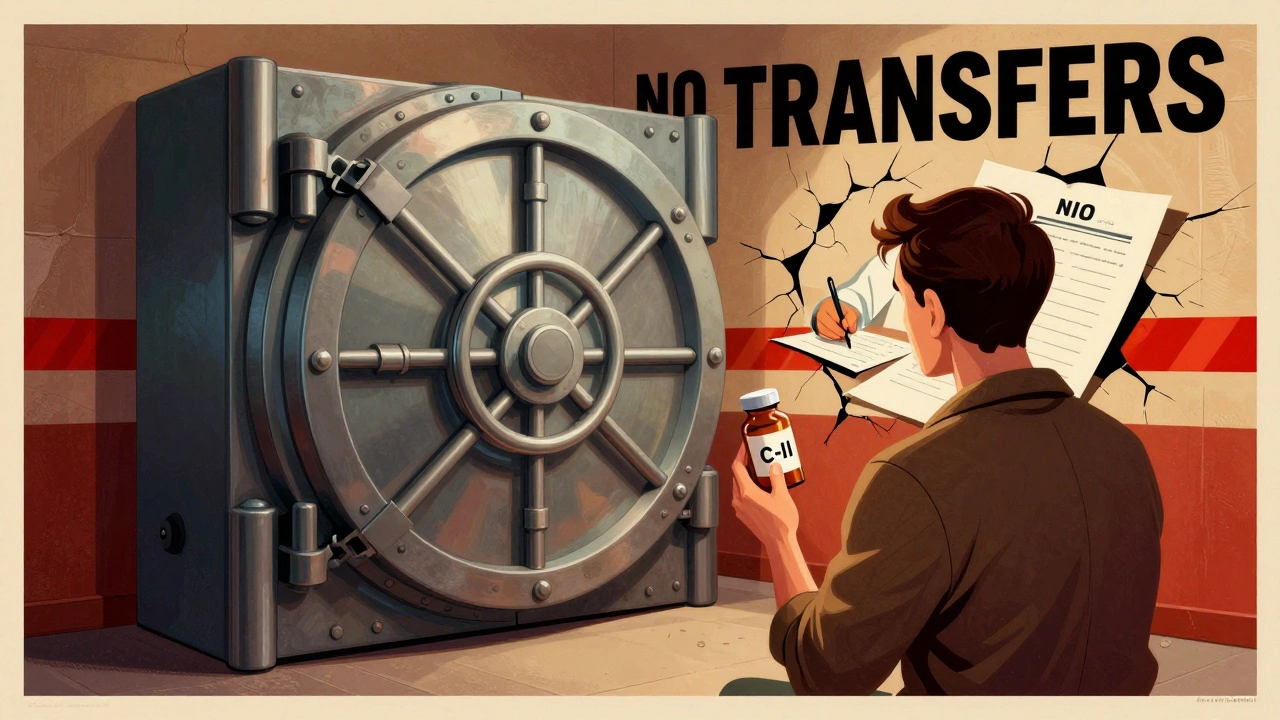
The first thing you need to figure out is whether your medicine is a controlled substance, and if so, which schedule it falls under. The DEA classifies drugs into five schedules based on abuse potential and medical use. This matters because each schedule has different transfer rules.- Schedule II (like oxycodone, Adderall, fentanyl): Cannot be transferred at all. If you switch pharmacies, you must get a new prescription from your doctor. No exceptions.
- Schedule III and IV (like hydrocodone, Xanax, tramadol): One-time transfer only. Once it’s moved to your new pharmacy, you can’t move it again-even if you switch back later.
- Schedule V (like cough syrups with low codeine): Also one-time transfer, same as III and IV.
- Non-controlled (like blood pressure pills, statins, antibiotics): Can be transferred multiple times as long as refills remain.
If you’re unsure, check your prescription label. It’ll say “C-II,” “C-III,” etc. Or ask your pharmacist. Don’t assume-mistakes here cause delays.
What Info to Give the New Pharmacy
Whether you’re switching for a new neighborhood, better prices, or convenience, you’ll need to give your new pharmacy the same core info every time:- Your full legal name (exactly as on your ID)
- Your date of birth
- Your current residential address
- The name of the medication and dosage (e.g., “Lisinopril 10mg daily”)
- The name of your prescriber (doctor, nurse practitioner, etc.)
- The pharmacy you’re transferring from (name and city)
For controlled substances (Schedules III-V), you also need to confirm the prescription number and the original fill date. Pharmacists use these to verify the transfer record. If you don’t have it, they can look it up-but it slows things down.
Pro tip: Don’t just say “I want my Adderall moved.” Say: “I need to transfer prescription #12345 for Adderall 20mg, written by Dr. Lee on May 12, 2025, from ABC Pharmacy in Perth.” Specificity cuts processing time in half.
How the Transfer Actually Works
You might think you’re just handing over a slip of paper. But behind the scenes, it’s a tightly regulated digital handshake.For controlled substances, the transfer must happen electronically between two DEA-registered pharmacies. The old pharmacy sends the prescription data directly to the new one. The original record is marked “VOID” in their system. The new pharmacy adds “TRANSFER” to the prescription, logs the old pharmacy’s name, address, and DEA number, and records their own pharmacist’s details.
It can’t be faxed, emailed, or texted. It can’t be handwritten. It has to be a secure electronic transfer-no exceptions. Even if you call the new pharmacy and say, “My old pharmacy said they sent it,” they still need to verify it through their system. That’s why transfers take 24-48 hours.
Non-controlled meds can be transferred via phone or fax, but most pharmacies now use electronic systems anyway. It’s faster and safer.

What Can Go Wrong (And How to Fix It)
You’re not alone if your transfer gets stuck. A 2023 Consumer Reports survey found 68% of patients ran into problems. Here are the top three issues-and how to solve them:- “We can’t transfer that.” If your med is Schedule II, they can’t. You need a new script. If it’s Schedule III-V and they say “no,” ask: “Is this because of state law?” Some states like California and New York have stricter rules. Request a written explanation. Pharmacies are required to give one.
- “We don’t have the record.” This usually means the old pharmacy didn’t send the data properly. Ask your new pharmacy to call the old one directly. Don’t ask the old pharmacy to re-send it-they can’t. Only the receiving pharmacy can initiate the transfer request.
- “It’s been 3 days and still not ready.” If it’s a non-controlled med, it should be done in 1-2 days. For controlled meds, it can take up to 5 business days if there are verification delays. Call the new pharmacy and ask: “Has the transfer been initiated? What’s the status?”
If your transfer is denied without a clear reason, ask to speak to the pharmacist-in-charge. They’re the only one authorized to override system blocks or request manual exceptions.
What to Do If You Run Out
If your refill runs out before the transfer finishes, you’re in a tight spot. Here’s what you can do:- For non-controlled meds: Ask your new pharmacy if they can provide a 7-day emergency supply. Many will, especially if you’ve been on the med long-term.
- For controlled substances (Schedules III-V): You’re out of luck. No emergency refills allowed. You’ll need to contact your prescriber for a new script. If your doctor is out of office, try an urgent care clinic or telehealth provider who can prescribe it.
- For Schedule II: No exceptions. You must wait for your doctor to issue a new prescription.
Plan ahead. Don’t wait until your last pill is gone. Start the transfer process when you have 5-7 days left. That gives you a buffer.
State Rules Can Change Everything
Federal law sets the floor, not the ceiling. In Australia, state pharmacy boards can add their own rules. For example, Western Australia has stricter record-keeping requirements than Queensland. If you’re moving interstate, your transfer might be blocked even if it’s allowed federally.Before you switch pharmacies in a new state, call the new pharmacy and ask: “Do you accept electronic transfers of controlled substances from out-of-state pharmacies?” If they hesitate, ask to speak to the pharmacist-in-charge. They’ll know the local rules.
Also, if you’re transferring from a pharmacy that’s part of a chain (like Chemist Warehouse or TerryWhite Chemmart), ask if both locations use the same system. Even if they’re under the same brand, if they’re different legal entities, the one-time transfer rule still applies.
What Happens After the Transfer
Once the transfer is complete, your new pharmacy becomes responsible for the prescription. That means:- They must keep a copy of the transfer record for at least two years.
- They must clearly mark the prescription as “TRANSFERRED” in their system.
- They can’t refill it beyond the original number of refills allowed by your prescriber.
And here’s something patients rarely realize: you can’t transfer a prescription that’s already used up all its refills. Even if it’s just one refill left, it can be moved. But if the last refill was filled yesterday? You need a new script.
Pro Tips for a Smooth Switch
- Call your new pharmacy first. Don’t show up without calling. Ask if they handle transfers and what info they need.
- Have your old prescription bottle handy. The label has the exact details they need.
- Don’t wait until the last minute. Start the process 7-10 days before you run out.
- For controlled substances, confirm with both pharmacies that they’re set up for electronic transfers. Not all small pharmacies updated their systems after the 2023 DEA rule.
- Keep a written record of the transfer date, who you spoke to, and what they said. If something goes wrong, you’ll have proof.
Most transfers go smoothly if you’re prepared. The DEA’s 2023 rule was designed to make life easier for patients-not harder. But it only works if you know the rules.
What’s Coming Next
The DEA is watching how this new one-time transfer rule plays out. They’ll review the data in late 2024. If there’s no spike in misuse, they might allow multiple transfers for controlled substances in the future. For now, though, the rule is firm: one transfer per prescription. Period.Meanwhile, pharmacies are getting better at it. Chains like Chemist Warehouse and TerryWhite have updated their systems. Independent pharmacies are catching up. But the system still relies on you having the right info-and knowing when to push back if something’s wrong.
Can I transfer a Schedule II prescription like oxycodone to a new pharmacy?
No. Schedule II controlled substances cannot be transferred between pharmacies under any circumstances. You must get a new prescription from your doctor. This rule is federal and applies in all states and territories.
How long does a prescription transfer take?
Non-controlled prescriptions usually transfer within 24 hours. Controlled substances (Schedules III-V) can take 24-48 hours, sometimes up to 5 business days if there are verification delays. Always start the process at least 7 days before you run out.
Can I transfer multiple prescriptions at once?
Yes. You can transfer multiple prescriptions to the same pharmacy, but each one counts as a separate transfer. A Schedule III prescription can only be transferred once, even if you’re moving five different meds. Each one must be processed individually.
What if my old pharmacy refuses to send my prescription?
The old pharmacy can’t refuse to transfer a valid prescription for a controlled substance (Schedules III-V) if you’ve requested it. They must send it electronically. If they say no, ask for the reason in writing. If they still refuse, contact your state’s pharmacy board. They can intervene.
Do I need to bring my old prescription bottle to the new pharmacy?
It’s not required, but it helps. The bottle has the exact medication name, dosage, prescriber, and prescription number. If you don’t have it, the new pharmacy can look it up-but it takes longer. Bringing it saves time and reduces errors.
Can I transfer a prescription from an online pharmacy to a local one?
Yes, as long as the online pharmacy is DEA-registered and uses an electronic prescribing system. The transfer rules are the same whether the pharmacy is online or brick-and-mortar. Just make sure the new local pharmacy accepts transfers from online sources.

Wesley Phillips
December 8, 2025 AT 01:55Lmao I just walked into CVS last week with my Adderall script and said 'transfer this' like a chump. They stared at me like I asked for a unicorn. Turned out I needed the damn prescription number. Now I carry my bottle everywhere. 🤦♂️
Ryan Sullivan
December 10, 2025 AT 00:47The DEA’s 2023 revision was a necessary recalibration. The prior system enabled rampant diversion, particularly in regions with lax oversight. One-time transfer protocols for Schedules III–V are not bureaucratic overreach-they are pharmacovigilance imperatives. Any suggestion otherwise reflects a fundamental misunderstanding of controlled substance dynamics.
Olivia Hand
December 11, 2025 AT 04:27I didn't realize Schedule II meds couldn't be transferred at all. I thought maybe there was a loophole. My doctor just gave me a new script last month and I didn't even think to ask why. Now I'm wondering how many other people are getting caught off guard. This is huge.
Desmond Khoo
December 11, 2025 AT 15:08Yessss this is so needed!! 🙌 I was panic-dialing my pharmacy at 11pm because my Xanax was gone and they said 'oh you can't transfer that anymore?' I was like... wait what?!? Thanks for the heads up-now I'm planning ahead. 7 days before empty = new rule for me 💪
Louis Llaine
December 13, 2025 AT 03:54So let me get this straight. I can't move my tramadol to a cheaper pharmacy because of some federal rule... but I can order it from a shady website in 3 days? Sounds like the DEA is just making life harder for people who follow the rules.
Jane Quitain
December 13, 2025 AT 16:59i just started taking lisinopril and i had no idea about all this stuff!! i was so scared i'd mess up the transfer and then what if i miss a dose?? but now i feel way more ready. thank you for writing this!!! 😊
Kyle Oksten
December 14, 2025 AT 05:17There's a deeper tension here between patient autonomy and regulatory control. We're told to be responsible with our medications, yet the system denies us the flexibility to adapt when life changes. The one-time transfer rule isn't just about abuse-it's about institutional rigidity. Is that really the best we can do?
Stacy here
December 16, 2025 AT 00:14This is all a distraction. The real issue? The DEA is working with Big Pharma to lock patients into specific pharmacies so they can charge more. You think they care about 'abuse potential'? Nah. They care about profit margins. And the 'electronic transfer' requirement? That's just to track your every move. You're being monitored. Always.
Kyle Flores
December 17, 2025 AT 01:36I used to be the guy who waited until the last pill to switch pharmacies. Then my dad ran out of his blood pressure med during a move and ended up in the ER. Since then, I always start the transfer 10 days out. It’s not just about rules-it’s about not putting your health on a timer. You got this.
Sam Mathew Cheriyan
December 17, 2025 AT 05:55why do they even have schedules? i mean if its a medicine why not just let people have it? this is all just to control us. also i heard the feds are putting microchips in the pills now. true or false?
Ernie Blevins
December 17, 2025 AT 14:43So you're telling me I can't just get my Oxy from a new pharmacy? That's ridiculous. My doctor's a joke anyway. Why should I have to beg for a new script? This system is broken. People are suffering because of red tape.
Nancy Carlsen
December 18, 2025 AT 05:47This post literally saved my life. 🥹 I moved from Texas to Oregon last month and thought I was gonna be pill-less for a week. Called my new pharmacy with the script # and date and they had it ready in 18 hours. I cried. Thank you for making this so clear. You're a gem 💖
Ted Rosenwasser
December 19, 2025 AT 15:39The fact that you need to know the difference between Schedule III and IV to get your medication is absurd. This isn't healthcare-it's a compliance obstacle course designed by people who've never had to refill a prescription. And yet, somehow, we're the ones who're 'not informed enough'.