
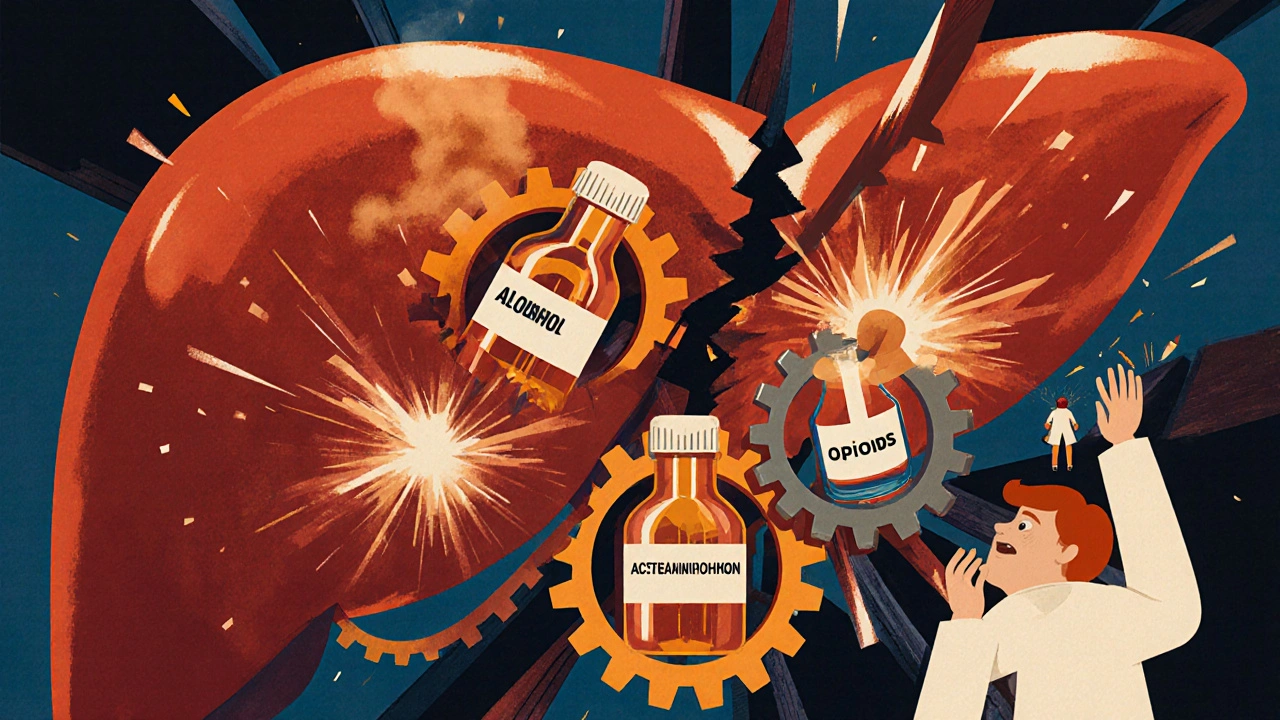
Many people don’t realize that drinking alcohol while taking medication can be as dangerous as taking the wrong pill. It’s not just about getting drunk faster-it’s about your body reacting in ways that can land you in the hospital, or worse. Whether it’s a painkiller, an antibiotic, or a sleep aid, mixing alcohol with certain drugs can turn a routine treatment into a life-threatening situation.
How Alcohol Changes How Medications Work
Alcohol doesn’t just sit there quietly. It gets absorbed quickly and travels straight to your liver, where most medications are broken down. When both alcohol and a drug are in your system at the same time, they fight over the same enzymes. This messes up how fast or slow your body processes the medicine.There are three main ways this goes wrong:
- Slowing down metabolism: Your liver gets overwhelmed, so the medication builds up in your blood. That means you get stronger side effects-even if you took the right dose.
- Speeding up metabolism: Alcohol can trick your liver into breaking down the drug too fast, making it useless. Your pain might come back, your anxiety could spike, or your blood sugar could go haywire.
- Adding effects: Alcohol and some drugs both calm your brain. Together, they can slow your breathing to dangerous levels.
This isn’t theoretical. In 2020, the CDC found that alcohol was involved in 20% of opioid overdose deaths. That’s not coincidence-it’s a direct result of how these substances interact.
Deadly Combinations You Need to Avoid
Some medications are just plain unsafe with alcohol. Here are the top offenders:Opioids: Codeine, Oxycodone, Methadone
These are powerful painkillers. Alcohol makes them even stronger. Together, they can shut down your breathing. The FDA pulled a long-acting opioid called Palladone off the market in 2005 after studies showed alcohol caused a sudden flood of the drug into the bloodstream-like a time bomb going off. Today, extended-release opioids still carry this risk. If you’re on one of these, even one drink can be enough to cause an overdose.
Benzodiazepines: Xanax, Valium, Ativan
These are prescribed for anxiety and insomnia. Alcohol does the same thing-slows down your nervous system. Combine them, and you’re looking at extreme drowsiness, confusion, loss of coordination, and possibly coma or death. A 2019 study found mixing alcohol with benzodiazepines increases overdose risk by 24 times.
Acetaminophen (Tylenol)
It’s in over 600 products-from cold meds to pain relievers. Alcohol and acetaminophen team up to create a toxic chemical called NAPQI. Your liver normally handles small amounts, but when alcohol is in the mix, it can’t keep up. Glutathione, your liver’s natural defense, gets drained. Result? Acute liver failure. The FDA says acetaminophen overdoses, often linked to alcohol, cause 56,000 ER visits and nearly 500 deaths every year in the U.S. alone.
NSAIDs: Ibuprofen, Naproxen
These are common for headaches and arthritis. But alcohol irritates your stomach lining. Add NSAIDs, and you’re doubling down on the damage. A 2017 meta-analysis showed this combo raises your risk of internal bleeding by 3 to 5 times. For someone over 65, this isn’t just uncomfortable-it can be fatal.
Metronidazole (Flagyl)
This antibiotic treats infections like bacterial vaginosis and some stomach bugs. Alcohol with metronidazole triggers a disulfiram-like reaction: flushing, pounding headache, vomiting, rapid heartbeat, and low blood pressure. It’s not just unpleasant-it’s scary. The Illinois Poison Center says you must wait at least 72 hours after your last dose before drinking.
Antidepressants: SSRIs like Prozac, Zoloft
Alcohol doesn’t cancel out SSRIs-it makes depression worse. It can increase drowsiness, dizziness, and impair judgment. Worse, it reduces the drug’s effectiveness over time. People who drink while on these meds often feel like they’re not improving, so they might increase their dose-making the risk even higher.
Diabetes Medications: Sulfonylureas, Metformin
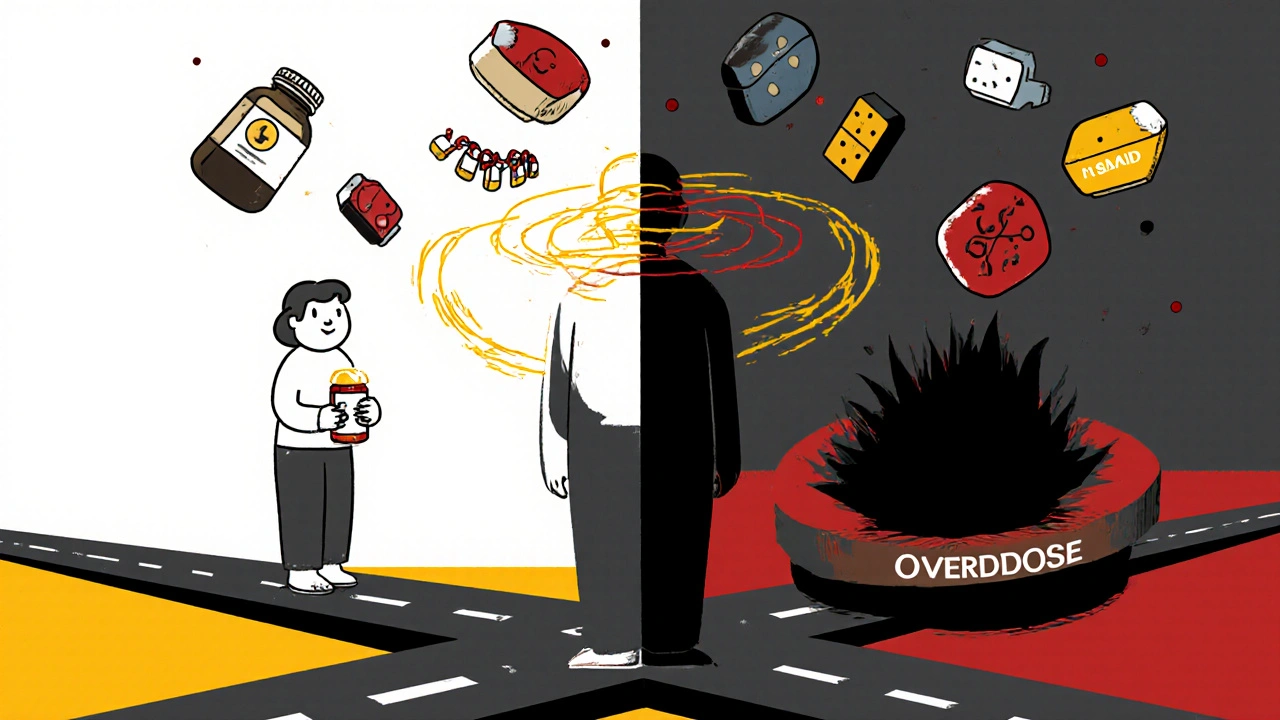
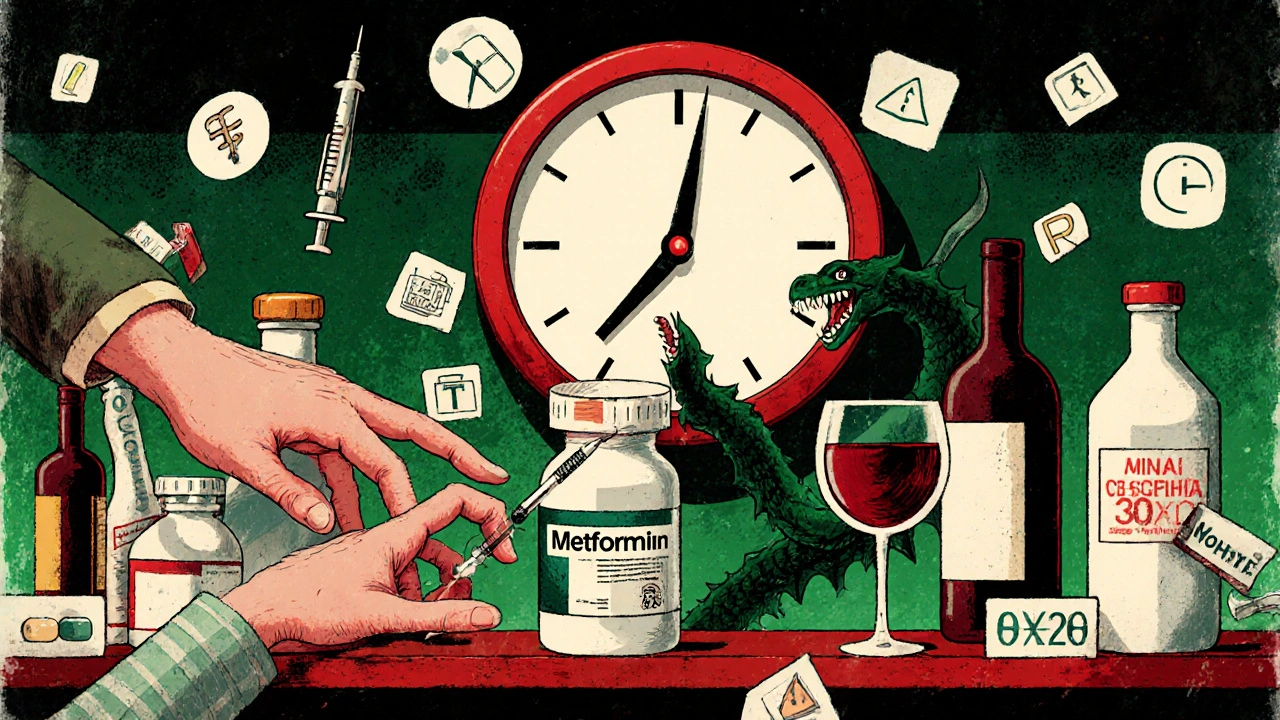
Alcohol lowers blood sugar. So do some diabetes pills. Together, they can crash your glucose levels. Sulfonylureas like glipizide carry a 300% higher risk of severe hypoglycemia when mixed with alcohol. Even metformin, which is usually safer, can raise the risk of lactic acidosis-a rare but deadly buildup of acid in the blood-if you drink more than one drink a day.
ADHD Medications: Adderall, Ritalin
Stimulants mask how drunk you feel. You might think you’re fine to drive, but your reaction time is still impaired. Alcohol also increases heart rate and blood pressure, which these drugs already raise. The combo can lead to irregular heartbeat, chest pain, or even heart attack.
Who’s at Highest Risk?
It’s not just about what you take-it’s about who you are.
People over 65 are the most vulnerable. Their bodies process alcohol slower. Their livers don’t work as well. And they’re on more meds-on average, 14 prescriptions a year. The Beers Criteria, used by doctors nationwide, lists 30 medications that are risky for seniors because of alcohol interactions. Benzodiazepines, muscle relaxants, and old-school antihistamines like Benadryl top the list.
Women are at higher risk too. Even if they weigh the same as men, women have less water in their bodies, so alcohol concentrates more in their blood. That means even one drink can have a stronger effect on medications.
Veterans face a deadly mix. The VA found that 30% of veteran suicides involved alcohol and prescription drugs. PTSD, chronic pain, and depression often lead to multiple prescriptions-and drinking to cope.
People with mental health conditions are 3.5 times more likely to mix alcohol and meds. It’s a cycle: anxiety leads to drinking, drinking makes meds less effective, symptoms get worse, and the urge to drink grows.
What You Should Do
Knowledge is your best defense. Here’s what to do:
- Ask your doctor or pharmacist every time you get a new prescription: "Can I drink alcohol with this?" Don’t assume it’s safe just because no warning label is obvious.
- Read every label. The FDA requires alcohol warnings on about 100 prescription drugs and 700 over-the-counter products. Look for phrases like "avoid alcohol," "may cause drowsiness," or "do not consume with alcoholic beverages."
- Check your supplements. Herbal remedies like St. John’s Wort, kava, or valerian root can also interact with alcohol-and many people don’t think of them as "meds."
- Use the AUDIT-C screen. If you’re over 50 or on multiple meds, ask your doctor to screen you for alcohol use. It’s a simple 3-question tool that takes less than a minute.
- Wait it out. If you’ve been on metronidazole, avoid alcohol for 72 hours after your last dose. For opioids or benzodiazepines, it’s not worth the risk at all.
Many people think, "I only have one glass." But one drink can be enough. There’s no safe amount when you’re on high-risk meds. The goal isn’t moderation-it’s complete avoidance.
What’s Changing in Healthcare
Doctors and pharmacists are finally catching up. Electronic health records now trigger automatic alerts when a provider tries to prescribe an opioid to someone with a history of alcohol use. The American Medical Association now requires all physicians to screen patients for alcohol use when prescribing high-risk meds.
Research is moving forward too. Scientists are testing genetic markers like CYP2E1 variants to predict who’s more likely to suffer liver damage from alcohol and acetaminophen. In the future, a simple blood test could tell you if you’re in the 4.7 times higher risk group.
Public campaigns like the CDC’s "Alcohol and Medicine Don’t Mix" are hitting pharmacies, social media, and ER waiting rooms. The goal? Make this common knowledge-not a secret you only learn after you’re in the hospital.
Final Thought
Medications are meant to help you feel better. Alcohol is a depressant that affects your brain, liver, and heart. When you mix them, you’re not just adding two things-you’re creating a new, unpredictable reaction. It’s not about being "responsible" with alcohol. It’s about protecting your body from a silent, avoidable danger.
If you’re taking any prescription or over-the-counter medicine, ask yourself: "Could this kill me if I have a drink?" If you’re not sure, don’t take the chance. Your liver won’t warn you. Your doctor might not ask. But you can choose to be safe.
Can I have one drink with my medication?
It depends on the medication. For some, like metronidazole or certain opioids, even one drink can cause a dangerous reaction. For others, like SSRIs or blood pressure pills, one drink might be okay-but it’s still risky. The safest answer is no. If you’re unsure, assume it’s unsafe. There’s no benefit to taking the risk.
What if I forgot and had a drink while on medication?
If you took a high-risk medication like an opioid, benzodiazepine, or metronidazole and drank alcohol, watch for symptoms: extreme drowsiness, slow breathing, confusion, vomiting, rapid heartbeat, or fainting. If any of these happen, call emergency services immediately. Even if you feel fine, call your pharmacist or doctor. They can help you assess your risk.
Do herbal supplements interact with alcohol too?
Yes. Supplements like St. John’s Wort, kava, valerian, and melatonin can all interact with alcohol. They often have sedative effects, which combine dangerously with alcohol. Many people don’t think of supplements as "drugs," but they affect your body the same way. Always check with your pharmacist before mixing supplements and alcohol.
Why do some medications say "avoid alcohol" but others don’t?
Not all interactions are obvious or well-studied. The FDA only requires warnings for drugs with proven, serious risks. Many medications have subtle interactions-like making you more dizzy or lowering your blood pressure-that aren’t labeled. Just because a label doesn’t warn you doesn’t mean it’s safe. Always ask your pharmacist.
Is it safe to drink the day before or after taking medication?
For most medications, alcohol clears your system in about 6-8 hours. But the drug might still be active. For example, extended-release pills can stay in your body for 12-24 hours. For high-risk drugs like metronidazole, wait 72 hours. For opioids or benzodiazepines, it’s best to avoid alcohol entirely while on the medication and for a few days after stopping.
Can alcohol make my medication less effective?
Yes. Alcohol can speed up how fast your body breaks down some drugs, like certain antidepressants or seizure medications, making them less effective. It can also interfere with absorption-so if you drink right before taking a pill, your body might not absorb it properly. This means your condition could worsen, even if you’re taking your meds exactly as prescribed.
Are there any medications that are safe with alcohol?
Some, like certain antihistamines (loratadine) or low-dose aspirin, have minimal interaction risk. But "minimal" doesn’t mean "safe." Even small interactions can add up, especially in older adults or people with liver issues. The safest approach is always to avoid alcohol unless your doctor or pharmacist says it’s okay.
Alcohol and medications don’t mix. Not even a little. The consequences aren’t just theoretical-they’re written in emergency room records, death certificates, and the quiet regrets of families who didn’t know. If you’re on medication, your body is already working hard. Don’t make it harder.

Steven Howell
November 29, 2025 AT 21:05While the article meticulously outlines the pharmacological risks, it overlooks the sociocultural context in which these interactions occur. In many households, particularly among older adults, alcohol is not viewed as a drug but as a social lubricant or even a medicinal tonic. This cognitive dissonance impedes public health messaging. We need targeted interventions that bridge the gap between clinical knowledge and cultural practice, not just lists of dangerous combinations.
Moreover, the emphasis on individual responsibility ignores systemic failures: fragmented healthcare, lack of pharmacist accessibility, and the normalization of polypharmacy in aging populations. Until these structural issues are addressed, warnings on labels will remain largely symbolic.
Also, the absence of discussion around socioeconomic disparities is notable. Low-income individuals often lack access to alternative pain management or mental health support, making alcohol a de facto self-medication tool. The solution isn’t just avoidance-it’s equity in care.
Robert Bashaw
December 1, 2025 AT 17:37OH MY GOD. I just read this and my liver just whispered ‘I’m done.’
One drink? ONE. DRINK. And suddenly you’re a human Popsicle with a heartbeat? I had no idea my Tylenol was basically a ticking time bomb wrapped in a Band-Aid.
I used to think ‘I only have one glass with my painkillers’ was chill. Now I realize I was one sip away from becoming a medical case study with a tragic footnote: ‘He died because he thought moderation was a virtue.’
My doctor never mentioned this. My pharmacist didn’t blink. My grandma still takes her wine with her blood pressure pills. WE’RE ALL WALKING TIME BOMBS WITH A SIM CARD AND A LIVER.
Someone get this on TikTok. #AlcoholIsTheVillain #MyLiverIsCrying
Brandy Johnson
December 3, 2025 AT 08:40This article is dangerously naive. The CDC data cited is cherry-picked to serve a puritanical agenda. Alcohol is a cultural cornerstone of Western society; demonizing its interaction with pharmaceuticals is not science-it’s moral panic dressed as public health.
Furthermore, the conflation of recreational use with medical necessity is a gross oversimplification. Millions take prescribed medications and consume alcohol responsibly. To imply that any consumption is equivalent to suicide is both unscientific and patronizing.
Where are the counter-studies? Where is the data on controlled, low-dose alcohol use in patients on SSRIs? The absence of nuance renders this piece propaganda, not education. The real danger here is fearmongering disguised as caution.
stephen idiado
December 4, 2025 AT 20:30Metronidazole-alcohol interaction: disulfiram-like reaction. CYP2E1 polymorphism modulates acetaminophen toxicity. NSAID + EtOH = GI mucosal erosion via COX-1 inhibition and reduced mucus synthesis. Opioid + EtOH = synergistic GABAergic depression of respiratory centers. Basic pharmacokinetics. Why is this news?
Subhash Singh
December 5, 2025 AT 02:08This is a profoundly important article, and I thank the author for the clarity. However, in countries like India, where over-the-counter medications are sold without prescriptions and alcohol consumption is culturally embedded, awareness is extremely low.
Many elderly patients take paracetamol for fever and drink tea with alcohol (arrack or local spirits) without knowing the risk. Pharmacists, often the first point of contact, are undertrained in drug interactions.
Perhaps we need community health workers to translate these warnings into local languages and visual aids. A poster in a village pharmacy saying ‘Alcohol + Tylenol = Liver Failure’ with a simple graphic could save lives. Knowledge must reach beyond the urban, educated elite.
Sohini Majumder
December 7, 2025 AT 01:30ok but like… why is this even a thing?? like i took tylenol after a glass of wine and i didn’t die?? and my cousin took xanax with tequila and he just… slept?? like what’s the big deal??
also why is everyone so scared of alcohol?? it’s just… drink??
and why do doctors act like we’re all idiots who can’t read labels?? i mean… i DID read the label?? it didn’t say ‘DON’T DRINK OR YOU’LL DIE’ it just said ‘may cause drowsiness’??
also i’m 23 and i’ve been doing this since 18 and i’m fine?? so maybe it’s just… not for everyone??
also why are you so mean to people who drink??
also i’m not a bad person for drinking??
tushar makwana
December 8, 2025 AT 11:48I just want to say thank you for writing this. I’ve been on antidepressants for years and used to drink to ‘take the edge off.’ I didn’t realize it was making my anxiety worse. I stopped last year. It wasn’t easy, but I feel like myself again.
To anyone reading this who’s scared to quit-start small. Talk to your pharmacist. You’re not weak for needing help. You’re brave for even asking the question.
And if you’re a doctor or nurse reading this-please ask your patients about alcohol. Don’t wait for them to bring it up. They might be too scared to say it.
We’re all just trying to get through the day. Let’s not make it harder.
Richard Thomas
December 9, 2025 AT 07:01While the article provides a comprehensive enumeration of pharmacological interactions, it fails to adequately contextualize the epidemiological significance of these phenomena within the broader framework of iatrogenic morbidity. The data presented, though statistically valid, lacks stratification by dosage, frequency of consumption, and comorbidities such as hepatic impairment or polypharmacy burden.
Furthermore, the assertion that ‘there is no safe amount’ constitutes an absolutist position that disregards the principle of dose-response relationships fundamental to toxicology. The conflation of acute intoxication with chronic, low-dose exposure obscures clinically meaningful distinctions.
Additionally, the omission of pharmacogenomic variability-particularly in CYP450 enzyme activity-is a significant oversight. A one-size-fits-all recommendation ignores individual metabolic differences that may render certain individuals substantially less susceptible to adverse interactions.
While the intent is commendable, the rhetoric undermines the credibility of the message by eschewing scientific precision in favor of alarmism.
Mary Kate Powers
December 10, 2025 AT 23:05I’m a nurse, and I see this every day. Someone comes in after mixing their blood pressure med with a beer. They’re scared, confused, guilty. They didn’t mean to hurt themselves.
Most people aren’t trying to be reckless. They just don’t know. Your pharmacist is your best friend here-ask them. Even if it feels silly.
And if you’re worried about your mom, your dad, your friend-say something. Gently. With love. This isn’t about shaming. It’s about keeping people safe.
You’re not alone. And you’re not bad for asking.
Sara Shumaker
December 12, 2025 AT 13:44This article made me think about how we treat our bodies as machines we can hack, rather than living systems we must honor.
Alcohol isn’t just a chemical-it’s a ritual, a comfort, a memory. Medications aren’t just pills-they’re lifelines.
When we mix them, we’re not just altering biochemistry. We’re disrupting the quiet balance between pain and peace, between healing and escape.
Maybe the real question isn’t ‘Can I have one drink?’
It’s: ‘What am I trying to numb?’
And is there another way to hold that pain without breaking myself?
I don’t have the answers. But I’m learning to ask better questions.