
When a brand-name drug loses its patent, a wave of cheaper generic versions hits the market. That’s not just good news for patients-it’s a financial earthquake for the entire U.S. healthcare system. The FDA doesn’t just approve these drugs; it tracks exactly how much money they save every single year. And the numbers are staggering.
What Exactly Are FDA Generic Savings?
The FDA doesn’t measure savings the same way as industry groups. Their focus is narrow but powerful: they track how much money is saved in the first year after a new generic drug is approved. That means if a drug like Lipitor or Humira loses patent protection and a generic version hits shelves, the FDA calculates how much less people spent on that drug during the next 12 months.
Here’s how it works: when a generic enters the market, the brand-name version usually drops its price-sometimes by 80% or more. Even if the brand doesn’t drop its price, the generic version sells at a fraction of the cost. The FDA multiplies the price difference by how many units were sold. That’s the savings.
It’s not just about one drug. It’s about dozens every year. And when those drugs are blockbusters-medications used by millions-the savings jump into the billions.
Year-by-Year Breakdown: The Real Numbers
Let’s look at the actual figures from FDA reports. These are savings from first-time generic approvals only-the very first generic version of a drug that was previously only available as a brand-name product.
- 2018: $2.7 billion saved
- 2019: $7.1 billion saved (the highest year on record)
- 2020: $1.1 billion saved
- 2021: $1.37 billion saved
- 2022: $5.2 billion saved
Why such wild swings? Because it’s a lottery. In 2019, several high-cost drugs lost patent protection at once-drugs used by millions of patients with conditions like high cholesterol, rheumatoid arthritis, and diabetes. That’s why savings hit $7.1 billion. In 2020, fewer big drugs came off patent. The savings dropped. In 2022, five major drugs-each with annual sales over $1 billion-got their first generics. That’s what pushed savings back up to $5.2 billion.
And it’s not just first generics. The FDA also tracks all generic approvals, including additional versions of drugs that already have generics. In 2021, total savings from all generic approvals hit $16.6 billion. In 2022, that number rose to $18.9 billion. That’s because more companies started making generics of already-generic drugs, driving prices even lower.
How Much Do Generics Save the Entire System?
The FDA’s numbers are impressive, but they only show part of the story. The Association for Accessible Medicines (AAM) looks at the full picture: how much money Americans spent on all generic drugs in a year, compared to what they would have spent if every drug were still brand-name.
Here’s what they found:
- 2023: $445 billion saved
- 2022: $408 billion saved
- 2020: $338 billion saved
That’s over $400 billion every year-just from generics. And it’s not spread evenly. Medicare saved $137 billion in 2023. Commercial insurers saved $206 billion. Medicaid saved the rest. For every Medicare beneficiary, generics saved an average of $2,672 that year.
Some conditions saw bigger savings than others:
- Heart disease: $118.1 billion saved
- Mental health: $76.4 billion saved
- Cancer: $25.5 billion saved
And it’s not just national. California saved nearly $38 billion in 2023. Alaska saved $354 million. Every state, big or small, saved millions.
Why Are These Numbers So Important?
Generics make up 90% of all prescriptions filled in the U.S. But they cost only 13% of what brand-name drugs cost. That’s the secret. The system doesn’t need to invent new drugs to save money-it just needs to let generics compete.
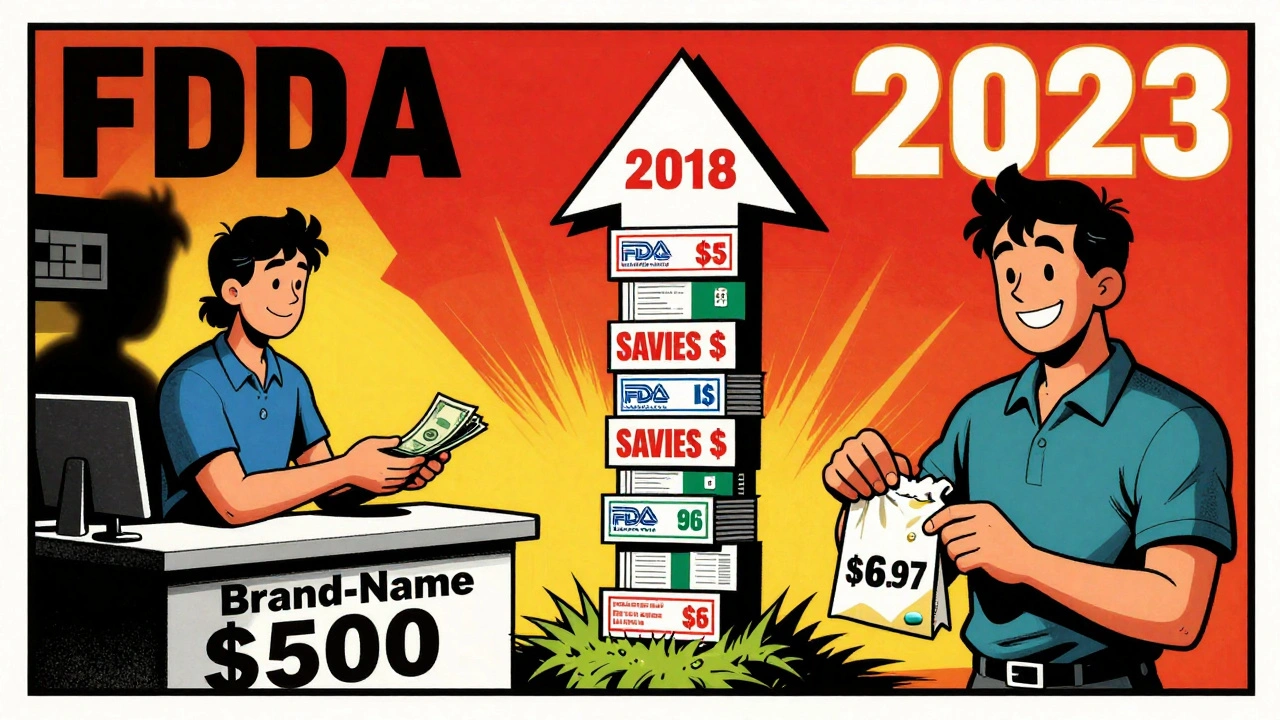
For patients, this means the difference between paying $500 a month for a brand-name drug and $15 for the generic. For pharmacies, it means 92% of generic prescriptions are filled for under $20. The average copay for a generic is $6.97.
But here’s the catch: not all savings reach the patient. Pharmacy benefit managers (PBMs) often take a cut. A 2023 Senate investigation found that only 50-70% of the savings from generics actually lower out-of-pocket costs for patients. The rest gets absorbed by middlemen, insurers, or rebates.
Still, even with those leaks, generics are the single biggest cost-saver in American healthcare. Without them, drug spending would be over $1 trillion higher every year.
What’s Driving These Savings?
The Hatch-Waxman Act of 1984 created the legal pathway for generics. It let companies skip expensive clinical trials if they could prove their drug was the same as the brand. That opened the floodgates.
Today, the FDA approves over 700 generic applications a year. In 2022, they approved 742. And they’re getting faster. Thanks to the Generic Drug User Fee Amendments (GDUFA), 95% of standard applications are reviewed in 10 months or less.
More importantly, big drugs keep losing patents. In the next few years, drugs like Humira, Eliquis, and Xarelto-each with billions in annual sales-will face generic competition. That means the savings numbers are about to climb again.
What’s Holding Back Even More Savings?
It’s not all smooth sailing. Some brand-name companies use legal tricks to delay generics. They file lawsuits, extend patents with minor changes, or use special safety programs (called REMS) to block generic manufacturers from getting samples of the drug to test.
Another hurdle: complex drugs. Biologics-like insulin or rheumatoid arthritis treatments-are harder to copy than pills. Their generic versions, called biosimilars, are expensive to develop. As of August 2024, the FDA had approved only 59 biosimilars. That’s far fewer than the thousands of small-molecule generics.
And even when generics arrive, prices don’t always drop as fast as they should. In some cases, multiple generics enter the market but prices stay high because manufacturers collude or because PBMs favor certain brands.
What’s Next?
The FDA is working on new rules to speed up approval of complex generics and to crack down on anti-competitive tactics. Their 2023 Drug Competition Action Plan targets these barriers directly.
Meanwhile, the AAM projects that by 2028, cumulative savings from generics and biosimilars will hit $3.9 trillion since 2014. That means annual savings could reach $450-500 billion per year by the end of the decade.
For patients, that’s more affordable insulin, cheaper blood pressure pills, and lower copays for antidepressants. For the system, it’s billions freed up to invest in other care.
Generics aren’t glamorous. They’re not new. They don’t make headlines. But every year, they save more lives than any new drug ever could-by simply making the old ones affordable.
How does the FDA calculate savings from generic drug approvals?
The FDA calculates savings by comparing the price of the brand-name drug before a generic enters the market to the price after generic approval. They multiply that price difference by the number of generic units sold, plus any reduction in brand-name sales volume due to lower prices. This is tracked for 12 months after each new generic approval.
Why did generic savings drop in 2020 after peaking in 2019?
Savings fluctuate based on which drugs lose patent protection each year. In 2019, several high-revenue drugs like Humira and Eliquis had their first generics approved. In 2020, fewer major drugs came off patent, so the total savings dropped sharply. It’s not about fewer approvals-it’s about which drugs are approved.
Do generic savings always mean lower costs for patients?
Not always. While generics lower the overall cost of drugs, pharmacy benefit managers (PBMs) often keep a portion of the savings through rebates and contracts with insurers. A 2023 Senate investigation found only 50-70% of generic savings reach patients directly at the pharmacy counter.
How do generic savings compare to biosimilar savings?
Biosimilars are the generic versions of biologic drugs, like insulin or cancer treatments. They’re harder and more expensive to make, so their savings are smaller. As of 2024, there were only 59 FDA-approved biosimilars. While they’re growing, their total savings are still a fraction of what traditional small-molecule generics save-over $400 billion a year.
Which therapeutic areas benefit the most from generic savings?
Heart disease saved the most-$118.1 billion in 2023-because so many patients take daily medications like statins and blood pressure pills. Mental health came second at $76.4 billion, thanks to widespread use of generic antidepressants and antipsychotics. Cancer treatments saved $25.5 billion, mostly from generic chemotherapy drugs.
Why do some states save more than others from generics?
Larger populations mean more prescriptions. California saved nearly $38 billion in 2023 because it has over 39 million residents and one of the largest Medicaid programs. Smaller states like Alaska saved $354 million-still significant, but proportional to their population size. Medicaid enrollment and state pharmacy benefit policies also affect how much savings are captured.
How many generic drugs does the FDA approve each year?
The FDA approves around 600-750 generic drug applications annually. In 2022, they approved 742. Most of these are additional versions of drugs that already have generics, but about 40-60 are first-time generics-those that trigger the biggest savings.
Are generic drugs as safe and effective as brand-name drugs?
Yes. The FDA requires generics to have the same active ingredient, strength, dosage form, and route of administration as the brand-name drug. They must also prove they’re absorbed the same way in the body. Over 90% of prescriptions filled in the U.S. are generics-and they’re used safely every day by millions.
Charles Moore
December 4, 2025 AT 00:21Generics are the unsung heroes of American healthcare. I’ve seen my grandma switch from $400/month brand-name statins to $8 generics-and she didn’t even notice a difference in how she felt. The system works when we let it work. Why do we still treat generics like second-class medicine?
Rashi Taliyan
December 5, 2025 AT 07:49OMG I JUST REALIZED MY ANTIDEPRESSANTS ARE $3 A MONTH NOW?? 😭 I used to cry at the pharmacy counter. This is why I fight for access. Generics didn’t just save me money-they saved my life. 🙏💊
Gavin Boyne
December 7, 2025 AT 02:03So let me get this straight: the FDA saves billions every year by letting people buy the same pills for 1/20th the price… but we still have CEOs making $200M while patients ration insulin? 🤔
Generics aren’t magic. They’re just capitalism with a conscience. The real scandal isn’t that generics work-it’s that we needed them to work at all.
Rashmin Patel
December 7, 2025 AT 04:52Let’s be real-this isn’t about savings, it’s about power. Big Pharma doesn’t lose patents because they’re ethical-they lose them because the law says so. And guess what? They fight it tooth and nail with lawsuits, REMS abuse, and patent evergreening.
Yes, $400B saved is insane. But if you think the system is fair, you haven’t read the Senate report on PBMs. They’re the real parasites. They take 30% of the savings and call it ‘rebate management.’ Meanwhile, I’m still choosing between my blood pressure med and groceries.
And biosimilars? We’ve had 59 approved in a decade. Meanwhile, 700 small-molecule generics drop every year. That’s not innovation-that’s neglect. We need to treat biologics like the life-saving drugs they are, not corporate cash cows.
And don’t get me started on how some states get $38B in savings and others barely scrape $100M. It’s not about population-it’s about policy. Medicaid expansion = more savings. Period.
Stop praising generics like they’re a gift. They’re a right. And if we don’t fix the middlemen, we’re just rearranging deck chairs on the Titanic.
Cindy Lopez
December 8, 2025 AT 20:05It’s ironic how the FDA tracks savings down to the dollar, but no one tracks how much of that actually reaches patients. The headline numbers are misleading. We need transparency, not just statistics.
Albert Essel
December 9, 2025 AT 01:18One thing people overlook: generics aren’t just cheaper-they’re more consistent. Brand-name companies used to change inactive ingredients to force patients to re-prescribe. Generics can’t do that. The FDA requires them to match exactly. So if your body reacts to a generic, it’s not the drug-it’s you.
Also, the 90% stat? That’s not just about cost. It’s about trust. Patients choose generics because they know they’re safe. That’s a win for science, not just the economy.
sagar bhute
December 9, 2025 AT 06:04Stop glorifying generics. They’re not heroes-they’re commodities. The real problem is that we let corporations control access to medicine. The FDA doesn’t save lives; it just approves paperwork. The real heroes are the people who can’t afford the $500 brand-name version. And they’re dying because the system is broken, not because generics exist.
Kara Bysterbusch
December 10, 2025 AT 10:22What strikes me most is the quiet dignity of this system: 90% of prescriptions filled, 13% of the cost. It’s not flashy, it’s not viral, it doesn’t have a TED Talk-but it’s the quiet engine keeping millions from financial ruin. The real tragedy isn’t the loopholes or the PBMs-it’s that we’ve normalized this as ‘just the way things are.’
Imagine if we invested in drug development with the same zeal we invest in blocking generics. Imagine if we treated medicine as a public good, not a profit margin. The science is there. The infrastructure is there. What’s missing is the moral courage to prioritize people over profits.
And yet-here we are. Millions of diabetics on $15 insulin. Heart patients on $5 statins. Parents breathing easier because their child’s asthma inhaler doesn’t cost a mortgage payment.
Generics aren’t a policy win. They’re a moral imperative. And the fact that we’re still debating them is the real scandal.