
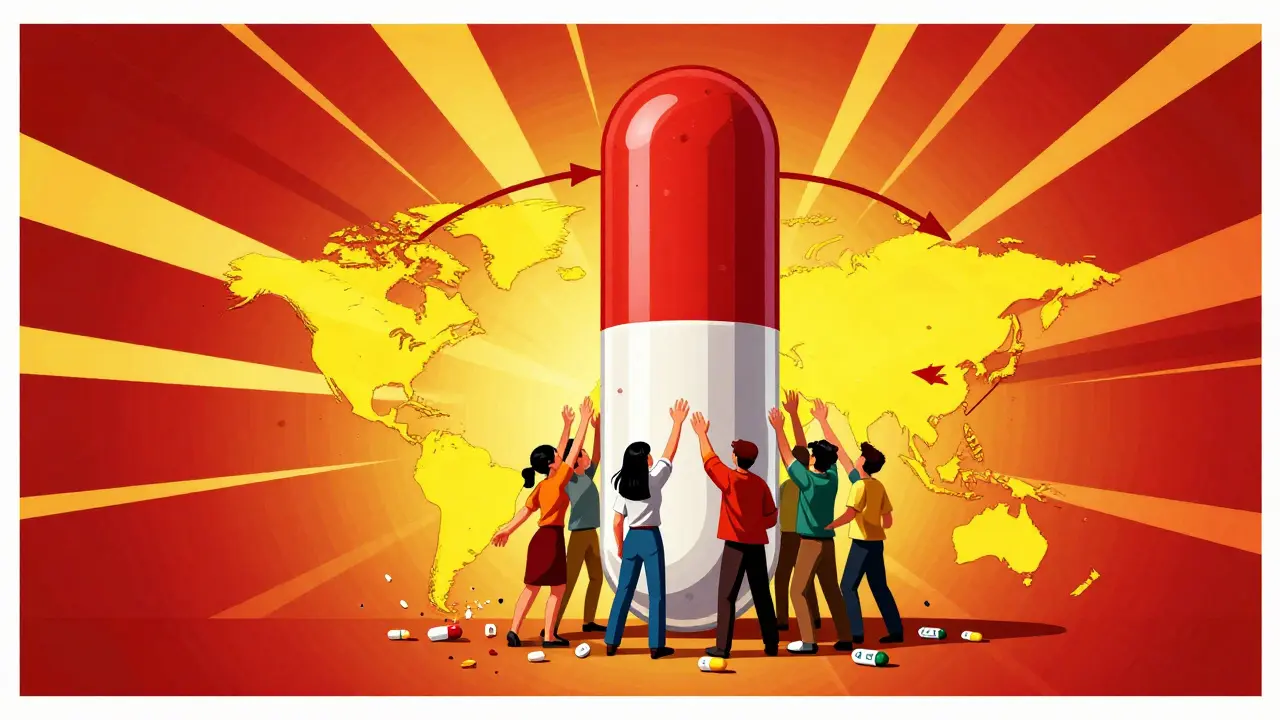
The global generic drug market isn’t just growing-it’s reshaping how the world accesses medicine. By 2030, it could be worth anywhere from $530 billion to over $800 billion, depending on who you ask. What’s clear is that cheaper, equally effective versions of brand-name drugs are no longer a niche option. They’re the backbone of affordable healthcare for billions. And with dozens of blockbuster drugs losing patent protection between now and 2030, the race to produce these generics is accelerating fast.
Why Generic Drugs Are More Important Than Ever
Generic drugs aren’t knockoffs. They’re exact copies of brand-name medications in active ingredient, dosage, safety, and effectiveness. The difference? Price. A generic version of a drug can cost 80% to 90% less than the original. That’s not just savings for patients-it’s savings for entire health systems. In the U.S., generic drugs account for 90% of prescriptions but only 20% of spending. In countries like Germany and the U.K., policies actively push doctors and pharmacies toward generics to control rising healthcare costs. The reason this matters now is simple: the patent cliff is here. Between 2025 and 2030, drugs making over $200 billion in annual sales will lose their exclusivity. That includes major treatments for diabetes, cancer, autoimmune diseases, and more. Drugs like ustekinumab (Stelara), vedolizumab (Entyvio), and liraglutide (Victoza) are about to open up massive new markets for generic makers. These aren’t small pills for minor conditions-they’re high-demand, high-revenue treatments that millions rely on.Where the Growth Is: Regions and Players
Not all markets are growing at the same pace. The Asia-Pacific region is leading the charge. India alone supplies 20% of the world’s generic drugs and 60% of its vaccines. Chinese manufacturers, meanwhile, are reshaping global pricing through aggressive volume-based procurement. When the government buys in bulk, prices drop-and other countries follow. This has turned China into a price setter, not just a player. In Europe, Germany and the U.K. are the biggest markets for generics, thanks to strong regulatory support and public trust. But even here, the game is changing. The EU has streamlined approval for biosimilars-complex, biologic versions of drugs like Humira and Enbrel. These aren’t simple pills; they’re protein-based treatments that require advanced manufacturing. Companies that can produce them reliably and affordably are winning big. The U.S. market is crowded. Giants like Teva, Viatris, Sandoz, and Amneal dominate, but competition is fierce. Profit margins are thin, and price pressure is constant. Still, with over $100 billion in at-risk sales expected by 2028, there’s plenty of room for new entrants-if they can navigate regulatory hurdles and patent lawsuits.Biosimilars: The Fastest-Growing Segment
Biosimilars are the future of the generic market. Unlike traditional generics, which copy small-molecule drugs, biosimilars mimic complex biologic drugs made from living cells. These include monoclonal antibodies used to treat cancer, rheumatoid arthritis, and Crohn’s disease. Developing them takes years, costs hundreds of millions, and requires advanced labs. But the payoff is huge. The biosimilars segment is growing at 8.2% annually-faster than traditional generics. By 2029, the oncology and immunology biosimilar market alone could hit $25 billion. Companies that got in early, like Sandoz and Amgen, are already capturing major market share. But it’s not just about being first. It’s about reliability. Hospitals and insurers want suppliers with proven quality control, strong pharmacovigilance systems, and multiple manufacturing sites. One plant going offline shouldn’t mean a drug shortage. Southeast Asia is catching on. Countries like Thailand and Vietnam are running pilot programs that award contracts to suppliers with dual-source production-meaning they can switch between two validated factories if one fails. This isn’t just smart logistics; it’s a strategy to avoid drug shortages in the future.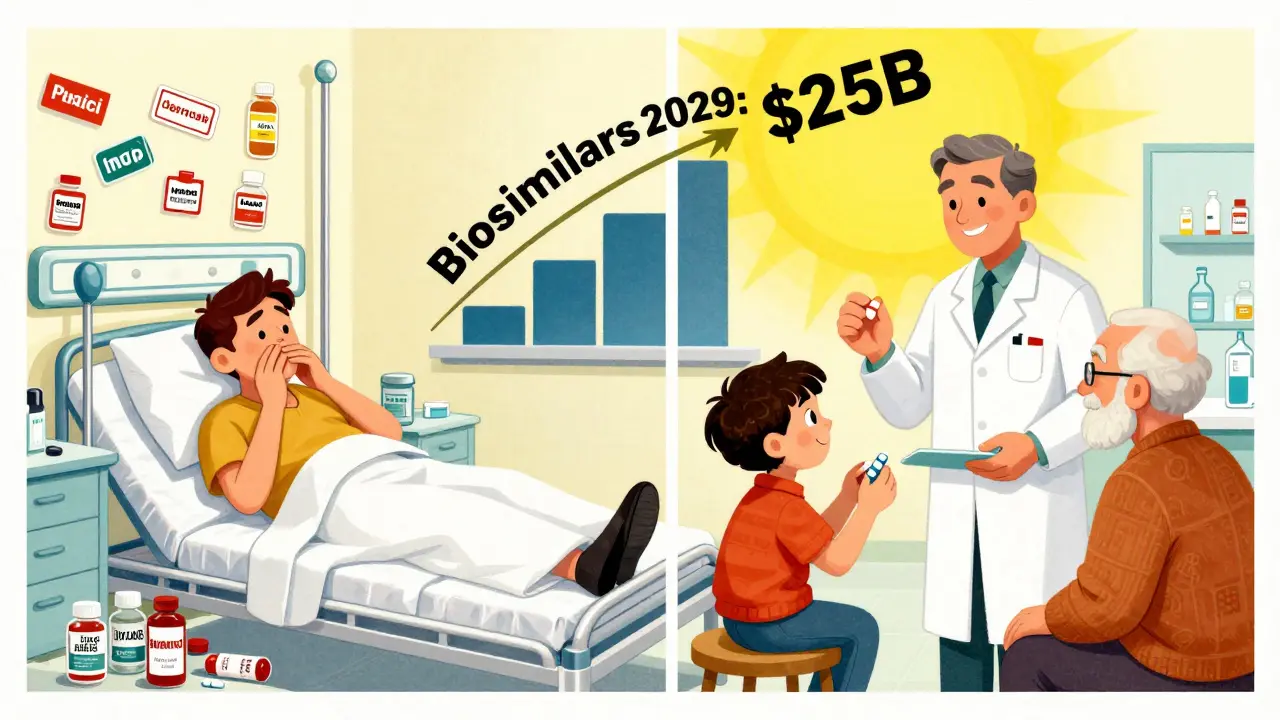
Therapeutic Areas Driving Demand
Not all generic drugs are created equal. Some categories are growing faster because of real-world health trends. Diabetes drugs are one of the biggest. With over 500 million people worldwide living with diabetes, medications like metformin and insulin are in constant demand. Generic versions of newer drugs like liraglutide (Victoza) and semaglutide (Ozempic) are coming soon. These aren’t just cost-savers-they’re lifelines for people who can’t afford the $1,000-a-month branded versions. Oncology is another major driver. Cancer treatments are expensive, and many are now going off patent. Generic versions of drugs like rituximab and trastuzumab are already hitting markets. By 2030, oncology will remain the most valuable therapy area globally, with over $300 billion in sales across branded and generic products combined. Inflammatory diseases like psoriasis and Crohn’s are next in line. Drugs like Dupixent and Skyrizi are projected to be top sellers by 2030. When their patents expire, expect a flood of biosimilars. These are complex, but the demand is undeniable.Technology Is Changing How Generics Are Made
Manufacturing generics used to mean mixing chemicals in large vats. Today, it’s a high-tech operation. Robotic process automation is cutting errors and speeding up production. Artificial intelligence helps predict drug stability and shelf life. Digital tools track patient adherence-so if someone misses a refill, the system flags it and triggers a reminder. This isn’t just about making pills cheaper. It’s about making sure people actually take them. In Europe, manufacturers are investing in smart factories where sensors monitor every step of production. This isn’t optional anymore. Regulators demand it. The FDA and EMA now require detailed digital records for every batch. Companies that can’t keep up won’t survive.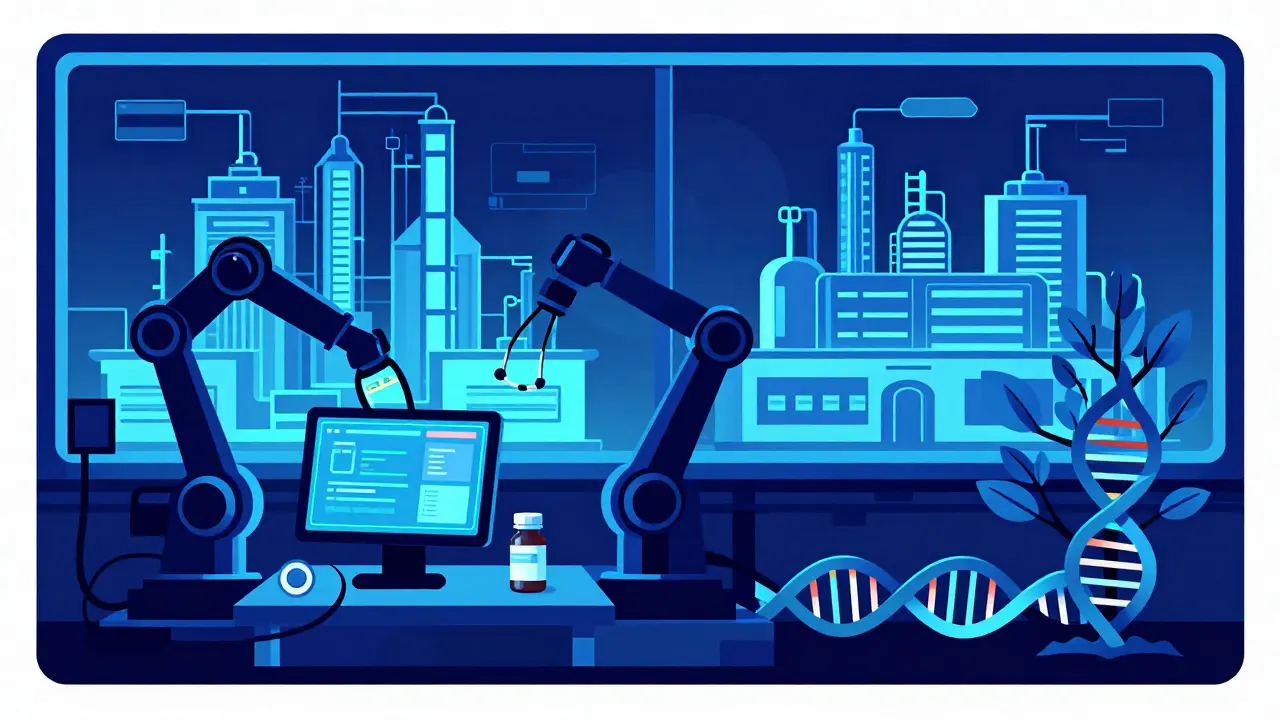
Challenges Ahead: Price Pressure and Complexity
It’s not all growth. The biggest threat to generic drugmakers is pricing pressure. In China, volume-based tenders have slashed drug prices by up to 90%. That’s great for patients, but it’s crushing margins for manufacturers. Many small firms have gone out of business. Even big players are cutting costs by moving production to lower-wage countries. Another challenge? Complexity. The next wave of drugs coming off patent aren’t simple pills. They’re injectables, inhalers, and biologics. Making these requires specialized equipment, sterile environments, and highly trained staff. It’s not something a small lab can do overnight. That’s creating a barrier to entry-and giving an edge to companies with deep pockets and technical expertise. Patent litigation is another wildcard. Brand-name companies often file lawsuits to delay generic entry, even when patents are weak. These cases can drag on for years, delaying market access. The U.S. is especially prone to this. But regulators are cracking down. The FDA has started fast-tracking reviews for generics that challenge questionable patents.What This Means for Patients and Systems
For patients, this is good news. More affordable drugs mean better access. A diabetic in rural Mexico can now afford insulin. A cancer patient in Poland can get life-saving treatment without selling their home. For health systems, it means sustainability. Countries with aging populations-Japan, Italy, Canada-are relying on generics to keep their budgets from collapsing. But it’s not just about cost. It’s about equity. When a drug becomes generic, it moves from a luxury to a basic necessity. That’s the real win.Looking Ahead: The Next Five Years
By 2030, the generic drug market will be bigger, more complex, and more essential than ever. Growth will come from biosimilars, Asia-Pacific demand, and the flood of expiring patents. But success won’t go to the cheapest maker-it’ll go to the most reliable, the most technologically advanced, and the most responsive. The era of cheap generics as a commodity is ending. The future belongs to companies that treat generics like high-stakes medicine-not just low-cost products. Those who adapt will thrive. Those who don’t will be left behind.Are generic drugs as safe and effective as brand-name drugs?
Yes. Generic drugs must meet the same strict standards as brand-name drugs for active ingredients, dosage, safety, strength, quality, and performance. Regulatory agencies like the U.S. FDA and the European EMA require generics to prove they work the same way in the body. Millions of patients use generics every day without any difference in outcomes.
Why are biosimilars more expensive to develop than regular generics?
Biosimilars are made from living cells, not chemicals. This makes them far more complex than traditional generics. Even tiny changes in the manufacturing process can affect how the drug works. Developing a biosimilar requires years of research, advanced labs, and extensive clinical testing to prove it’s highly similar to the original biologic. Costs can run into hundreds of millions of dollars.
Which countries are leading in generic drug production?
India is the world’s largest supplier of generic drugs by volume, providing 20% of global supply and 60% of vaccines. China is a major player too, especially in setting global prices through its bulk procurement system. The U.S. and Germany are top consumers, while countries like Brazil and South Africa are expanding their domestic generic manufacturing capacity.
How do patent expirations affect generic drug availability?
When a drug’s patent expires, other manufacturers can legally produce generic versions. This usually leads to lower prices and faster access. Between 2025 and 2030, over $200 billion in annual sales from branded drugs will lose patent protection, opening the door for generics. However, legal challenges or regulatory delays can slow down this process, especially in the U.S.
Will generic drugs replace all brand-name medications?
No. Brand-name drugs will still be needed for new innovations, rare diseases, and complex treatments where generics aren’t yet available. But for most common conditions-diabetes, high blood pressure, infections, depression-generics will dominate. The goal isn’t to eliminate brands; it’s to make essential medicines affordable for everyone.
Darryl Perry
January 11, 2026 AT 16:38Generic drugs are a scam. The FDA lets them slide on bioequivalence testing. I’ve seen patients crash after switching. It’s not the same. They’re cutting corners to save a buck, and we’re paying with our health.
They’re not ‘equivalent’-they’re just cheaper. And that’s not healthcare. That’s negligence.
Windie Wilson
January 12, 2026 AT 18:20Oh honey, let me get this straight-you’re telling me the same pill that costs $1,000 in the U.S. is now $20 because some guy in Mumbai stirred it in a bucket? And we’re supposed to believe it’s just as good?
My grandma took generics for 15 years. She’s still alive. But she also had a pet parrot named Dr. Phil. So… take it with a grain of salt. And maybe a glass of wine.
Daniel Pate
January 13, 2026 AT 22:55There’s a philosophical tension here: if a drug works identically but costs 90% less, is it still a commodity? Or has it been elevated to a public good?
Capitalism treats medicine as a product. But medicine, at its core, is a human right. The fact that we even debate whether generics are ‘good enough’ reveals how broken our system is.
We don’t ask if a fire hydrant is ‘as good’ as a branded one-we just need it to work. Why is medicine different?
Patents were meant to incentivize innovation, not to lock life-saving drugs behind paywalls for decades. The ‘patent cliff’ isn’t a crisis-it’s a correction.
And yet, we panic because the profit model is crumbling, not because access is improving.
Maybe the real threat isn’t the generics-it’s the illusion that health should be a market.
Amanda Eichstaedt
January 14, 2026 AT 14:31Let’s talk about the real heroes here: the Indian and Chinese manufacturers who keep the world alive.
When I was in Uganda last year, I saw a kid on generic insulin-$3 a vial, no insurance, no drama. His mom cried when she told me how she used to boil water to sterilize syringes because the branded version was $200.
Generics aren’t just ‘cheaper’-they’re justice. They’re dignity.
And yet, here in the U.S., we’re still arguing about ‘quality’ like it’s a luxury. We’re not even close to being the moral leaders we pretend to be.
It’s not about science. It’s about who gets to live.
And if you think biosimilars are expensive, try being the parent of a child with Crohn’s and no access to Humira.
That’s not a market failure. That’s a moral failure.
Abner San Diego
January 15, 2026 AT 19:05China’s running the world’s pharmacy now? Great. Just what we needed-another foreign power controlling our medicine supply. Next they’ll be making our vaccines, our antibiotics, our heart meds.
And you call that ‘progress’? This isn’t globalization-it’s surrender.
India’s fine, I guess. But China? They’re not playing fair. They’re dumping drugs at prices that bankrupt American factories.
Who’s gonna make our pills when the factories close? Our grandkids? In a communist lab? I don’t think so.
We need to bring this back home. Or at least ban imports from countries that don’t play by our rules.
And stop pretending generics are ‘just as good.’ They’re not. Not really.
Eileen Reilly
January 17, 2026 AT 09:56so like… biosimilars are basically the fancy version of generic but like… more expensive? and also harder to make? but also like… the future??
idk i just saw a guy on tiktok say ‘if your insulin is made in china you’re basically a lab rat’ and now i’m scared to take my meds
also why is everyone so chill about this? like… we’re all just gonna take pills from robots in india now? what even is life anymore??
also can we talk about how the FDA is just… a suggestion at this point??
also why is no one talking about the fact that half these companies have zero customer service??
my last generic bottle had a barcode that scanned to a .tk website. that’s not a drug. that’s a glitch in the matrix.
Monica Puglia
January 17, 2026 AT 20:14Just wanted to say thank you to everyone who makes these drugs possible 🙏
My dad’s on a generic for his diabetes-costs $5/month. He’s been stable for 7 years.
He didn’t have to choose between food and medicine.
That’s not a market trend. That’s a miracle.
And the fact that someone in Vietnam is building dual-source factories so no one goes without? That’s innovation with heart.
Let’s not forget: behind every pill is a person who needs to live.
And we’re lucky to live in a time where that’s possible.
Keep going. We see you. ❤️
Cecelia Alta
January 18, 2026 AT 11:49Oh my god. I just read this whole thing and I’m emotionally drained.
Do you realize how much of this is just corporate spin wrapped in a white coat?
‘Biosimilars are the future!’ Yeah, right. The future is a bunch of pharma CEOs laughing while they pay their shareholders $2 billion in dividends while the rest of us are still choosing between insulin and rent.
And don’t even get me started on the ‘technology is changing how generics are made’ part. Robotic automation? AI predicting shelf life? Please. That’s just a fancy way of saying ‘we’re automating the lies.’
They’re not making drugs better-they’re just making them cheaper to produce while charging us more for the ‘premium’ versions.
And the ‘patent cliff’? That’s not a cliff. That’s a cliffhanger they’ve been dragging out for 20 years with lawsuits and loopholes.
And now they want us to believe that ‘reliability’ is the new metric? Who’s keeping track? Who’s auditing?
Meanwhile, in the real world, people are still dying because their insurance won’t cover the generic version of a drug that’s been off-patent since 2022.
And the FDA? They’re just a rubber stamp with a fancy logo.
So yeah. The market’s growing. But the people? They’re still getting left behind.
And you call this progress?
It’s not progress. It’s performance art.
And we’re all just the audience.
And the curtain’s about to fall.
And no one’s got a ticket to the next show.